As a global stakeholders involved in protecting and sustainably managing the world’s oceans gather in Mombasa from Tuesday, June 16, Coastal communities and environmentalists have called for a commitment to protecting at least 30 per cent of Africa’s oceans by 2030.
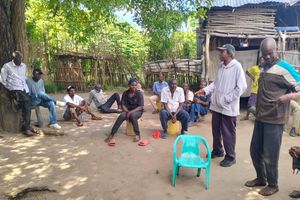
Fishermen in the Coast region emphasised that communities that depend on the ocean must be involved in decisions affecting marine resources.
Mr Athman Mwinyi, a fisherman under the Bamburi Beach Management Unit, called for stricter controls on fishing gear to protect fish stocks from depletion.
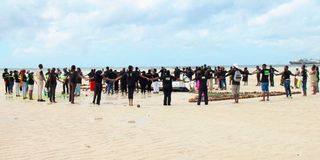
Members of the Greenpeace Africa demand African Governments to protect Oceans and millions of People who depend on them ahead of the 11th Our Ocean Conference in Mombasa in this photo taken on June 15, 2026.
Photo credit: Kevin Odit | Nation Media Group
“We want the use of 2.5-millimetre nets to be made mandatory and the 1.5-millimetre nets banned because they catch juvenile fish. The ocean is our life and we must protect these resources for future generations. If we continue harvesting young fish, there will be nothing left for our children,” he said, ahead of the 11th Our Ocean Conference.
The conference will take place in Mombasa, the first time it is held in an African country.
Fish trader Khadija Hussein said plastic pollution and declining fish stocks have already begun affecting the livelihoods of thousands of families along the Kenyan coast. She said this has forced fishermen to risk their lives going to the deep sea, which also makes their catch more costly.
“When fishermen catch fish close to shore, we, fish vendors benefit because we get affordable fish and many other businesses thrive. Today, fishermen are forced to travel farther into deep waters because fish are becoming scarce near the coast, this affects everyone who depends on the fishing economy," said Ms Hussein.
They spoke during a beach activation organised by Greenpeace Africa at Pirates Beach in Mombasa, where volunteers and local residents created a large sand art installation carrying messages demanding stronger protection of marine resources and greater inclusion of coastal communities in ocean governance.
The artwork, visible from the air, highlight growing concerns over illegal fishing, pollution and climate change that continue to threaten Africa’s marine ecosystems and the livelihoods of millions of people.
According to the organisation, an estimated 600 million Africans depend on ocean resources for food security, employment and income. However, illegal, unreported and unregulated (IUU) fishing continues to rob African countries of billions of dollars annually while contributing significantly to the depletion of fish stocks.
Greenpeace Africa Oceans Campaign Lead Aliou Ba said African governments have a unique opportunity to strengthen marine protection through the Biodiversity Beyond National Jurisdiction (BBNJ) Agreement, a legally binding international treaty adopted in 2023 to govern and protect biodiversity in areas beyond national jurisdiction, commonly known as the high seas.
“The BBNJ Agreement gives African governments a historic opportunity to protect the high seas and safeguard the future of our fisheries. At the same time, we must confront the ongoing crisis of IUU fishing, which is stripping African waters of life and robbing communities of food and income. Governments cannot afford to delay," said Mr Ba.
Mr Ba noted that illegal fishing has become one of the greatest threats facing African waters, undermining food security and depriving coastal communities of jobs and economic opportunities.
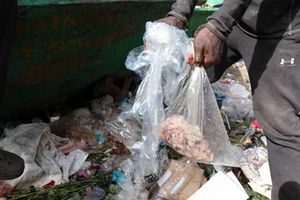
Environmental activists also raised concerns over increasing levels of plastic pollution, which they say continue to damage marine ecosystems and coastal habitats across the continent.
During the three-day conference, environmentalists are expected to lobby governments to accelerate ratification and implementation of the BBNJ Agreement, support the establishment of a High Seas Marine Protected Area in the Canary-Guinea Convergence Zone, end illegal and harmful industrial fishing practices, and adopt integrated approaches that address both biodiversity loss and pollution.
Members of the Greenpeace Africa create an art work as they demand that African governments protect oceans and millions of People who depend on them, ahead of the 11th Our Ocean Conference in Mombasa in this photo taken on June 15, 2026.
Photo credit: Kevin Odit | Nation Media Group
Environmentalists are also demanding meaningful participation of coastal communities in decisions concerning ocean governance, arguing that those most affected by declining fish stocks and environmental degradation should have a direct voice in shaping solutions.
"As the conference convenes in Africa for the first time, it marks an important milestone for ocean governance, marine conservation, and the sustainable blue economy. It is also an opportunity to strengthen international cooperation and accelerate action to protect the ocean for future generations.” Ms Betsy Njagi, the Blue Economy and Fisheries Principal Secretary stated.
Since its launch in 2014, the conference has generated more than 2,900 commitments worth over $169 billion (Sh21.8 trillion) in support of ocean action, according to Oceana, one of the world’s largest conservation organisations.
Dr Christina Hicks, a Professor at Lancaster University, Pew Marine Fellow, and Oceana Board Member, stated that millions of livelihoods are at risk across Africa as marine ecosystems are under increasing pressure from overfishing, pollution, and climate change.
Dr Hicks urged leaders to use the conference as a platform to advance ocean policies that protect food security, livelihoods, and marine ecosystems together.