The Council of Governors has opposed a planned performance audit of education funds in six counties.
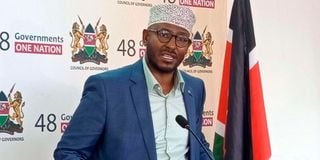
The Chairperson of the Council of Governors, Ahmed Abdullahi, criticised a plan by the Office of the Auditor-General to scrutinise bursaries, scholarships, and Early Childhood Development Education (ECDE) centres in select counties.
The Wajir governor said the audit was outside the constitutional and statutory timelines outlined in Article 229 of the Constitution and Section 36 of the Public Audit Act.
The Council of Governors also questioned the criteria used to select the six counties, terming the process opaque and lacking in transparency.
“There has been politicisation of the bursaries matter. I do not know who is so determined to ensure counties are barred from giving out bursaries. Why select the six counties? Why audit the last four years?” He asked.
He said the Office of the Auditor-General wants to audit bursaries which go back to 2021, yet some of the governors were not in office. Mr Abdullahi said the issue should have been discussed with governors first.
He said the audit was conceptualised without any engagement with the Council of Governors and the affected counties.
“This results in a process that lacks critical input for a comprehensive and context-specific audit in a devolved system. The criteria for selection of the counties under review remain unexplained and, therefore, opaque,” said Mr Abdullahi.
The Council of Governors said counties have already been audited for the said financial years, and any repeat exercise risks being prejudicial and duplicative.
Auditor-General Nancy Gathungu.
Photo credit: Dennis Onsongo | Nation Media Group
“Any audit exercise that is not anchored in the legal framework, including those initiated outside the timelines prescribed under Article 229 of the Constitution and the Public Audit Act, is irregular, unconstitutional, and therefore null and void,” he added.
Mr Abdullahi urged the Auditor-General to conduct performance audits within legal parameters and prescribed timelines.
“You must uphold the rule of law and mutual institutional respect is essential to maintaining the integrity of the audit process and safeguarding the principles of devolution. The Council of Governors remains fully committed to accountability, transparency, and responsible governance in service delivery,” he said.
However, the council said it welcomes constructive, lawful audit processes that are done in the spirit of collaboration, fairness, and respect for devolved governance.
The Council of Governors Vice Chairperson, Mutahi Kahiga, also weighed in on the matter.
“As a council, we stand firmly with the Constitution and the law, which states that audits must be conducted within six months of the end of the financial year. Unfortunately, we’ve received word that six counties are now being targeted for re-audit,” said the Nyeri governor.
Mt Kahiga said that counties have made major progress in devolved functions such as health, water, and agriculture. He questioned why the Auditor-General was targeting bursaries.
“Counties step in to provide bursaries because there is a need. Why re-audit the performance of bursaries and ECDEs alone? What about health, agriculture, and water, where counties have also excelled?” He asked.
Mr Kahiga said that counties have employed ECDE teachers, built infrastructure for pre-primary learners, and are now focusing on school feeding programmes.