Members of Parliament are pushing for legal reforms to allow the Controller of Budget (CoB) to independently oversee the estimated Sh63 billion collected annually from Kenyans as a Housing Levy, meant to fund the construction of affordable housing units.
The call came from the Constitution Implementation Oversight Committee (CIOC) of the National Assembly, which highlighted potential misuse of funds due to CoB’s inability to supervise the levy.
The CIOC report on CoB’s role in implementing the Constitution cites Controller of Budget Dr Margaret Nyakang’o, who said that a loophole in the law “prevents any independent oversight” of the housing levy, “severely undermining” her supervisory mandate.
“The Controller of Budget clarified that the Housing Levy falls outside the OCoB’s oversight mandate due to its classification as a levy rather than a budgeted fund,” the report reads.
To ensure proper accountability, the report recommends amending the Public Finance Management (PFM) Act to bring all special funds and levies under CoB’s oversight.
“The CoB's oversight mandate is severely undermined by legislative limitations and lack of enforcement mechanisms. The Housing Levy's exclusion creates significant accountability gaps,” the report adds.
The committee also called on the National Treasury to implement an CoB-Central Bank of Kenya (CBK) integrated payment system to track funds from collection to expenditure.
Earlier this year, Housing and Urban Development Principal Secretary Charles Hinga told the National Assembly that the government collects between Sh5 billion and Sh6 billion monthly from the housing levy. He noted that while the funds are invested in Treasury bills and bonds, the delivery of affordable housing units remains behind schedule.
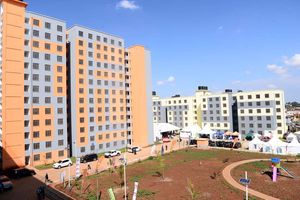
An affordable housing project. Two Kenyans have challenged President William Ruto's plans to allocate teachers and the police 20 percent each of the affordable housing units.
Photo credit: File | Nation Media Group
The MPs also want the Controller of Budget Act amended to grant enforcement powers, remove reporting restrictions on economic developments and introduce sanctions for violations.
President William Ruto, through his Affordable Housing Programme, pledged to construct at least 200,000 housing units annually to address the housing deficit and create jobs for low- and middle-income earners.
The programme is funded through a mandatory levy established under the Affordable Housing Act, operational since March 19, 2024. Employees contribute 1.5 percent of their gross monthly income, with a matching employer contribution.
However, in her August 2025 national government budget implementation report, Dr Nyakang’o revealed that the housing project remains behind schedule three years after its launch. She cited legislative and operational constraints in the CoB Act as critical limitations.
For instance, the law bars her office from reporting on economic developments, fiscal forecasts, or revenue trends. Section 9(4) of the CoB Act states:
“For the avoidance of doubt, the reports submitted to Parliament shall not include reports on recent economic developments and outlook, including revenue, grants and loans forecasts and receipts.”
Other constraints include inadequate sanctions for violations of public finance management laws and restricted access to critical financial information from some government entities.
The committee noted that wasteful expenditure continues unabated despite oversight institutions, with multiple unauthorized accounts suggesting deliberate attempts to circumvent financial controls.