Kenya’s Affordable Housing Programme (AHP) has been one of President William Ruto’s flagship projects, funded largely through the housing levy.
With billions of shillings deducted monthly from workers’ payslips, questions have mounted over how the money is being managed, the pace of construction, and fears of corruption or political interference.
Housing and Urban Development Principal Secretary Charles Hinga says the private sector provides an estimated 50,000 units every year.
“The Government envisages to build 200,000 units every year to bridge the gap on Housing. We haven’t hit the target yet but we are on a good trajectory,” Hinga told Nation in an exclusive interview.
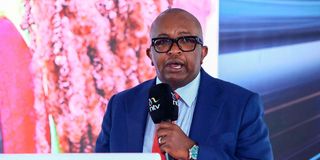
The Principal Secretary, State Department for Housing and Urban Development, Charles Hinga, speaks during the Smart Cities Forum in Nairobi on October 30, 2025.
Photo credit: Wilfred Nyangaresi | Nation Media Group
“Of course there are challenges here and there, availability of land, but through our partnership with the county governments we have started to free up land for the project,” he added.
Another contentious issue under the project has been reports that the government is “lending itself its own money” by investing housing levy contributions into Treasury bonds. Mr Hinga confirmed during the interview that this happened but defended the move.
“According to Section 12 of the Affordable Housing Act 2024, the Board may, with the approval of the Cabinet Secretary in charge of Treasury, invest any income not immediately required,” he explained.
“In the early stages of the programme, not all funds could be absorbed immediately. Instead of lying idle, they were invested. Now that the programme has matured, the Board is utilizing all funds — plus the interest earned — for construction.”
The PS also defended the program’s implementation, explaining the progress made so far, and measures being taken to ensure transparency.
Q: What is the progress of the affordable housing project? Have you hit the set targets per year? If not, why?
A: The AHP (Affordable Housing Project) is well on course. The Government has completed 3,171 housing units so far. Forty thousand more units are at advanced stages, and 161,911 housing units in total are ongoing. The Private sector provides an estimated 50,000 units every year. The Government envisages to build 200,000 units every year to bridge the gap on Housing. We haven’t hit the target yet but we are on a good trajectory.
Of course there are challenges here and there, availability of land, but through our partnership with the County Government we have started to free up land for the project. The bigger picture should be; why do we have facilities such a prisons in the heart of City? They own vast land masses that could be utilized.
Q: Auditor-General reports have pointed to low absorption of funds in the housing programme. Why has this happened, and what steps are you taking to improve budget execution?
A: These reports were for the previous financial year (2023/24), during which the AHP was at an incremental stage. The SDHUD (State Department for Housing and Urban Development) absorbed over 97 percent of funds in the AHP in the FY 2024/25, due to ongoing projects in all regions of the country.
Q: Several reports suggest that housing funds have been diverted to non-housing projects. Can you categorically confirm whether any funds have been misapplied, and if so, how will you ensure restitution?
A: No funds have been misapplied. The housing funds are being implemented on affordable housing schemes and attendant social infrastructure only.
Q: You are investing housing levy contributions in bonds to earn interest. Why is the government lending itself its own money? Was that part of the intended purposes of the levy?
A: According to Section 12 of the Affordable Housing Act 2024, “the Board may, with the approval of the Cabinet Secretary in charge of Treasury, invest any income that is not immediately required.” Thus, in the incremental stages of the AHP, the Board invested some of the funds. However, with the maturity of the program, the Board is now utilizing all funds, together with interest earned, to construction of affordable housing schemes.
Q: What systems are in place to track every shilling collected from the housing levy from deduction to project completion, and will this information be made public?
A: The AHB (Affordable Housing Board) is mandated to report to various key stakeholders on the utilization of the housing funds. According to Section 55 of the AH (Affordable Housing) Act, the accounts of the Fund shall be audited and reported upon in accordance with the Public Audit Act, 2015.
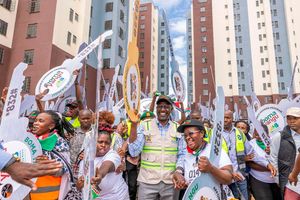
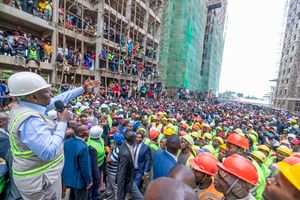
President William Ruto addresses wananchi after inspecting the Limuru Affordable Housing Project in Kiambu County on August 10, 2025.
Photo credit: PCS
Additionally, the Board does publish yearly reports, the AHB Strategy, the five-year investment program, and the yearly investment plans online, as well as to key stakeholders. Furthermore, the Board reports regularly to various government partners, including the Cabinet, the Cabinet Secretary, the Executive Office of the President, and the National Assembly, on the utilization of funds for housing.
Q: Why do we not have real-time online disclosure of all tender awards, contractors, and project costs for public scrutiny?
A: We have close to 100 contractors for the Affordable Housing Program, 99 percent of them are local contractors therefore leveraging on job creation for the locals. Projects cost vary from one project to another depending on several factors. But the figures are actually in the public domain. When a project is launched, its cost is made public. All the tenders awarded were under the old procurement system. They were advertised publicly, bids opened publicly then evaluation done and notification given to successful bids.
At the same time regret is given to those who haven’t won and they are allowed a two weeks freeze period to lunch complains to Public Procurement Regulatory Authority (PPRA). Under the new procurement system, the process will be public from the onset, from requisition to evaluation and awards. The public will be able to access the portal.
Q: How do you ensure that affordable housing units are actually accessible to low- and middle-income Kenyans rather than being snapped up by higher-income buyers?
A: Section 2 of the Affordable Housing Act mandates that the implementing agencies must have social housing units in all affordable housing schemes. Social housing units are only for Kenyans earning Sh 20,000 and below. The Government has implemented stringent measures to ensure only deserving beneficiaries get these slots, including income verification and impartial allocation.
Q: There have been complaints that some units are priced beyond the reach of ordinary Kenyans. How do you define ‘affordable’ in this context?
A: Affordable housing units are those that cost 30% or less to rent or pay for. Our affordable housing units also come with social and physical infrastructure such as kindergartens, boreholes, power houses, kids’ play areas, open spaces, and community areas for residents. Moreover, our projects are connected to the towns and urban areas.
Q: Beyond the number of units built, how is the government measuring the social and economic impact of the programme on communities?
A: The Government is undertaking in depth ESIA (Environmental and Social Impact Assessments) of all affordable housing schemes on communities before, during and after completion.
These reports guide future engagements, designs, and site selections of affordable housing scheme. The Affordable Housing project isn’t just about providing housing, it’s also about creating jobs.
The Principal Secretary, State Department for Housing and Urban Development, Charles Hinga, speaks during the Smart Cities Forum in Nairobi on October 30, 2025.
Photo credit: Wilfred Nyangaresi | Nation Media Group
For the youth, women in construction and the Jua Kali sector. The Program has so far employed more than 350,000 people directly and indirectly. Job creation is at the center of a growing economy. Hundreds of millions have been ring-fenced for the Jua Kali sector, where different associations in different parts of the country have been awarded tenders to supply windows, doors among other components for the program.
The manufacturing sector has not been left behind. The program has created a consumptive demand for production of steel, cement, among other products. This then also creates more opportunities for employment in industries. The social, economic gains of the program are there for everyone to see.
A: The AHP is a panacea for the proliferation of informal settlements throughout the country. Currently, over 50,000 social housing units are under implementation in various informal settlements in the country.
President William Ruto during the handover of 1,080 homes built under the Affordable Housing Programme in Mukuru, Nairobi on May 20, 2025.
Photo credit: PCS
We work with informal settlement residents, key stakeholders in government, and community organizations, to map, enumerate, and sensitize them on the program, and assist them to apply for units, and capacity build them after the projects to live harmoniously and sustainably in these schemes.
A: The AHP is a noble idea whose time has come. With over 160,000 housing units under implementation, and over 700,000 more in various stages of planning, this program is the biggest targeted housing sector intervention in Kenya's history. The government is committed to providing adequate, safe, secure and affordable housing solutions to all deserving Kenyans as guided by the Constitution, the Affordable Housing Act and the guiding vision of His Excellency the President.