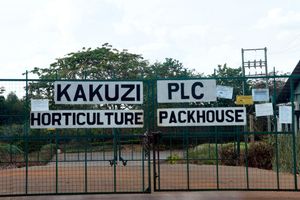
On May 29, a gang armed with machetes, axes, spades, hoes and shovels stormed the estate of agricultural firm Kakuzi, near Kenol town in Murang’a County.
In the ensuing weeks and months, more groups arrived in batches, ultimately taking control of over 400 acres of the company’s land.
Nearly 500 invaders, some drawn from the local community, pitched tents on parts of Block 10731, plundering resources around the clock, while authorities watched.
Investigations by the Nation , including aerial surveillance of the farm, have revealed that the gang operates with heavy protection, earning millions of shillings monthly through stone extraction from open-pit quarries.
They have also been cutting down trees from Kakuzi’s commercial forest, a key revenue source for the superfood firm listed on the Nairobi and London Stock Exchanges.
Kakuzi managers report losses exceeding Sh100 million and warn of a further Sh800 million if the gang secures legal ownership of the land.
“The invasion started in May this year. We reported it to Ithanga Police Station, and the gang temporarily left after police patrolled the area,” said Christopher Flowers, Kakuzi Plc Chief Executive Officer.
“However, they returned in June once the officers were withdrawn. Since July, we have lost control of 400 acres out of the 37,000 acres the company owns.”
On July 8, Kakuzi filed a suit in the Environment and Land Court in Murang’a, naming the National Land Commission, the National Police Service, and six individuals allegedly abetting the invasion.
The court issued an injunction halting further activity by the intruders pending the matter’s hearing.
“That an order be and is hereby made that there should be no more quarrying and no further activity on LR 3558 and 10731 pending the hearing and determination of this suit,” Justice M.N. Gicheru ruled. The judge directed police in Ithanga to enforce the order, with the next mention set for September 30.
Kakuzi Plc said it attempted diplomacy with the intruders, who claimed they had been deployed by the government to mine construction materials for the ongoing affordable housing project at Makenji in Kandara Constituency. Police dismissed the allegation, noting the group provided no evidence.
The area has become so volatile that security guards employed by Kakuzi have reported assaults and threats at local police stations.
Investigations reveal that the invasion is part of a systematic, well-coordinated scheme allegedly spearheaded by a Cabinet secretary and two outspoken MPs from central Kenya.
Officials say the three have been eyeing parts of Kakuzi land following the expiration of a lease last year.
Documents show the lease for LR 3558, measuring 22.8 acres, expired in February last year.
Politicians reportedly ferried criminals from Kiambu and parts of Murang’a County to probe the land for a potential takeover.
On July 24, Maragua MP Mary Wamaua led Gacagi residents in a protest outside Kakuzi offices, demanding that the multinational cede 35 acres to squatters, citing an alleged board resolution.
The land, registered under LR 11674, has already been partly occupied, prompting Kakuzi to seek eviction orders. The company maintains the memorandum of understanding allowed community access to only 10 acres; the remaining land remains company property.
“The people you are asking about are dangerous and well protected. Politicians and senior officers are involved, ready to intervene to protect their interests,” a senior officer said. “Can an ordinary person invade a farm and harvest trees or mine a quarry without protection from above?”
Last week, the Murang’a County Security Committee, led by County Commissioner Charles Muriithi and Ithanga police boss Kiema Mutua, raided the occupied area.
The gang temporarily vacated the scene, only to regroup and reclaim it, according to police and Kakuzi management.
During an interview, then-Murang’a County Police Commander Benjamin Kimwele was informed by Delmonte Kenya officials of a bulldozer moving illegally into Kakuzi land.
“Land is a thorny issue in Murang’a. The county security committee will meet on September 4 to discuss enforcing the eviction order, and we may seek directions from Inspector-General of Police Douglas Kanja,” Mr Kimwele said.
A week later, Mr Kimwele was transferred before the scheduled meeting took place; the new police boss was expected to assume office on Monday. Inspector-General Kanja declined immediate comment, stating he would await briefings from his team.Land grabbing remains lucrative in Kiambu and Murang’a.
Politicians recruit influential land activists, who mobilise squatters—often former farm workers—to agitate for ownership claims.
Masses, lured by promises of land allocation, join the cause, bolstering political narratives.
Mr Flowers rejected claims that Kakuzi’s disputes with the local community reflect historical grievances.
“These are criminals. This is not a community issue. Kakuzi Plc is not in conflict with the local community; we are being targeted by organised criminal elements,” he said.
The conflict over Kakuzi’s land illustrates the dangerous interplay of politics, business, and land in central Kenya. Authorities face pressure to enforce the law, while powerful interests manipulate narratives and orchestrate land grabs, exploiting local populations and creating conditions for ongoing insecurity.
As Kakuzi continues legal proceedings, the eyes of investors, local communities, and national authorities remain fixed on Murang’a, where the struggle over land, resources, and law enforcement unfolds with high stakes for both the company and the broader region.