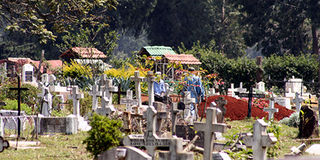
Nairobi residents will soon have a place to bury their loved ones after City Hall revealed it has secured 150 acres of land to ease the capital’s deepening burial crisis.
The new sites—100 acres at Kamiti Prison and 50 acres at Embakasi Garrison— signal the end of an era for the overstretched 100-acre Lang’ata Cemetery
Nairobi County Chief Officer for Public Health Tom Nyakaba said the new burial sites are in the final stages of testing and preparation, and are expected to be opened to the public soon.
“Nairobi County Government has a good working relationship with the national government. President Ruto met with Nairobi Governor Johnson Sakaja and the Head of State allocated the land to the county government to aid in burial planning and ensure that city residents are given a decent send-off,” Mr Nyakaba told the Nairobi City County Assembly Health Committee yesterday.
President William Ruto and Nairobi Governor Johnson Sakaja at a past event.
Photo credit: Dennis Onsongo | Nation Media Group
Mr Nyakaba was responding to questions raised by Mugumoini MCA Jared Akama regarding the status of the city’s cemeteries and the proposals being implemented by the county executive to ensure safe and dignified burial options.
Mr Akama revealed he is in the process of developing a private member’s bill that will guide how burials should be conducted within Nairobi County. The bill will include provisions discouraging the burial of loved ones in private residences or homes within city boundaries.
“The city is growing and in the next few years, there will be a greater need for expansion. That is why we need regulations in place to guide the use of public cemeteries. We must ensure that people do not bury their loved ones in their homes and mandate that they use available public cemeteries,” Mr Akama said.
Lang’ata Cemetery, the city’s largest public burial ground, was officially declared full in the early 2000s. Despite this, the 100-acre site continues to receive new bodies, with graves often dug dangerously close to the surface or layered atop older ones.
Mr Nyakaba explained that the county is currently relying on temporary graves to keep up with the rising number of deaths.
“We usually inform families that their loved ones will be buried in temporary graves. This means the grave will not be exclusively theirs. We bury the first body at 10 feet, the second at 8 feet, the third at 6 feet, and the last at 4 feet,” he said.
The looming closure of Lang’ata Cemetery follows recent recommendations by Members of Parliament and senior health officials, including Public Health Principal Secretary Mary Muthoni, who warned that continued use of the site poses serious public health risks.
Ms Muthoni urged the county to formally decommission Lang’ata, citing issues such as shallow graves, groundwater contamination and the potential spread of disease. Lawmakers have supported the call and pressed City Hall to act swiftly to provide safer, more dignified alternatives for burials within the city.
This latest move follows a failed attempt by the Nairobi County Government to acquire land for a cemetery in Mavoko, Machakos County.
In 2008, the county paid more than Sh280 million for a 120-acre parcel but the deal later collapsed amid corruption allegations. Investigations revealed the land was overpriced and unsuitable for burials.
Despite the hefty expenditure, the Mavoko site was never developed and no burials have taken place there.
The scandal has long haunted the county’s burial planning efforts and prompted repeated calls for accountability.