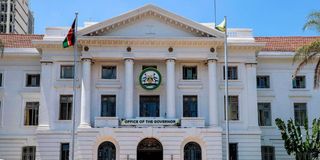
City Hall is banking on the newly enacted National Rating Act, 2024 to unlock Nairobi’s estimated Sh60 billion annual own-source revenue potential.
The law introduces a uniform framework for county governments to assess and impose rates on land and buildings, with clear valuation and enforcement procedures.
Governor Johnson Sakaja said his administration intends to fully exploit the new provisions to boost internal revenue, which currently stands at Sh13.8 billion — the highest ever recorded by the county.
Despite the milestone, the governor noted that revenue performance remains far below potential. According to the Commission on Revenue Allocation, Nairobi has capacity to collect at least Sh60 billion per year if persistent challenges in land rate compliance are addressed.
Mr Sakaja said the new Act offers a pathway to fix chronic under-collection by modernising land valuation, expanding the tax base and strengthening enforcement mechanisms. Under the law, defaulters will receive a 60-day demand notice and may face penalties, restricted access to county services, legal action, or — in extreme cases — auction of property.
He added that proper implementation of the Act, including rectifying valuation disparities such as bungalows and apartments paying similar rates despite varying land sizes, would help bring all 250,000 parcels of land in Nairobi into the rating system.
Currently, the county only collects rates from 50,000 parcels, leaving 200,000 outside the revenue net.
“If that happens, the city could multiply its revenue base and unlock development that has been delayed for years,” Mr Sakaja said.
Signed into law in December by President William Ruto, the National Rating Act replaces the outdated Rating Act and Valuation for Rating Act.
It introduces modernised valuation guidelines, promotes equitable taxation and allows counties to charge rates on urban and rateable properties — excluding freehold agricultural land primarily used for farming.
Single license application
Appearing before the Senate County Public Accounts Committee, the county boss also highlighted the impact of the Unified Business Permit on revenue growth.
The permit consolidates multiple licences into a single application processed directly through the NairobiPay platform, improving efficiency and compliance. The reform, he said, has contributed an additional Sh3 billion to the county’s revenue.
“You no longer need many licences or visits to City Hall. The Unified Business Permit covers all services, and you apply directly on NairobiPay,” he told the committee chaired by Homa Bay Senator Moses Kajwang’.
Mr Sakaja further noted that the county has started regularising unauthorised developments to enhance safety, ensure structural integrity, promote orderly growth and widen its revenue base.
He defended the NairobiPay platform — developed in collaboration with the Ministry of ICT — as the engine behind Nairobi’s record collection, saying it has sealed leakages by eliminating human interference and digitising all revenue streams.
“When we came in, not all revenue streams were digitised. Under NMS, KRA was collecting revenue. NairobiPay has helped us raise own-source revenue from Sh10.8 billion to Sh13.8 billion in just three years,” he said.
“We have digitised every revenue point to bring leakage down to zero, and this has greatly improved collections,” he added, noting that other counties and national agencies could replicate the model to curb revenue losses.