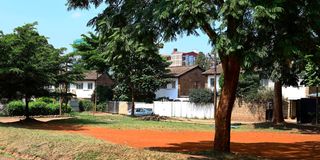
A section of the residents of Goan Housing Estate in Pangani are staring bleakly at the possibility of what has been their communal playground for almost seven decades being grabbed by a private developer.
What hurts, even more, is that they feel helpless and powerless to do anything about it.
The 0.21 acres of land, valued at nearly Sh80 million, has now become the centre of contention between the Goan community and a private developer who wants to construct a high-rise building on the land.
Residents say the land was given to their ancestors in the early 1950s after it was divided into 26 plots, according to plans of the estate shown to the Nation. It was then agreed that the residents would leave the piece of land in question as a communal playground.
For Gale Dcosta, it is unbelievable that the land originally granted to her grandfather in the 1950s has somehow found new owners and is now the same piece of land being used to build a high-rise in the middle of her estate.
Her family has lived in the same house ever since, and her children are the fourth generation since their grandfather was given the house in 1957 by the then mayor, Alderman Israel.
"How can anyone now claim to own the same piece of land without our involvement when it was land given to us, the Goan community?" she asked.
Her story echoes that of several other Goan members who said their grandparents were given the land in question, which houses 26 houses on equally divided plots, as well as the community playground.
Mr Saund has lived on the estate for more than three decades and recounted how, on one occasion in 1995, a developer turned up and said he had bought the land from one of the residents, Abdul Wahab. The investor then told them he wanted to use the playground and build some flats on the land.
"We totally rejected the plan. We asked him to show us the documents that supported this alleged ownership of the playground, but he could not show us any proof and we stopped the planned construction," he said.
Things went back to normal until 2007, when the developer told them he wanted to go ahead with the project, but the residents effectively blocked him.
Now, another 16 years later, the developer is back, and this time it is more serious, as he has sent a team of builders to drop some iron sheets and poles to cordon off the playground and start construction. This happened last Friday.
Terrified residents rushed to their local chief, who informed the Starehe Deputy County Commissioner, who ordered the work to stop immediately.
"I sent my deputy county commissioner, the local chief and the police inspector to investigate the matter and bring me their findings," DCC John Kisang told the Nation.
Interestingly, the investigation revealed that Hassan Wahab, the son of the late Abdul Wahab, was the actual owner of the playground, which had all along been accepted as community property in Goan Housing Estate.
Documents seen by the Nation showed that Mr Wahab, through a company called Dieci Entreprises, obtained the lease certificate for the disputed piece of land, LR number 209/4300/157, measuring 0.085 hectares (about 0.21 acres), at exactly 12 noon on February 2, 1995.
The DCC also revealed that the company had two directors, Mr Wahab and another person, but the former bought out the latter and became the sole owner of the piece of land.
"The Council has agreed to grant a lease to the lessee of one of the said parcels of land in consideration of the sum of Sh45,000 paid by the lessee to the Council by way of stand premium...to be held by the lessee for the remaining term of 99 years," the title deeds document said.
It is this ownership that the Goan residents are sceptical about. They wonder how Mr Wahab, a beneficiary like all of them, could suddenly become the sole owner of the community playground.
"How could Wahab subdivide a playground where most of our social events are held and which belongs to all of us, without involving the community? Something is not right," said Ms Dcosta.
For his part, DCC Kisang said their hands were tied because Mr Wahab had proved that he owned the land and had followed due process to acquire it.
"The residents have not given us any document to prove ownership of the land, so according to government records, the land legally belongs to Wahab. The best thing they (the residents) can do is to go to court and plead their case," he said.