For thousands of Kenyans, Globe Roundabout is a gateway into and out of Nairobi’s central business district. As you sit in traffic, waiting for the perennial gridlock to ease, your eyes may inevitably drift to the dark, sluggish water flowing beneath the roundabout.
This is the Nairobi River, winding its way through the capital.
For as long as most Kenyans can remember, someone in power has stood beside this river and made the same promise. That one day, this water will be clean enough to swim in again. Yet, government after government, it remains filthy. So what gives?
Nairobi River choked with garbage metres from Mathare North Hospital
Do you remember Toxic Flow, that special report by the Nation Media Group in 2019? The team followed the Nairobi River from source to the Athi, documenting the filth and even collected samples at various locations for testing. Researchers who also tested this river have recorded E. coli counts as high as a million units per 100 millilitres.
The safe limit for swimming is 100 to 200 units per 100 millilitres. Separate studies have measured lead, chromium and manganese above both Kenyan and World Health Organisation safety thresholds.
Strip away the numbers and what is left is raw sewage, slaughterhouse blood and offal. Untreated industrial chemicals. All of it moving through a city of more than four million people.
For the families who live closest to the bank, this is the daily view. And further downstream, this is bath water, drinking water for their livestock and in some homes, it is the same water they use to cook and water their crops.
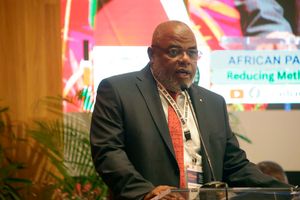
“The toxins that are in the water are in two levels; there are the organic pollutants, and there’s what we call heavy metals. Heavy metals: you can have very clean water that looks very clean but is very toxic. That is the challenge that we have that eventually, after evacuating all the sewage, which is mixed both industrial and domestic, to the sewage treatment works, our sewage treatment works must be upgraded to be able to remove this toxic waste; unless that is done we will have clean-looking water but heavily polluted and that is the most dangerous one,” offers Scientist Benjamin Langwen, a Commissioner at the Nairobi Rivers Commission.
The most common toxins in the water, he says, are mercury, lead, arsenic and chromium. “These can be traced back to industries, not the sewage.”
Attempts to clean the river
Over the years, there have been numerous efforts to clean up the river, or attempts to clean, but none has worked. The first recorded attempt was in 1999. The Nairobi River Basin Programme, backed by the
Sometime under President Kibaki, Mutula Kilonzo, serving as Minister for Nairobi Metropolitan Development, promised Kenyans they would one day swim in this river again.
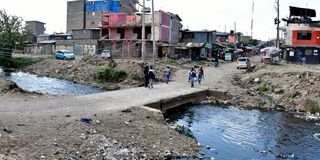
A section of the heavily polluted Nairobi River.
Photo credit: Dennis Onsongo | Nation Media Group
Then came John Michuki, Kibaki’s Environment Minister in the mid to late 2000s, who actually made some progress. He put 17 government ministries in one room, pulled roughly 20,000 tonnes of waste out of the
river in eight months, and a stretch near Museum Hill became clean enough that mudfish came back. The United Nations gave him an award for it, in Basel.
In November 2017, President Uhuru Kenyatta convened his own Nairobi regeneration meeting with then- Governor Mike Sonko, launching what became the Nairobi Regeneration Programme. NEMA took over the
river mandate in 2018. An Urban Rivers Regeneration Programme ran from 2019 to 2024. An Adopt-A-River drive launched the same year with UNEP and Rotary Clubs. A regeneration initiative followed in 2020 with
UN-Habitat. But that too yielded little fruit. And then came President William Ruto with the Nairobi Rivers Commission.
This is the second attempt under the Ruto administration at a river clean-up, and the third environment minister. On the 2nd of December 2022, President Ruto gazetted the first Nairobi Rivers Commission,
reporting to Deputy President Rigathi Gachagua. It barely functioned. Gachagua later admitted, on national TV, that it never received the budget it needed. An Auditor General’s report found the commissioners drew close to eighteen million shillings in salaries over seven months, with almost nothing built or cleared to show for it.
In September 2024, President Ruto tried again, launching the Nairobi River Regeneration Project from Korogocho, alongside a new youth employment scheme called Climate WorX Mtaani, with a target of 200,000 young people across all 47 counties. This ongoing regeneration is a 50 billion shilling project with a Chinese contractor, promising 40,000 jobs, a 60 kilometre sewer line, and 50,000 new homes on reclaimed land, on a 48-month timeline.
A man looks at the polluted Nairobi River.
Photo credit: File | Nation
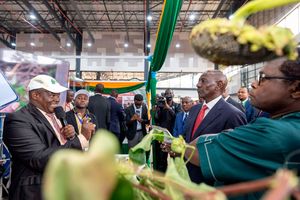
And the commission is convinced that this time around, the job will get done.
“The difference here is that it was realised that for us to be able to clean the river, we have to put the infrastructure that can control both domestic and industrial effluent so that it doesn’t find its way directly into the river. Once that is done, then the process of regenerating and cleaning the river will be on its course, and eventually the river will be clean,” he offered.
What the commissioner is saying is that the other regimes failed because they couldn’t manage the effluents.
“They were dealing with it at the industrial level trying to punish the industries but the problem was not there. The problem is to provide the infrastructure for them to discharge into and let the rivers flow and only handle the flood water. In 18 months, the river will be clean,” said commissioner Langwen.
There’s a piece of this system most Nairobians have never given a second thought to, yet it is directly connected to the Nairobi river system. On the Ngong River sits Nairobi Dam. Eighty-eight acres of water, built in 1953. It is fed by the Mutuini River (which turns into the Ngong River) and empties out over a spillway back into the Ngong River, which is one of the main component rivers making up the wider Nairobi River basin.
Traders sell their wares on a footbridge along Pumwani Road as Nairobi River flows below them headed towards Gikomba Market in Kamukunji on May 14, 2025.
Photo credit: Francis Nderitu | Nation Media Group
When Nation toured the dam last month, it was in a deplorable state. At the bottom end was raw sewage, while at the top end, families were farming arrowroots in what used to be open water. In between, hyacinth choked whatever life is left underneath. It was built to supply the city with clean water and to hold back flooding downstream, the same job the river itself was supposed to do. Today it can barely manage either.
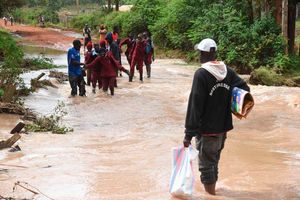
With Kenya Met having predicted enhanced rainfall during the October -November -December rainfall season, Commissioner Langwen told Nation on October 6 that more than 14,000 families living downstream in the areas of Nairobi West and South C would be affected if nothing was repaired ahead of the rains, describing the situation as urgent.
“The dam has cracks. And if it's not fixed, and the floods come, it can give way. That's why there is a need for the dam to be re-engineered, to make it operate the way it was designed to operate, that is, to control floods.
As of October 6, work to repair the spillway had yet to begin. Desilting the dam is expected to take at least two months, meaning the exercise will not be completed during the current rainy season, according to Commissioner Langwen.
A week later, however, the commissioner told Nation that repairs to the Nairobi Dam spillway are underway to address flood risks ahead of the October-November-December rainfall season.
Bramwel Simiyu, Chief Officer, Disaster Management & Coordination at Nairobi County, said the broader strategy has two components: prevention and mitigation, and rescue and recovery.
“The prevention component includes civil and engineering works, garbage collection and the clearing of drainage systems by the Green Army. The Kenya Urban Roads Authority (Kura), the Kenya National Highways Authority (KeNHA) and the Nairobi Rivers Commission are involved in the civil works, alongside the Kenya Defence Forces and the National Youth Service.”
The second component focuses on rescue and recovery, involving disaster management agencies, the Kenya Red Cross, the National Disaster Operations Centre (NDOC) and the National Disaster Management Unit (NDMU).
Simiyu said authorities had identified flood-prone areas in Nairobi, including what he described as hotspot corridors covering Nairobi Dam and Kibra, Dagoretti, Kawangware, the Mukuru-Industrial area belt, and the eastern and northern rivers corridor stretching from Mathare to Ruai.