Nairobi emerges as counterfeit goods hotspot amid crackdown
The infiltration of counterfeit consumable goods into the Kenyan market has reached alarming levels.


The Anti-Counterfeit Authority (ACA) has identified Nairobi as a major hotspot for illicit trade and counterfeit products as it intensifies a nationwide crackdown.
Speaking at a press briefing on Thursday, the authority’s chairperson, Nelson Ributhi, said a multi-agency Rapid Results Initiative conducted in high-risk areas of Nairobi between August 20 and September 3 resulted in 36 arrests and apprehensions, the seizure of more than 5,555 suspected counterfeit bottles and the recovery of approximately 39,580 litres of illicit brew.
Dagoretti North accounted for the largest volume of illicit alcohol recovered in Nairobi, with approximately 27,330 litres seized. More than 5,000 bottles were confiscated in Kayole, while 868 assorted alcoholic beverages were seized in Eastleigh.


In Makindu, Makueni County, officers working with the police seized 8,459 suspected counterfeit alcoholic products valued at approximately Sh2.1 million.
Separately, crackdowns in Nairobi, Nyeri and Eldoret led to the recovery of goods worth Sh3.74 million during September.
“The authority's enforcement also extends to counterfeit tobacco and related products. These include cigarettes bearing imitations of registered brands and forged excise stamps, as well as counterfeit nicotine products, electronic cigarettes, vapes, refill liquids, rolling papers and filters,” Mr Ributhi said.
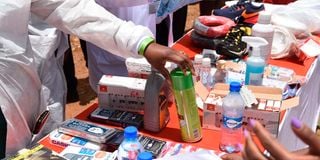
Part of an assortment of counterfeit goods worth Sh27.4 million impounded in Eldoret town. Alcohol beverages, pharmaceuticals, and cosmetics have been placed on a priority list as traders and their agents scramble to beat a January 1, 2023 deadline to register the intellectual property rights (IPRs) on all goods to be shipped into Kenya.
The authority has warned Kenyans to be vigilant as demand for alcohol, tobacco, foodstuffs and personal care products is expected to rise in the coming weeks ahead of the festive season.
“I am therefore announcing that the Anti-Counterfeit Authority is intensifying its countrywide enforcement operations, with particular emphasis on counterfeit and illicit alcohol, tobacco and nicotine products, foodstuffs, school stationery and learning materials, and agricultural inputs,” he said.
According to the ACA, the seized products are manufactured outside regulatory oversight, making it difficult to verify their contents and safety.
“Their trade also results in loss of government revenue and undermines legitimate manufacturers. The authority will intensify enforcement in this sector together with KRA, KEBS, the Ministry of Health and rights holders,” Mr Ributhi said.
The authority also seized illegally repackaged fertiliser in Matungu, Kakamega County, alongside two loaded lorries and industrial packaging equipment.
“Preliminary investigations indicate that the fertiliser had been diverted from the government subsidy programme and repackaged in counterfeit branded bags for sale at commercial prices. Fertiliser intended to make farming affordable for ordinary Kenyans was instead being sold for private profit,” the authority said.
Ahead of the national examinations, the ACA said it was also targeting pirated textbooks and revision materials, as well as counterfeit calculators and mathematical sets bearing imitations of registered brands and publishers.
“Pirated materials may contain errors, omissions or outdated content, and counterfeit calculators and mathematical sets may not meet the required standards of accuracy,” the authority said.
Stationery was among the highest-value categories of goods in the ACA's most recent destruction exercise. The authority said officers would step up inspections of bookshops, stationery wholesalers and suppliers serving schools.
Separately, a section of licensed alcohol manufacturers has raised the alarm over counterfeit liquor, accusing unscrupulous traders of recycling branded bottles and refilling them with illicit brews that are then sold to unsuspecting customers.
Speaking during a crisis meeting with the Isinya Sub-County Bar Owners Association in Kitengela town, two weeks after three people were reported to have died from illicit brew, the manufacturers distanced themselves from the killer liquor.
The Kajiado metropolitan area, comprising Ngong, Ong’ata Rongai, Kiserian and Kitengela, has recently emerged as a hotspot for illicit brew, prompting public outcry.
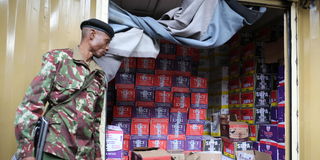
A police officer stands guard at a liquor store in Kitengela town, Kajiado County on October 28, 2025 where authorities seized Sh5.28 million counterfeit alcohol.
During the stormy two-day meeting, medium-sized alcohol manufacturers claimed that some bar owners were colluding with unscrupulous suppliers to obtain cheap liquor packaged in counterfeit bottles bearing established brands, in a bid to deceive customers and maximise profits.
Platinum Distillers marketing manager Onesmus Muturi said the killer liquor had been reported in only a few regions, suggesting that it originated from a limited supply network, unlike licensed manufacturers whose products are distributed nationwide.
“Some bartenders and owners collude with unscrupulous traders to obtain cheap liquor packaged in recycled bottles bearing established brands to widen their profit margins. They usually buy a few original bottles and obtain a receipt just in case their dirty trade is exposed,” Mr Muturi said.
The manufacturers are now urging security agencies to tighten controls on the recycling of alcohol bottles and step up the fight against illicit brews flooding the market.
“Let the government ensure recycled liquor bottles do not end up in the hands of unscrupulous traders who also recycle cartons bearing established brands. Recycled bottles remain a major catalyst for the distribution of killer brew in alcohol, wine and spirits outlets,” Mr Muturi added.
The manufacturers have also pledged to accelerate efforts to sensitise bar owners and bartenders on counterfeit alcohol across the country.
“In collaboration with bar owners’ associations and government agencies, we will roll out sensitisation forums for bartenders and bar owners on counterfeit alcohol in an attempt to avert more alcohol-related deaths,” said Nelson Kangethe, a consultant with Maspot Distillers.
Isinya Sub-County Bar Owners Association patron Fredrick Chege said cooperation between the two stakeholders in the alcohol sector would help eliminate killer brews, especially as the festive season approaches.
“The partnership has irreducible minimums: to root out fake liquor and illicit brews and ensure no one dies from the killer alcohol that has flooded the market,” Mr Chege said.

According to Anti-Counterfeit Authority, illicit and counterfeit alcohol account for approximately 59 percent of the market by volume.
Isinya Sub-County Police Commander Simon Lokitari assured the distillers that they were not targets of the ongoing crackdown. He urged them to provide information on unlicensed distillers to help restore order in the alcohol industry.
“The crackdown on illicit brew will be intensified in both towns and residential areas. Licensed distillers must come out and identify their unlicensed competitors who are flooding the market with killer alcohol,” Mr Lokitari said.
The nationwide crackdown follows an order by the National Police Service (NPS) to sustain operations against illicit alcohol and drug trafficking issued a fortnight ago.
A circular signed by Mathew Kuto on behalf of the Inspector-General on September 24 cited a resurgence of illicit alcohol and drug abuse across the country despite earlier directives to sustain the crackdown.
The circular warned that commanders in areas experiencing persistent or rampant cases of illicit brew and drug abuse would be held personally responsible. They were also directed to record daily arrests and seizures.
Follow our WhatsApp channel for breaking news updates and more stories like this.