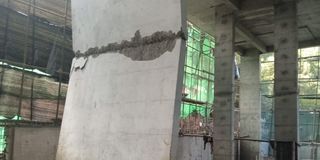
From the outside, the 13-storey building along Peponi Road appears to be just another addition to Nairobi’s fast-changing skyline.
However, beneath its concrete shell lies a troubling reality: the cement used in its construction was allegedly produced at a factory operating within a residential area, raising fears that the structure could fail—with catastrophic consequences.
Both the building and the questionable cement manufacturing company are linked to businessman Jahangir Tejani, a director of Elegant Properties Limited, which has developed several buildings across the country.
On Tuesday, a meeting involving officials from Nairobi County, the National Construction Authority (NCA) and the National Disaster Management Unit failed to conclude the next course of action.
One attendee told the Nation that two meetings had been held on the matter, alleging that Mr Tejani was being defended by Nairobi County officials.
When contacted, Mr Tejani confirmed that the building had developed cracks but declined to give further details, saying the matter was being handled before abruptly ending the call. He refused to comment on issues related to the cement factory.
The NCA said the project was registered on September 27, 2024. The contractor is Meraki Universal Building Limited, with Peter Kamau Mwangi as the architect and Samuel Maina as the structural engineer.
“The area surrounding the site is currently under the control of the National Disaster Management Unit and the National Police Service. As a precautionary safety measure, neighboring occupants have been alerted and advised to temporarily vacate, pending further technical assessments,” said NCA Director General Maurice Aketch.
Officials survey a faulty building on Peponi Road.
Photo credit: Pool
Mr Aketch added that a multi-agency team had been formed to assess whether the building can be safely salvaged or if it requires controlled demolition.
The committee comprises officers from the NCA, the Engineers Board of Kenya (EBK), the Board of Registration of Architects and Quantity Surveyors (BORAQS), the National Environment Management Authority (NEMA), Nairobi County Government, the National Youth Service (NYS), the National Building Inspectorate (NBI), and the National Government Administration Officers (NGAO). Mr Aketch advised members of the public to keep off the affected area.
According to information displayed at the construction site, the project is a proposed residential development by Donyo Hill Residences Limited, located on Land Reference Number 1870/II/165, later converted to Nairobi/Block 6/179, along Donyo Sabuk Avenue in the Upper Parklands–Highridge–Westlands area of Nairobi County.
The development was approved under Plan Registration Number PLUPA-BPM-004083-N and issued NEMA licence number EIA/PSL/32930.
“The Authority has dispatched a quality assurance team to the site to conduct compliance checks,” the NCA said, adding that the building was still under construction when the cracks were detected.
Meanwhile, residents near the cement factory site in Parklands have consistently raised concerns over its operations.
A report released in May 2025 by the Architectural Association of Kenya (AAK) noted that the facility’s operations are in stark contrast to Aspiration 2 of the Nairobi County Integrated Development Plan (NCID) 2023–2027, which targets a clean environment with reduced noise pollution in residential areas and designated silent zones.
The report says that industrial facilities such as cement plants should be located away from residential areas.
“The cement plant’s location violates the area’s zoning ordinance, constituting a breach of zoning regulations,” the report stated.
According to the AAK, the cement plant is allegedly operating covertly, with no visible signage indicating its existence. The association said the likelihood that the plant is operating illegally is high.
The report also raised concerns about worker safety, noting that employees are exposed to multiple hazards. It further stated that workers operate under strict instructions not to open the gates whenever visitors arrive.