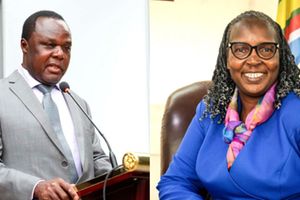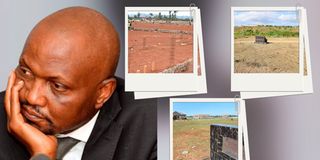
Former Trade Cabinet Secretary Moses Kuria.

They were sold by President William Ruto’s administration as a solution to the country’s widespread unemployment and a boost to rural economic growth.
Projected as one of the Kenya Kwanza’s pet projects, top government officials, led by then Trade Cabinet Secretary Moses Kuria, hit the ground running in 2023, flying from one county to another launching their construction amid colour, fanfare and live television broadcasts.
But three years down the line, no single County Integrated Industrial Park is complete, according to a report by the Parliamentary Budget Office (PBO).
The report says that 13 counties are yet to start the projects. They are Bomet, Elgeyo/Marakwet, Isiolo, Kisumu, Lamu, Mandera, Makueni, Nairobi, Samburu, Taita Taveta, Tharaka Nithi, Turkana, and West Pokot.
Another 16 counties have implementation level at 30 per cent and below. They are Narok at 10 per cent, Muranga’a (10), Mombasa (10), Vihiga (15), Kajiado (16), Nyandarua (17), Laikipia (20), Kakamega (22), Siaya (23), Nyeri (25), Trans Nzoia (25), Kilifi (30), Baringo (30), Nyamira (30), Nandi (30) and Nakuru (30).
Only 14 counties have above 50 per cent completion rate.
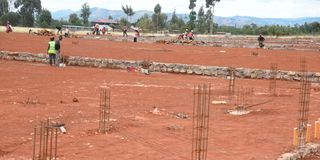
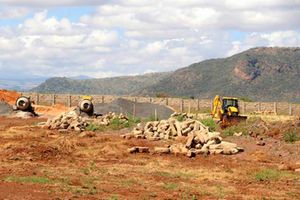
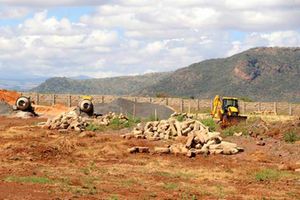
Warehouses under construction at Uasin Gishu County Aggregation and Industrial Park at Moiben.
Each county was required to allocate Sh250 million and the national government, through the State Department for Industry, would give Sh250 million to each of the devolved units for the project. This implies that the two levels of government were each to allocate Sh11.75 billion adding to Sh23.5 billion.
According the PBO report titled Devolution Budget Watch 2025, only 10 counties have received full contribution of Sh250 million from the national government, translating to Sh2.5 billion. Based on the agreement to match the contribution, it means the 10 counties were to also set aside an extra Sh2.5 billion.
Stalled projects
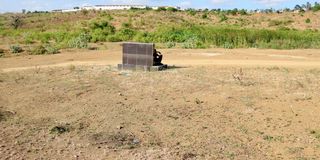
A plaque put on September 2023 by then Investment and Trade Cabinet Secretary Moses Kuria during the launch of an industrial park in Jomvu, Mombasa.
It suggests Sh5 billion has so far been gobbled up by the stalled projects. The report indicates that in this 2025/26 financial year, the government will pump in an additional Sh4.45 billion, which has been allocated to another set of 24 counties.
Some of the counties are set to receive the full amount, of Sh250 million, while others will get as low as Sh50 million.
PBO is a non-partisan professional office of Parliament, whose function is to provide professional services in respect of budget, finance, and economic information to committees of Parliament.
In August 2023, Mr Kuria pledged that all the counties would have industrial parks within 12 months. He was, however, moved from the docket in October 2023 and assigned Public Service, Performance and Delivery Management docket in a Cabinet reshuffle.
He was thereafter fired from the Cabinet following the June 2024 youth-led protests.
Mr Kuria, in an interview with Daily Nation, described implementation of the project as ‘a lost dream’ while asking those responsible to allocate resources for their completion.
In reference to President Ruto’s vision of making Kenya a first world nation, the former CS said having the County Integrated Industrial Parks would have been the fastest way of making Kenya catch up with Singapore.
He said the vision was to create job opportunities for thousands of unemployed youth as well as to reverse rural-urban migration.
Former Trade Cabinet Secretary Moses Kuria.
“I sold the vision to governors during a meeting in Naivasha, and everything was well on course. By the time I was being moved, I had launched the industrial parks in 16 counties. The counties were very enthusiastic, and were competing to put money,” said Mr Kuria.
“By now, we would be having hundreds of youths working in those industrial parks. Mine is to ask those responsible to act, because this is the real Singapore. My vision was to see rural-urban migration reversed. My idea was to industrialise the counties, but the vision was totally lost.”
Contractors abandon sites
Mr Kuria said some of the contractors have abandoned the sites, shattering dreams for hundreds of traders.
Governors have, in the past, blamed the national government for bungling the project by failing to disburse the required funds. For instance, in the financial year ending June 2024, only Sh1.15 billion was disbursed against the budget of Sh4.5 billion. In the fiscal year ending June 2025, the budget was Sh2 billion but only Sh1 billion was disbursed.
In June, while appearing before the Senate County Public Accounts Committee, Siaya Governor James Orengo laid bare how they have been left with warehouses no investor wants. He said the project was doomed to fail from the word-go with counties now left with nothing but warehouses.
“Before any infrastructure is put on the ground, there should have been a conversation with the private sector on their needs. The private sector was not engaged yet they wanted to invest in the projects,” said Mr Orengo.
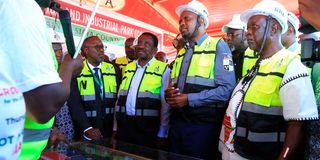
Then Trade Moses Kuria (second right) with Siaya Governor James Orengo (second left) and Siaya Senator Oburu Oginga (right) as they are shown plans during the groundbreaking ceremony for the county aggregation and industrial park at Got Akara in Siaya on September 21, 2023.
“In Siaya for example, we need a modern cotton and textile ginnery but the industrial park is just a warehouse. We have talked to possible investors in the cotton industry, they say this is just a warehouse and it does not measure up to our requirements. We have also tried leather and sugarcane industry players and the response is the same,” he said.
During the Senate session, Taita Taveta Senator Johnes Mwaruma questioned why some counties accepted the projects yet they have nothing to aggregate.
“When you want to build an industrial park, and you have nothing to aggregate, then we are left asking ourselves what should come first. Is it making sure we have agricultural produce to aggregate before building the industrial park. Or is it the other way around?” he said.
In the 10 counties that have received full contribution from the national government, the report shows that none is complete.
In Meru, the project is at 92 per cent, while Embu is at 83, Kirinyaga (81), Migori (80), Garissa (79), Busia (70), Machakos (61), Uasin Gishu (55), Bungoma (54) and Homa Bay (47).
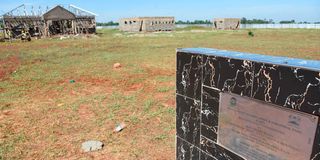
The Busia County Aggregation and Industrial park (CAIP) which was officially launched by CS Trade, Investment and Industries Moses Kuria in August 2023.
The report notes the plan to facilitate completion of the projects in another set of 24 counties by having part of the Sh250 million allocation by the national government disbursed in the 20225/26 financial year.
“The CAIPs project is being implemented in phases by the national government in all 47 counties since 2023. In FY 2025/26, this programme will prioritise completion of the project in another set of 24 counties, following completion of CAIPs project in 10 counties in FY 2024/25,” the report says further.
Counties lined up for national government allocation in this financial year include Kisii, which has been allocated Sh127 million, with the project cur at 75 per cent completion.
Wajir has been allocated 127 million, with project completion at 65 per cent while Kwale has been allocated Sh75 million, with completion level at 60 per cent, Kiambu has been allocated Sh133 million, with works at 60 per cent, while Tana River has been allocated 250 million, with works at 50 per cent.
The other counties have completion rate below 50 per cent. They are Marsabit, which has been allocated Sh250 million, Kitui (Sh250 million), Kericho (Sh250 million), Nakuru (Sh133 million), Nandi (Sh133 million) and Nyamira (Sh133 million).
Others are Nyamira (133 million), Baringo (250 million), Kilifi (Sh250), Trans Nzoia (133 million), Nyeri (Sh250), Siaya (Sh133), Kakamega (Sh50 million), Laikipia (Sh250 million), Nyandarua (250 million), Kajiado (250 million), Vihiga (Sh250 million), Mombasa (Sh133 million), Murang’a (Sh133 million) and Narok (Sh250 million).
Many counties invested significant resources in infrastructure development, land acquisition, and promotional activities to attract investors to these parks.
However, a combination of factors, including bureaucratic bottlenecks, inadequate infrastructure, poor planning, and limited access to financing, have hindered their progress. As a result, many of these once-promising projects remain unfinished or abandoned, serving as stark reminders of the challenges facing economic development initiatives at the county level.
Mr Orengo had also attributed the delay to a lack of a clear agreement between the county and national governments to ease the approval of funds by the controller of the budget.
“The plan was that counties would contribute Sh250 million against a similar amount by the national government. The crisis however is that for such funds, which are similar to conditional grants to be released, they must be approved by the CoB. This includes a signed agreement between county and governments as a sign of commitment that they will keep their end of the bargain,” said Mr Orengo.
Follow our WhatsApp channel for breaking news updates and more stories like this.