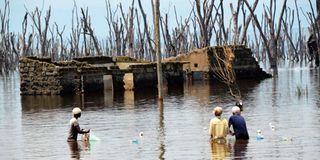
At dawn on the fringes of Lake Nakuru, jobless youths slip quietly through a broken fence, their nets clutched tightly, eyes scanning for rangers.
For them, the swelling waters of Kenya’s world-famous lake are not just a sanctuary for flamingos and rhinos — they are a last resort for survival.
What was once a conservation success story has become a battleground, where hungry residents of Mwariki settlement clash with armed Kenya Wildlife Service officers over the right to fish.
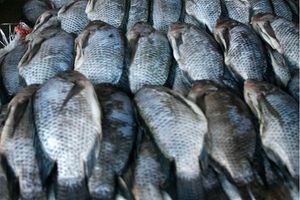
For the displaced and destitute, the tilapia now thriving in the lake is food and income. For conservationists, it is an illegal intrusion into a fragile, protected ecosystem.
When heavy rains swelled the salty waters, hundreds of residents lost their homes and farms. The entire neighbourhood was submerged. But as despair loomed, an unexpected form of hope emerged: fish.
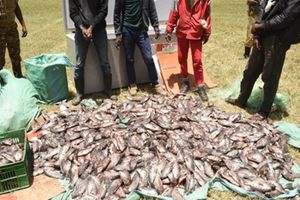
The swollen lake, once thought incapable of sustaining edible species, now teems with tilapia. For the displaced, the catch has become both food on the plate and cash in the pocket — transforming some from poverty to small-scale traders and in rare cases, even millionaires overnight.
Young men on a fishing expedition in the swollen Lake Nakuru, whose waters have submerged houses in Mwariki, Nakuru West Sub-county, following heavy rainfall on September 4, 2025.
Photo credit: Francis Mureithi| Nation Media Group
However, this blessing has come with blood and constant clashes on the shore.
To KWS, the fishers are trespassers in a protected national park, endangering both their lives and the delicate ecosystem. To the residents, the lake is their neighbour, their inheritance and their only chance to fend off hunger.
“Why are KWS rangers beating us when we fish on Lake Nakuru? We are hungry. True conservation is not about guns. It’s about coexistence, fairness and justice. This lake will remain our neighbour as long as we live,” cried Irene Anyongo, a mother of three.
Her frustration is echoed by Benson, a jobless youth who limped home after an early morning clash. His leg bore bruises, scars of a fight with armed rangers.
“I’m lucky to be alive today. I fought with two rangers and escaped by God’s mercy,” he said.
“On a good night, I can make Sh1,000. That money stops me from engaging in crime or drugs like other idle youths in Mwariki. What do they want me to do when I see fish floating by the fence?”
KWS, however, dismisses these claims. Senior Assistant Director for the Central Rift Conservation Area Gideon Kebati insists the narratives of brutality and mysterious disappearances are exaggerated.
“The so-called disappearances are cases of drowning. These young people risk their lives, sneaking at night in wooden boats between hippos and crocodiles. Many simply don’t make it back,” Mr Kebati said.
He added that illegal fishing endangers human lives and the ecological balance of a lake listed as a Ramsar Wetland of International Importance.
"Lake Nakuru is a protected area. It is not just about fish. It is about safeguarding endangered species and a fragile, irreplaceable ecosystem.”
A 2021 scientific report by researchers Mary Florence Nantongo, Joseph Edebe, Elick Otachi, and Julius Kipkemboi concluded that fish from Lake Nakuru were unfit for human consumption.
The study found Nile tilapia samples contaminated with heavy metals above World Health Organisation permissible limits, posing risks to the kidney, liver, nervous and reproductive systems.
“I’ve been eating this fish since 2020. My children are healthy,” argued Anyango.
“Are these poisons supposed to stay hidden in our bodies forever? If they want us to die, it will not be because of fish. Hunger will kill us first.”
Young men on a fishing expedition in the swollen Lake Nakuru, whose waters have submerged houses in Mwariki, Nakuru West Sub-county, following heavy rainfall on September 4, 2025.
Photo credit: Francis Mureithi| Nation Media Group
Damaris Wairimu, 80, lost her two-acre farm purchased in 1972. Now frail and sickly, she survives on handouts.
Julius Mutisya, 68, once a landlord, saw his four rental plots swallowed by the lake.
“My children dropped out of school. I depend on handouts. I will die in this lake,” he explains.
Mary Wambui, a mother, risks rape and wild animal attacks when she sneaks into the park to fish. “I risk it all because my children must eat.”
For 20-year-old mother Aziza Osman, the catch is her only means of raising her child. The stories cut across age, gender and class. Once-rich farmers, landlords and casual workers now share the same survival tactic: illegal fishing.
Beneath the cries of the poor, a darker narrative emerges. Residents allege that illegal fishing is also a lucrative business controlled by influential traders.
“On a good catch, I pocket Sh180,000 in one night. You only need to play safe,” admitted one trader who requested anonymity.
Evidence of this claim lines the KWS compound in Nakuru, where lie impounded lorries, pickups and expensive fishing gear.
Residents accuse KWS of double standards — turning a blind eye to the powerful while unleashing brutality on the poor.
“They deny us fish while the ‘big fish’ make millions at night. Where is the justice?” asked Benson bitterly.
As mistrust deepens, so does lawlessness. The electric fence meant to protect endangered rhinos is vandalised almost daily, with some youths perch dangerously on the wires, scanning for rangers’ movements while casting their nets. Meanwhile, wildlife increasingly strays into Mwariki with hyenas, lions and buffaloes raid homes, turning the human-wildlife conflict into a daily nightmare.
“The fence is porous. Wild animals roam inside our homes at night. The baboons are our permanent neighbors, destroying the little maize we have left. If KWS can’t protect us from lions, hyenas and baboons, why do they stop us from catching fish?” asked resident Peter Kungu.
Environmentalists agree that the bigger issue in Kenya’s conservation story is how to balance ecological protection with poverty reduction for those living near national parks.
“The government must strike a balance between wildlife and those living adjacent to the park,” said environmentalist Muturi Karanu.
But in Mwariki, the model of “fortress conservation” — walls, guns, and patrols — collides with the realities of poverty, joblessness and displacement.
As unemployment soars and climate shocks displace more communities, the Lake Nakuru crisis mirrors a growing national dilemma: a ballooning population of unemployed youths willing to risk everything rather than starve next to a rich lake.
“The displaced of Mwariki are not asking for charity. They are demanding recognition, jobs, compensation for lost homes, and above all, coexistence. Until those demands are met, the clash between the guardians of nature and the guardians of empty stomachs will rage on,” said Mr Karanu.