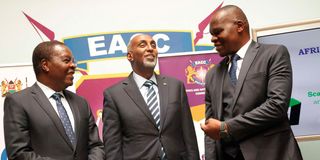
The Ethics and Anti-Corruption Commission (EACC) has launched investigations into claims of widespread voter bribery in Ol Kalou, warning that the increasing circulation of huge amounts of cash and household items by politicians ahead of the 2027 General Election poses a serious threat to electoral integrity.
Speaking during African Anti-Corruption Day commemoration at the Integrity Centre in Nairobi yesterday, EACC Chairperson David Oginde said the commission was already pursuing those suspected of engaging in illegal cash transactions in Ol Kalou.
"We are in the process of looking into that. There is so much cash circulating. We will not say the exact thing we are doing because we have not completed the investigations yet, but we are on to a few of those involved. This is a matter of concern," Dr Oginde said.
His remarks come amid growing concern over politicians openly distributing cash and household goods at public gatherings months before the official campaign period, raising fears that vote-buying is already taking root.
The commission said it is also working with other State agencies to develop a coordinated strategy to curb voter bribery, hate speech and other election-related offences before the 2027 polls.
"In matters of elections, this is a national exercise involving several agencies, with the Independent Electoral and Boundaries Commission (IEBC) at the centre. It requires collaboration," Dr Oginde said.
On his part, EACC CEO Abdi Mohamud said the Commission was already engaging the IEBC, the National Cohesion and Integration Commission (NCIC) and other agencies to ensure each institution plays its role in safeguarding the credibility of the elections.
"We are coming together, the agencies involved in election matters, so that we strategise on how to deal with this issue. The NCIC is looking at hate speech and language that incites violence, the IEBC is responsible for managing elections, while EACC will handle voter bribery and ethics issues so that we ensure 2027 does not take us back to where we were in 2007," he said.
He however cautioned that merely possessing or distributing money does not automatically amount to an offence.
"Having money is not an offence. Giving out money to people is not an offence. The issue is whether that money is proceeds of crime or whether we have sufficient evidence that it is intended for bribery," he said.
"If an MP is giving out money to constituents, we have to establish where that money came from."
The commission also expressed concern over the increasing use of cash in public transactions, saying the practice creates opportunities for corruption because cash is difficult to trace.
"Why should we have so much cash in circulation when today you can even pay for maize using M-Pesa?" Dr Oginde posed.
"People who engage in corruption know cash is difficult to trace. We want to put measures in place to ensure the flow of large amounts of cash is limited because it is not traceable."
He said recent arrests of public officials over corruption-related offences were part of proactive investigations initiated by the commission to stop abuse of public resources.
The anti-graft agency also warned State officers against participating in partisan politics, saying advisories had already been issued reminding public officials of the restrictions under the Constitution and the Leadership and Integrity Act.
The remarks were made during the commemoration of African Anti-Corruption Day under the African Union theme, "Scaling Up the Promotion of Integrity and Anti-Corruption Actions Across Africa."
During the event, EACC highlighted its shift from a largely reactive enforcement agency to one focused on preventing corruption through institutional reforms, integrity systems and public education. Over the past three years, the commission says it has recovered assets worth Sh7.4 billion, secured forfeiture of corruptly acquired assets valued at Sh25.71 billion, prevented the loss of Sh10.74 billion in public funds and secured 72 corruption-related convictions.
Dr Oginde further warned that corruption continues to discourage investment across the continent, noting that many international investors rely on global corruption perception rankings when deciding where to invest.
"We have to build integrity so that people can trust us, invest in our countries and do business with us. We should not become a place where people dump their goods but a respected continent where trade flourishes and prosperity reaches all our people," he said.