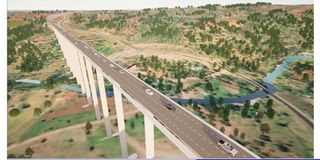
The Kenya National Highways Authority (Kenha) has released designs of the new Nithi bridge, billed as one of the most spectacular and expensive road crossings in the country once completed.
With a projected budget of Sh7 billion, the bridge will gobble up half of the 84-kilometre Kenol-Marua dual carriage whose initial estimated cost was Sh14.6 billion.
However, due to delays and land acquisition challenges, the total cost of the project which is currently 95 percent complete, was later revised to Sh17 billion.
The longest road bridge in Kenya is the 1.44km Mteza Creek overpass built as part of the Sh27 billion Dongo Kundu Phase II project linking Mombasa mainland with the South Coast. At a cost of Sh2.66 billion per kilometre, it is estimated to have cost nearly Sh4 billion.
But for Nithi, due to the cost of the current bridge in terms of lives lost and the agony it has caused Kenyans, especially in Mt Kenya East region, government agencies believe Sh7 billion is a drop in the ocean.
When the Nkubu-Thuchi road was commissioned in 1985, it was a great relief to motorists and residents of Meru and Tharaka Nithi counties since it provided an important business link.
However, the Nithi bridge became a source of agony, sorrow, and death. With a steep descent and several sharp corners, the three-kilometre stretch is a death trap, earning the infamous name of a black spot.
The current state of Nithi bridge, a blackspot along the Meru-Embu-Makutano highway in Tharaka Nithi County taken on February 20, 2024.
Photo credit: Alex Njeru | Nation Media Group
As you approach the bridge on both sides, there are screaming road signs warning motorists of the danger ahead. Rubble strips were also installed separating the lanes, with the measures failing to stop the carnage.
Over the past 40 years, hundreds of lives have been lost, while thousands of people have lived with trauma and scars of disability after they were involved in accidents at the spot.
But this is about to end. After years of promises by successive governments that a realignment of the killer bridge would be done, the initiative has finally taken the first baby steps.
Addressing residents of Meru recently, Deputy President Kithure Kindiki said the government was committed to completing the project on time.
“We now have the funds and the public has already been engaged for their input. Soon, I will bring the contractor to start construction,” the DP said in Tigania East on February 25, 2026.
Mr Michael Ngala, the project engineer said the project scope involves realignment of the road on a 2.7-kilometre stretch from Marima to Mitheru shopping centres, with the bridge itself spanning 880 metres.
“As a result of the many carves and steep descent on this stretch, many lives have been lost in road accidents. We have had engagement with members of the community and explained what the project entails,” Mr Ngala said.
“With a gradient of 1.2 percent, the bridge will be fairly flat and we don’t anticipate that such accidents will occur as a result of human error,” he added.
According to the Kenha project brief, the bridge will have an eight-metre dual carriageway, two metres shoulder or walkway on either side and a maximum gradient of eight per cent to enhance safety.
The structure, literally flying over the Nithi River, will be supported by massive pillars, some of them rising as high as 100 metres from the deepest point of the Nithi valley.
Engineers explained that since the bridge takes a different route from the current road, there will be minimal traffic diversion during construction.
“As part of enforcement of traffic rules, the speed limit on the bridge is 70 kilometres per hour and there will be cameras to check on offenders as well as manned roadblocks on each side of the bridge,” Mr Ngala, who is also deputy director in charge of structures at Kenha.
After the public participation which was conducted in collaboration with other stakeholders including government administrators from both counties, Kenha said engineers are currently at the site doing final surveys.
“It is in the interest of the government that this project is done as fast as possible and we call upon members of the community to offer full support to all teams. While the contract is for 24 months, the actual period will depend on the cooperation with members of the community,” Mr Ngala said.
Design of the new Nithi bridge released by Kenha.
Photo credit: Pool
Speaking after the public participation exercise, Tharaka Nithi county commissioner Mr David Gitonga asked residents to offer full support, adding that the National Land Commission (NLC) will also assess the amount of land required for the project.
“The NLC will also determine how many people will be affected by the project so that they are compensated. Let me assure you that this bridge will be one of its kind in eastern and central Africa and will be a tourist attraction,” Mr Gitonga said.
Residents expressed hope that the realignment of the bridge will solve the problem once for all, saying they were happy that the project was finally a reality.
“Several people have died here while many were maimed including our friends and relatives. When we leave our homes especially during rainy season like now, we’re always worried. But we now have an assurance that this problem will be a thing of the past,” said Mr Biden Kiura, a resident of Marima.
Justus Mbae, a resident of Mitheru urged the government to ensure that the project was not delayed, saying members of the community will abide by all conditions set out by the project’s implementing agencies.
“On several occasions we see projects launched but stall or stay for long before completion. When we first heard of this project, many people told us it was mere talk. But now we have seen it’s a reality and our only hope is that it’ll be completed on time,” Mr Mbae said.