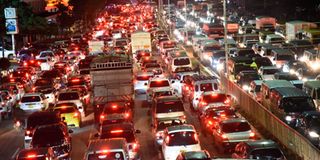
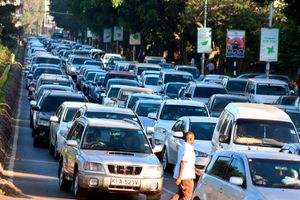
Traffic congestion costs Kenya’s economy approximately $1 billion (Sh129 billion) each year. According to the Kenya Urban Roads Authority (Kura), this translates to about Sh353 million per day — a staggering toll on the country’s economy. For many Nairobi residents, the daily commute begins long before sunrise.
Mr Frank Soreh, from Kasarani, says, “I leave home before 6am and still get stuck for nearly two hours. By the time I reach my destination, I am already tired. It’s the same story in the evening. You cannot plan your day around traffic in Nairobi.”
The effects of congestion are not limited to those who drive cars. A boda boda rider from Kangemi said, “When you spend the whole day on the road, you can feel the dust in your chest. You get exhausted. There are days when my eyes burn.”
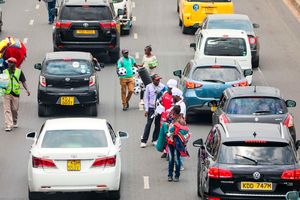
Hawkers selling their merchandise to motorists stuck in a traffic jam along Thika Road in Nairobi on September 30, 2025.
Photo credit: Bonface Bogita | Nation Media Group
Julie Gathimba, a student, notes, “Whether it’s 10am or 3pm, you can find traffic jams anywhere. It is unpredictable. The roads feel smaller because there are just too many cars.”
For those who earn a living on the roads, the frustration is both physical and financial. Matatu driver Peter Muchiri says, “You can spend more than an hour covering just a few kilometres. Passengers get angry, but there’s nothing we can do.” The roads are too crowded, and everyone is trying to beat the traffic. By the end of the day, you’re exhausted.”
David Adolla, a resident of Utawala in Nairobi, points out that the problem goes beyond vehicles. “Traffic is not just about cars. It’s about how the city is planned. Until public transportation improves, we’ll continue to waste time and money in traffic.”
For decades, Nairobi has tried to ease its gridlock by expanding highways, carving new lanes, and building interchanges.
However, Kura notes, “The more roads we build, the more vehicles there are. As a result, the city always ends up with traffic.”
At the recent Smart City Forum, city planners announced that they are changing course.
‘’The solution is no longer about more tarmac, it is smarter infrastructure powered by data, sensors, and real-time communication,” former senator Sylvia Kasanga, who is an architect with more than 16 years of experience, said.
Digitising traffic management is a new territory. Until recently, Nairobi’s traffic management system was stubbornly analogue. Police officers manually controlled junctions, sometimes armed only with hand signals.
“Traditionally, we collected traffic data manually, analysed it manually, and returned to adjust the signals manually,” Kura said. “It was tedious, inconsistent, and reactive.”
Hawkers sell their wares to motorists stuck in a traffic jam on Thika Road in Nairobi on September 30, 2025.
Photo credit: Bonface Bogita | Nation Media Group
Kura has since shifted from reactive management to Intelligent Transport Systems (ITS), a set-up touted as a digital overhaul to eliminate guesswork and enable data-driven decision-making.
At the heart of ITS are smart cameras and sensors that detect vehicle flow, count cars, identify violations, and relay data to a centralised control centre.
The system uses Artificial Intelligence (AI) to adjust signal timings in real time, easing pressure at busy junctions without (traffic police) human intervention.
“You don’t have to walk into a junction to adjust signal timings anymore,” Kura said. “Everything happens from the control room.”
So, how does the system work? It is designed in such a way that every smart intersection is equipped with cameras capable of vehicle detection and plate recognition. For instance, they can tell whether a boda boda rider is wearing a helmet, track red-light and speed violations, and even detect the number of passengers.
Beyond enforcement, the technology enhances safety and responsiveness.
“If there is an accident, the system detects a change in traffic flow and immediately alerts the control centre,” Kura explained. “Police and emergency teams can then be dispatched instantly.”
The control centre is currently under construction at City Cabanas and will act as Nairobi’s digital traffic nerve hub. Technical staff stationed there will monitor live feeds from over 200 planned intersections, ensuring the city’s traffic grid operates in sync.
The first phase of the ITS began in February with the contracting and groundwork for the initial roll-out. This stage focuses on 25 key intersections across Nairobi, where engineers are redesigning road geometry and installing the first batch of smart infrastructure. Before physical work began, Kura and its partners collected traffic data and obtained approvals from agencies such as the National Environment Management Authority (Nema) and other regulators to ensure compliance with environmental and urban planning standards.
According to Kura, the contractors are on-site replacing outdated designs with modern, signalised intersections equipped with sensors and cameras.
Running concurrently with the first phase, the second phase of the ITS project aims to extend smart traffic control to 60 additional intersections across Nairobi. Phase two will see the establishment of interconnectivity between corridors. It will ensure all major junctions communicate seamlessly with each other and with the control centre.
Engineers are preparing designs and technical frameworks that allow smooth integration between county-managed feeder roads and national corridors managed by KeNHA and Kura.
Once completed, this phase will cover the city’s busiest routes, helping decongest critical avenues such as Jogoo Road, Ngong Road, and Waiyaki Way.
The third phase, also running in parallel with the others, will mark the full integration of Nairobi’s traffic ecosystem. It will encompass 125 intersections, linking them to the central control system at Cabanas. The three phases will bring 210 signalised intersections under one intelligent network which is envisioned to be the largest of its kind in East Africa. This phase focuses on refining real-time monitoring, data analytics, and automated traffic enforcement.
It will also integrate public transport systems such as the Bus Rapid Transit (BRT) and support e-mobility by linking road data with commuter operations.
The goal is not only to improve travel efficiency and safety but also to reduce emissions and promote sustainable urban mobility.
In an interview with the Nation, Godfrey Akumali, the acting county secretary and head of county public service in Nairobi, said the city is already piloting AI-enabled traffic lights.
These lights can read vehicle volumes using camera sensors and automatically adjust their timing to reduce congestion.
“They will be using AI technology,” he said. “All traffic lights will speak to each other through a central system. This will make coordination seamless across the entire city,” said Akumali.
He said the initiative is ongoing and roads such as Ngong Road and some places in Kileleshwa already have smart traffic lights that operate without the need for police officers. However, he noted that full integration is limited by disconnected systems at other junctions.
“For the system to work perfectly”, Mr Akumali said, “all the interchanges must be smart. One manual junction can disrupt the flow for an entire corridor.”
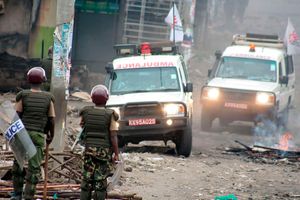
He added that the recent protests in the city destroyed parts of Nairobi’s existing traffic infrastructure, forcing the county to invest in more resilient and integrated digital systems.
Kura and the county government of Nairobi are working hand-in-hand with Kenya National Highways Authority (Kenha) to ensure roads and designs align. “County roads are mostly feeder roads, major corridors such as Uhuru Highway fall under Kenha, while others such as Ngong Road and Jogoo Road fall under Kura. We are now designing them to speak to each other,” said Mr Akumali.
Officials say the partnership is critical to realising Nairobi’s Smart City agenda, which seeks to weave automation, safety, and sustainability into the city’s transport grid. However, a Kura official cautioned that technology alone is not enough: “Technology on our roads alone will not solve congestion. Nairobi is on the upper curve of urbanisation, and that comes with higher transport demand.”
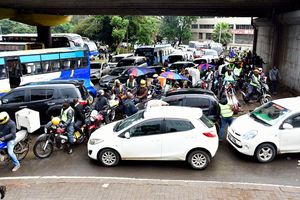
Traffic jam on Jogoo Road, Nairobi after a heavy downpour.
Photo credit: Bonface Bogita | Nation Media Group
To tackle the city’s chronic traffic jams, authorities have shifted their attention to mass transit systems such as BRT network. The BRT project introduces dedicated bus lanes designed to move commuters quickly while cutting emissions and accidents.
“One bus may replace 50 cars,” Kura said. “That means instead of 1,000 people per hour, you can transport 10,000 on the same stretch of road.”
The BRT system will feature CCTV-equipped buses, priority seating for persons with disabilities and expectant mothers, and real-time monitoring for passenger safety. “Within the bus, we have cameras connected to the control centre,” Kura noted, “It guarantees safety both inside and outside the vehicle.”
The city is encouraging the adoption of electric buses and vehicles to cut carbon emissions and align with Kenya’s green transport agenda.
“We are trying to reduce our carbon footprint as a city, and we’ve already signed up to that commitment,” Akumali said.
Speaking to Nation, Ms Effie Konaka, from e-mobility firm Spiro, said their electric motorbikes have collectively covered over 500 million kilometres of carbon-free travel across Africa, contributing about 20 tonnes in voluntary carbon credits in Kenya.
Electric vehicle taxes and import incentives remain under national government control. However, Nairobi County positions itself in focusing on developing the supporting infrastructure.
Photo credit: Sil Kiplagat | Nation Media Group
“We are partnering with the private sector to build charging hubs along the routes. Quite a number of transport Saccos have already acquired electric buses and motorbikes and the number is rising,” said Ms Konaka.
The Nairobi Metropolitan Area Transport Authority (Namata) plays a key role in regulating and integrating public transport systems across the metropolitan area. The authority ensures the BRT, commuter rail, matatus, and future systems function under a unified framework.
Kura says Kenya’s transport policy identifies public transport as a service, not just a commercial enterprise. “This calls for collaboration. The government regulates and invests, the private sector operates, academia trains professionals, and innovators create new solutions,” it says.
The officials envision a Nairobi where data drives decision-making, roads communicate, and commuters move efficiently.
As a result, Nairobi expects that there will be a 40 per cent reduction in travel times, a significant drop in emissions from reduced idling and fewer private cars, enhanced pedestrian safety through intelligent crossings, integrated enforcement through AI cameras and digital record, and a seamless connection between BRT, rail, matatus, and e-mobility.