When Mr Sylvester Kiptoo Keter was hit by a speeding car while cycling home from school along the Kitale - Kapenguria road, doctors were not sure he would ever walk again.
The high-speed crash left the then 40-year-old teacher from Trans Nzoia County disabled. But instead of retreating into silence, the father of four and teacher of mathematics and business studies turned personal tragedy into public advocacy.
The road accident that nearly took his life became the path to his purpose. Today, his voice rings loud across classrooms, community halls, hospitals, and county boardrooms as a leading voice in Kenya’s fight for road safety, disability rights, and trauma-informed care.
He recalls the crash that changed everything. He was cycling from Maili Nane to Maili Saba when a car hit him at high speed. The impact crushed his right leg and threw his life into chaos, physically, emotionally, and financially.
It became the longest journey of his life. But also a journey from pain to purpose. From injury to impact. From silence to change.
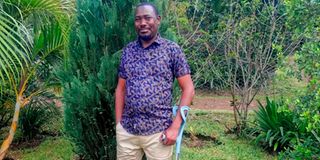
Sylvester Kiptoo Keter.
Photo credit: Evans Jaola | Nation Media Group
“It wasn’t just an accident. It was waking up to a reality I never imagined. Suddenly, I was in the ‘disability corner,’ wondering how I would live, work, or be independent again,” recalls the crash survivor, now teaching at St Mark's Cherangany High School.
He was rushed to St Luke's Orthopaedic & Trauma Hospital in Eldoret in the neighbouring Uasin Gishu County, where he underwent six surgeries in a drawn-out, painful journey to save his leg. Despite the efforts, his right leg remains shorter by about two centimeters and is supported by two metal implants. While the physical healing was gruelling, it was the emotional and human support that gave Mr Keter strength.
“The staff at St Luke’s were absolutely incredible. We built such a strong bond that they even sneaked in extra food; it felt like family. Even my visitors noticed the warmth and loved being there,” he recalls with a laugh.
To cover his over Sh4 million in treatment costs, he relied on a teacher’s insurance cover, loans, and support from friends and family. As he recovered, Mr Keter began to reflect on not just his own ordeal, but the broader systemic failures — poor road safety enforcement, lack of emergency support, and the silence surrounding survivors.
“It wasn’t just the injuries; we were hurting from the silence, from being ignored like we didn’t matter. That is when it hit me, and staying quiet wasn’t an option. I had to speak up, or nothing would change,” he explains.
He began telling his story in schools, community events and in Hospitals. He soon found himself stepping into an advocacy role.
“This should never have happened. Period. I am going to do everything in my power to make sure no one else has to go through it,” he says.
Slyvester Kiptoo recuperates after several surgeries. He was involved in an accident 2020
Photo credit: Evans Jaola | Nation Media Group
Now a key figure in road safety initiatives, he works with boda boda saccos, community health workers, and Taraja Counselling Services, a local organisation supporting accident survivors.
His advocacy centres on both prevention and protection. He advises drivers to obey speed limits, avoid distractions like mobile phones and wear seatbelts.
“Worn-out brakes or tyres can be deadly,” Mr Keter warns motorists. He asked cyclists to wear helmets, use reflective gear, obey traffic laws, and stay vigilant, especially in early mornings or late evenings. He also advocates for better medical insurance for cyclists and boda boda riders.
“Every task started to feel like a mountain I had to climb, slow, exhausting, and sometimes overwhelming. But through those struggles, I realised something important — independence isn’t about doing everything perfectly or getting it right the first time. It is about having the strength to keep going, even when it’s hard. It’s about not giving up,” he reflects.
For him, healing is more than physical recovery.
“Healing isn’t just about surgery or physiotherapy. It is emotional and even spiritual. It is celebrating the small victories, every step, every smile, every day you choose to try again,” he says.
He actively promotes the Social Health Authority (SHA) insurance scheme, which covers emergency treatment.
“My story actually pushed a bunch of riders to finally get insured. I’ve even covered the cost for some myself, because honestly, if something matters that much, you don’t wait around. You just do it,” he says.
He points to a major gap in healthcare, which is the lack of psychological and emotional support for trauma survivors.
“Most hospitals are set up to treat the body, to fix what’s physically broken. But what about the mind? What about the spirit? Those parts of a person often get overlooked entirely. That’s a gap in care, and it’s one that desperately needs to change,” he notes with concern.
Mr Keter describes life after the accident as a person living with a disability as one of the toughest personal battles he’s faced.
“Every task started to feel like a mountain I had to climb, slow, exhausting, and sometimes overwhelming. But through those struggles, I realised something important - independence isn’t about doing everything perfectly or getting it right the first time. It is about having the strength to keep going, even when it’s hard. It’s about not giving up,” he reflects.
For him, healing is more than physical recovery.
“Healing isn’t just about surgery or physiotherapy. It is emotional and even spiritual. It is celebrating the small victories, every step, every smile, every day you choose to try again,” he says.
Mr Keter’s efforts are already making a difference. He is seeing more cyclists adopting safety gear, more riders signing up for insurance, and some hospitals beginning to integrate emotional care for accident survivors.
“People are beginning to wake up. They are asking the hard, necessary questions. Some are even brave enough to share their own stories; that is how healing spreads,” he says.
His dream is to see a Kenya where road safety is a shared priority, and where no survivor suffers in silence.
“We all have a part to play - drivers, cyclists, pedestrians. Road safety is more than just following rules; it is about looking out for one another. It is a shared responsibility, and so is compassion,” he notes.
According to the World Health Organization (WHO), road crashes kill an estimated 1.19 million people globally each year, leaving millions more with life-altering injuries and disabilities.
In Trans Nzoia County, where Mr Keter lives, transport stakeholders have launched the Trans Nzoia Traffic Quadra Road Safety Strategic Management Plan (2024–2030) to curb road carnage. The five-year plan aims to improve traffic enforcement and reduce motorcycle-related accidents, a major cause of fatalities in the region.