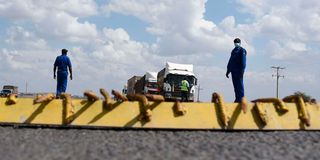
The government has initiated plans to introduce instant fines for motorists who flout traffic rules, noting that indiscipline on the roads is among the main causes of accidents.
This comes as new data from the National Transport and Safety Authority (NTSA) shows that Kenya has recorded 3,397 road crash deaths in the first nine months of 2025, underscoring the scale of the country’s road safety crisis. The figure represents about 12 fatalities daily.
The figure also represents 28 more fatalities than the same period last year, with a total of 17,270 people affected by crashes—291 more than in 2024. Pedestrians accounted for the highest share of deaths at 1,285, followed by 858 motorcyclists, 568 passengers and 309 drivers.
According to him, the introduction of an intelligence system using cameras at major junctions is meant to help enforce the Road Traffic Offences Act of 2016 by collecting data to identify lawbreakers and issue fines.
“We are in the final stages, and the Cabinet will issue a memo. We are bringing together the police, judiciary, and NTSA as the enforcers. We already have the building blocks of the proposal, which will also determine how the instant fines collected will be shared,” said Mr Chirchir.
He explained that the process will leverage technology to capture activities at major road junctions, with footage relayed to an Intelligent Transport Management System in a central control room.
“We do not want to overload our courts with petty offences. We understand that when there is instant discipline, people tend not to misbehave on the road,” said the CS.
According to him, the government is deliberating on how to fund the system and maintain the cameras to ensure its long-term effectiveness in addressing reckless driving.
A traffic police officer inspects the wreckage of a car at the scene of a road accident in this past photo.
Photo credit: File I Nation Media Group
In the conference that brought together various stakeholders of road transport, various agencies explained how the ITMS will improve road safety and save the lives of Kenyans.
“One of the key challenges facing road agencies in the country is funding. Instant fines will require collaboration between NTSA and the police to ensure offenders pay on the spot without lengthy processes. Some black spots remain unrepaired due to costs, with funding for such projects often tied to road safety,” said Mr William Oginga from Kenya Urban Roads Authority (Kura).
According to the agencies, the system will help police avoid allegations of bribery, as offenders will be issued a ticket or a paybill number to ensure fines are paid.
“The police or enforcer does not have to worry, just write you the ticket. It is then up to the offender to pay on the spot or later. Given the complexity of road safety funding, this initiative will add to the limited resources we currently have,” said Mr Michael Muchiri from the Ministry of Transport during a panel discussion.
Since the launch of the National Transport Action Response Plan 2024–2028, the country has recorded a surge in fatalities, prompting the government to call for a multi-sectoral approach to curb the deaths.
The sharp rise in casualties has prompted the government to roll out a tough five-year National Road Safety Action Plan, which targets reckless drivers, accident hotspots and high-risk behaviours such as drink-driving.
“Another major risk behaviour is driving under the influence of alcohol. To address this challenge, the Traffic (Drink Driving) Regulations, 2025, have been developed,” the NTSA said in its strategy document.
Police officers control the flow of traffic along Kenyatta Avenue in Mombasa City.
Photo credit: Kevin Odit | Nation Media Group
The agency noted that fatal crashes are highly concentrated in the evenings, with 26 percent of accidents in Nairobi (and 30 percent nationwide) occurring between 7 pm and 10 pm—when reduced congestion, poor visibility, and alcohol consumption increase risks.
At the same time, the government has unveiled major road infrastructure projects expected to reduce fatalities, including the expansion of the Rironi–Mau Summit highway, dualling of the Kwa Jomvu–Mariakani road, upgrades along the Nyali–Mtwapa–Kilifi corridor and improvements to the Kitale–Morpus road linking Kenya to South Sudan.
Other safety upgrades are underway at known blackspots such as the Ngata Bridge in Nakuru, the Bonje area in Kilifi, and the Kisumu–Kakamega highway.
In Nairobi, the Kenya Urban Roads Authority (Kura) is building 13 pedestrian footbridges along the Bus Rapid Transit (BRT) corridor on Outer Ring Road.