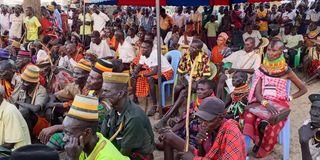
After weeks of unexplained delays, Members of Parliament on Tuesday finally began public hearings on Kenya’s South Lokichar oil project in Turkana County — only to face anger and grief from locals recounting deadly bandit attacks, stolen livestock, and worsening insecurity that now threatens to derail the multi-billion-shilling project.
The hearings quickly turned tense as residents confronted MPs and senators, declaring they would not allow oil exploration to continue until the government addresses insecurity in the region.
The joint committee — comprising the National Assembly Departmental Committee on Energy and the Senate Standing Committee on Energy — launched a week-long public participation and stakeholder consultation on the South Lokichar Field Development Plan and Production Sharing Contracts (PSCs) for Blocks T6 and T7.
Villagers seized the platform to voice frustrations over rising banditry, citing the latest attack in Kakong village last weekend, where six people were killed. The victims’ bodies were still lying in the mortuary, awaiting burial.
Lodwar Township MCA Ruth Kuya said she had just returned from Lodwar County Referral Hospital mortuary, where the six victims were being preserved.
“It would have been better if we prioritised a security meeting first because the bodies of people who were recently killed are still in the mortuary,” she said angrily. “You have come just because of oil. We are not happy. No oil issues at the moment.”
Kakong village lies along the strategic Kitale–Lodwar corridor, which will be used to transport crude oil. It is also adjacent to land earmarked for irrigation.
The first session with Members of the Turkana County Assembly (MCAs) was co-chaired by Siaya Senator Dr Oburu Odinga and Nakuru Town East MP David Gikaria.
Siaya Senator Dr Oburu Odinga addresses journalists at the Turkana County Assembly on February 3, 2026.
Photo credit: Sammy Lutta | Nation Media Group
Lokichar MCA Samwel Lomodo warned that the Kitale–Lodwar road, which will be used by an estimated 600 trucks transporting crude oil, remains unsafe.
“More than 2,000 livestock were stolen at Kakong, and a motorist was killed. If Interior Cabinet Secretary Kipchumba Murkomen cannot tackle banditry, this project will fail,” he said.
Earlier this week, Turkana residents threatened to block both the Turkana Oil Development Project — whose first crude export is expected by December — and a Kerio Valley Development Authority (KVDA) irrigation scheme spanning 1,000 acres.
Demonstrators in Lodwar town and Kakong demanded that the Ministry of Interior prioritise anti-banditry measures over development projects.
“Security must come first; nothing is more important than our safety,” said community leader James Kisike.
Katilu MCA William Etubon dismissed recent demands by neighbouring leaders for a 20 percent share of oil revenues, calling them diversionary tactics.
“They cannot receive the same share as Turkana, where oil was discovered,” he said, adding that their allocation would come from the 70 percent reserved for the national government.
Mr Etubon also criticised government security efforts, saying specialised units deployed in Kainuk were not making an impact.
“These units should be redeployed to deal with bandits, not to militarise Kainuk,” he said.
“If we are talking about an oil project and security is not assured, we will be dealing with tricky issues,” he cautioned.
He promised to escalate the matter to President William Ruto and urged Interior CS Murkomen to meet both security agencies and political leaders in Turkana.
Dr Odinga also stressed the need for better infrastructure and technology to combat banditry, noting that poor roads in volatile areas hinder security operations.
MP Gikaria said he was saddened by the insecurity along the Turkana–West Pokot border and noted that the county security committee had assured him that an operation would soon be rolled out.
During the hearings, MCAs also raised concerns over local content and revenue sharing, insisting that sub-counties such as Aroo and Suguta must benefit through jobs, contracts, and oil revenues.
The committee urged residents to submit their views for inclusion in the final report, which will be tabled in Parliament for ratification — a key step toward unlocking commercial production under Kenyan-owned Gulf Energy.
Gulf Energy said its local content plan aims to promote inclusive development and ensure petroleum operations translate into measurable socio-economic benefits for both Kenya and Turkana.
On Monday, while visiting Kainuk, CS Murkomen said the government would roll out a comprehensive operation involving disarmament and the arrest of perpetrators and their sponsors.
This came a day after protesters in Lodwar called for his resignation, accusing him of slow response and poor coordination.
“If suspending all oil-related activities is the only path to peace, then so be it,” said professional Peter Lolem. “Too many lives have been lost.”
Residents had set aside 300 acres for flood-based farming to reduce dependence on livestock — increasingly vulnerable to raids.
Turkana South MP Ariko Namoit criticised Operation Maliza Uhalifu, saying stolen livestock must be recovered before peace talks can proceed.
He also urged the government to revive existing irrigation schemes rather than launching new projects in insecure areas.
Local leaders noted that similar protests occurred in 2018, when residents disrupted the Early Oil Pilot Scheme until the government promised improved security.