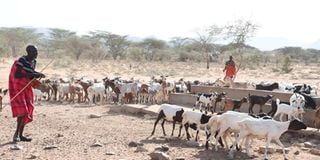
After weeks of being turned away at the Kenya-Uganda border, drought-stricken Turkana herders are finally crossing into Karamoja’s region for pasture and water, thanks to an exchange of a herd of livestock that settled decades-old disputes and cleared the border for safe grazing.
The breakthrough comes through a traditional livestock compensation system for past killings and stolen animals that has eased tensions along the fragile Kenya-Uganda border.
For weeks, Ugandan authorities had turned back herders who failed to comply with dispute-resolution rules designed to prevent cross-border conflict.
Now, with livestock compensation paid in cattle under the centuries-old system, trust is being rebuilt between the Turkana herders of Kenya and communities in Uganda’s Karamoja sub-region.
Herders, however, must surrender all firearms before crossing, a rule strictly enforced by local authorities and the Uganda Peoples’ Defence Forces (UPDF).
The arrangement is rebuilding trust, easing tensions and ensuring peaceful co-existence between communities on both sides, while Kenyans herders survive one of the harshest droughts in recent memory.
For decades, Karamoja in north eastern Uganda has been a refuge for Turkana pastoralists escaping Kenya’s recurring droughts, offering water, pasture, and protection from both local police and military.
Its remote villages, namely Kobebe, Losogol, Lopei, Naput, Chokchok, Nakabaat, Losilan, and Nadunget, offer vital water and pasture, alongside protection from local authorities and the Uganda Peoples’ Defence Forces (UPDF).
However, this migration has not always been smooth, with opportunistic criminals exploiting the movement of herders, engaging in highway banditry and livestock theft.
As a result, illegal guns carried across the border have previously caused deadly incidents.
The deadliest incident occurred in March 2022 when three Ugandan geologists and two UPDF officers were killed while mapping minerals in Karamoja. The tragedy strained diplomatic relations between Kenya and Uganda.
Mr John Esekon, a herder from Urum village in Lokiriama Sub-County, recounted the risks of crossing to the neighboring country.
“Uganda authorities once arrested 32 herders for illegal possession of firearms. They were sentenced to 20 years in jail, but interventions by both governments and local leaders secured their release. That is why many of us now strictly follow the host nation’s laws,” he said.
Tensions resurfaced in February 2026, when Turkana pastoralists in Uganda’s Kaabong District were ordered to return home. Authorities cited unresolved criminal incidents, including the killing of a Ugandan trader in Kotido District two months earlier. Weeks without access to water and pasture heightened the risk of conflict.
Local Turkana leaders, including Turkana West MP Daniel Epuyo and Special Envoy for Peace in the Ateker Region John Munyes, intervened and worked with both governments to mediate a solution and prevent escalation, and peace was restored through traditional compensation.
During a ceremony in Nakapelimoru village, the Turkana community handed over 73 goats, 73 sheep, and three heifers to the neighbouring Jie community as restitution for past livestock thefts and killings.
In addition, 250 cows were offered to Ugandan authorities to compensate for the 2022 killings of Ugandan geologists and UPDF officers. The gestures helped rebuild trust, eased tensions, and allowed Kenyan herders safe passage into Uganda.
“Through compensation, our community is showing remorse and a genuine commitment to peaceful coexistence,” he said.
Uganda’s Assistant Resident District Commissioner for Kotido District Mr Peter Abrahams Lokwii, praised the role of elders in mediating disputes and emphasised the importance of dialogue.
“We rely on respected elders to mediate disputes. Pastoralists must use structured reconciliation, respect laws, and avoid revenge attacks,” he said.
The Ateker Leaders Council, established in December 2025 to promote cross-border cooperation among Turkana, Karamojong, Toposa, Jie, and Nyangatom communities, has played a central role.
Mr Munyes explained that the Council’s goals extend beyond dispute resolution: “We aim to end hostilities, ensure equitable sharing of resources, improve pastoral livelihoods, and keep children in school. Strong cross-border cooperation is essential for the region’s stability and socio-economic transformation.”
This community-led conflict resolution approach, combined with government oversight and enforced rules, has created safer conditions for migration while preventing the re-emergence of violent disputes and old hostilities.
“It also helps communities invest in livestock management, maintain grazing areas sustainably, and focus on education and local development,” said Mr Munyes.
Because of the arrangement, herders like Esekon are now able to access remote villages in Uganda, such as Kobebe, Losogol, Lopei, Naput, Chokchok, Nakabaat, Losilan, and Nadunget, for grazing and water.