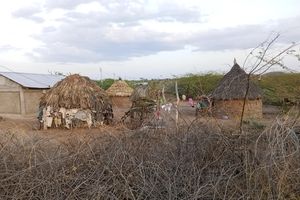
Turkana County is facing one of its worst droughts in recent memory. Temperatures across the region have soared to over 41°C and seasonal rivers that once provided water are now dry and sandy.
The drought is not just a climate crisis but a humanitarian emergency affecting the very survival of people and livestock.
Climate Tracker
Kenya Satellite Analysis
Developed by Geoffrey Onyambu • © 2026 Nation Research Desk
In most villages, the elderly and children, unable to migrate like herders, have retreated to dry riverbeds where they wait under palm trees for the fruits to fall before returning home at sunset.
In Kapua village, one of the most remote parts of Turkana Central Sub-County, by noon, the heat is mercilessly punishing.
Homesteads once alive with activity lie silent. The only movement is at the local primary school, sustained by a feeding programme, a handful of small shops and goats roaming through thorny dry shrubs.
Along the vast, sand-choked Kosiayi seasonal riverbed, more than 100 metres wide and now bone dry, the elderly sit beneath the duom palm trees.
Elderly residents in the village have each identified a specific tree under which they settle daily with the young children, transforming the riverbed into a community of silent endurance.
The river flows only during the rains. But now it offers only shade, palm fruit and shallow hand-dug wells tapping what remains of the underground water.
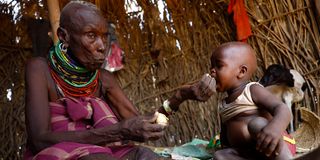
Echakan Amaja 76, eats wild doum palm fruit (Hyphaene thebaica), following a prolonged drought spell outside her Tukul shelter in Loperot village in Turkana County, on February 16.
Photo credit: Pool
For 61-year-old Mr. Ekunyuk Locham, survival has narrowed to this strip of sand.
“I have not cooked for my husband this year. We don’t have food,” said his 68-year-old wife, Apur Ewoi.
Each morning, the couple and their granddaughter leave their deserted homestead and walk to their chosen palm tree. In the evening, after sunset, they harvest the tree’s hard brown fruit, soak it overnight and slice it open with rounded Turkana knives. The softened pulp feeds both the family and their goats.
“We only return home after sunset when we are satisfied that we have something in our stomachs, have quenched our thirst occasionally and our four goats have also fed,” Mr Locham explained.
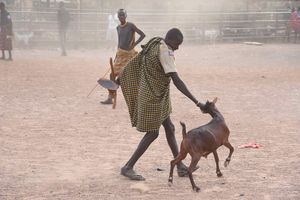
Mr Locham once owned more than 100 goats and sheep. However, he now remains with only four. Some died in the fields. Others collapsed on the 70-kilometre journey to Lodwar market. Some were taken by wild animals.
“These trees used to give us materials for thatching and weaving mats. Now we rely on them for shade, food and pasture,” Mr Locham said.
Across all 11 sub-counties of Turkana, this is the same situation. From Turkana North to Loima and Turkana East, traditional water sources have dried up, and pasture has disappeared, leaving livestock weak and vulnerable.
Herders have been forced to migrate hundreds of kilometres toward Ethiopia and Uganda in search of water and grazing land.
Those left behind are the elderly, children, and women, the least mobile, and increasingly the most vulnerable.
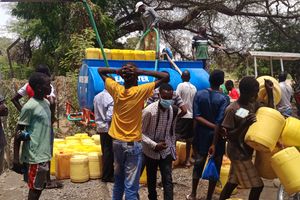
Water scarcity is severe and overcrowded boreholes have been vandalised or overused, while traditional scoop holes and shallow wells provide inadequate and often unsafe water.
Livestock markets, once the backbone of the pastoral economy, are flooded with emaciated goats and sheep, with prices crashing by up to 60 percent A goat that sold for Sh13,000 now struggles to fetch Sh5,000. Many herders cannot afford feed for their weakened animals and some livestock die before reaching markets.
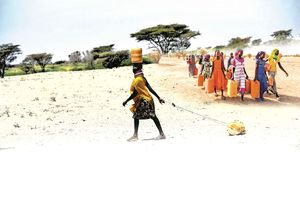
Women and children walk for hours daily to fetch water, sometimes risking their lives in unstable wells. Children as young as 10 are digging their own wells to help families survive.
The elderly, the sick and disabled who cannot migrate face extreme hardship. Many spend their days under sparse shade in dry riverbeds, surviving on soaked palm fruit and credit from local shops.
Relief food programmes have reached some communities but remain inconsistent, leaving vulnerable families without reliable support.
In nearby Nakaalei village, where President William Ruto launched a relief food distribution and livestock offtake programme in November 2022, elderly residents who can walk have become beggars for food.
Residents say at least 100 elderly people, abandoned, sick, or living with disabilities, require urgent support. When well-wishers visit, they ensure the frail are prioritised.
76-year-old widow Abel Lokala Mekede recalls receiving maize, beans and free meat through the Kenya Red Cross on the last visit in 2022.
“I appeal to the government to come to our aid again. I am starving,” she said.
For the past week, Ms Mekede has been confined to her unfenced compound after a scorpion sting. She crawls from her manyatta to the single tree in her yard, shifting her position with the moving shade.
“At the moment, I cannot go to beg for food from neighbours. If there was food in the village, the faces of desperation would be replaced with joy and satisfaction,” she said.
Lokai Ekeno, 35, walks her children past a bare, deserted trading centre following a prolonged drought spell in Loperot village in Turkana County, February 16.
Photo credit: Pool
67-year-old Louriem Ng’ikaruka, who has a hearing impairment, was fortunate to receive 37.5 kilogrammes of sorghum from a humanitarian agency last week. She is cared for by her daughter, Ms Alice Lokwawi, who supports a household of 13 through weaving mats sold for Sh100 each.
Ms Lokwawi spends the first day sourcing duom palm leaves from the seasonal riverbed. After drying them, she weaves late into the night. Each mat sells for Sh100 after what she describes as a hectic encounter.
“We survive on credit from local shops. After selling the mats, that is when we pay,” she said.
“I am not allowed to take goods worth more than Sh200 after clearing previous debt. A balanced, nutritious meal is not within our reach. We mostly survive on white rice,” she explains.
For 90-year-old Yakalel Ewotol Loririkiriki, hosted by his late friend’s family, meals are uncertain. He cannot remember the last time he ate breakfast, lunch and supper in a single day.
“I appeal for relief food before the situation worsens,” he said.
The relief food distribution and livestock offtake programme that was launched in the village by the President was an effort to cushion families against hunger. Residents believed their location, at the intersection of Turkana East Sub-County, Turkana South Sub-County and Turkana Central, would ensure they remained a priority for aid.
Kebo Ngikimo 71, feeds her grandson Bernard Ekiru 1, with a crashed wild doum palm fruit (Hyphaene thebaica), following a prolonged drought spell inside her Tukul shelter in Loperot village in Turkana County, on February, 16.
Photo credit: Pool
In Kalapata village, residents recall receiving maize and beans in August last year. A more recent distribution of sorghum and green grams did not reach many of them.
The hardship is acute for men such as Lodio Bukang’or, who must provide for two elderly wives, but has no livestock and cannot travel to neighbouring villages when rumours of relief food circulate.
Further afield in Kochuch village in Loima Sub County, 84-year-old Longumo Adokoro is left with only three goats, the last evidence of a life built on pastoralism.
“I have lost 15 goats since December. The remaining three are emaciated. I do not think they will survive the next week,” he told Daily Nation.
Along the dry Kochuch seasonal river, there is no pasture and the scoop holes that once held water have turned to dust. His peer, Lodio Achumunyang, is down to four goats.
“Our village is near Turkwel centre along the Lodwar-Moroto road. When we sell goats, we are assured of daily meals,” he said.
“Now the goats are too weak to even reach the centre. We will starve to death if we are not given relief food and supplementary feeds for our remaining livestock,” he said.