The planned resumption of petroleum activities in Turkana County this year is facing a critical obstacle—the poor state of the Kitale—Lodwar highway, a key transport corridor repeatedly cut off by floods and seasonal rivers.
Disruptions to transport along the busy Kitale-Lodwar road in March, after heavy rains cut off the Morpus section in West Pokot County, have renewed concerns as the Turkana oil exploration project prepares to resume.
Gulf Energy, which acquired Tullow Oil Kenya’s assets, plans to begin commercial production in Turkana’s Block T6 and Block T7 by December 2026.
The project will rely heavily on the highway, despite its numerous seasonal rivers and lack of bridge, to transport about 20,000 barrels per day (bpd) using a fleet of approximately 600 trucks until 2032, before scaling up.
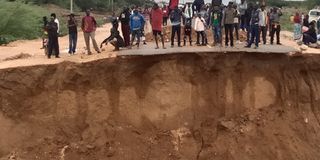
The rains have destroyed a huge section of the Kitale-Lodwar road.
Photo credit: File | Nation Media Group
On March 23, the Kenya National Highways Authority (Kenha) confirmed that a section of the Kitale-Lodwar (A1) road had been temporarily cut off at Ortum in West Pokot County following heavy rains across the country.
Motorists were advised to use an existing diversion as the affected section was being desilted and backfilled.
Kenha Director-General Luka Kimeli said the damage had rendered movement between Chapareria and Sebit towards Lodwar unsafe for motorable traffic.
“The section had earlier been cut off. Our teams remain on site to monitor the situation and undertake any necessary works to ensure continued safety and stability of the road,” he said.
The disruptions led to shortages of food supplies and critical commodities such as fuel in Turkana County.
In 2019, Tullow Oil was forced to suspend the Early Oil Pilot Scheme due to severe damage to sections of the Kitale-Lodwar road caused by adverse weather.
At the time, the road was also temporarily cut off at Ortum in West Pokot County.
Subsequent repairs have offered only temporary relief, with motorists now renewing calls for the government to rebuild the road and construct bridges across seasonal rivers.
Key sections include the Lokori-Lokichar road and the Lokichar–Morpus stretch, where the lack of bridges often forces travellers to wait for hours for flash floods to subside.
“With the national government intensifying efforts to commercialise oil production in Turkana by December, where trucks will move crude oil from the oilfields to the Kenya Petroleum Refineries Limited (KPRL) facilities in Mombasa for storage before export through the Kipevu Oil Terminal- it is time to ensure seamless transport through an improved road network,” said Mr Simon Egiron, a local driver.
He added that with the expected increase in truck traffic along the highway linking Kenya and South Sudan, the road should be widened and all critical bridges constructed.
“It is now common to spend more than eight hours at Kalemngorok centre whenever the seasonal river floods. Intense flooding disrupts transport and business, with motorists sometimes stranded for an entire day until water levels subside,” he said.
Mr Egiron noted that existing drifts are frequently submerged during floods and should be replaced with permanent bridges.
Turkana County government officials inspect Kotome bridge in Turkana North Constituency on April 11, 2021.
Photo credit: Sammy Lutta | Nation Media Group
Another driver, Mr Peter Lolimo, recalled being stranded overnight last December when the Kalemngorok seasonal river burst its banks, rendering the drift impassable for more than 15 hours.
“One driver heading to Kapenguria attempted to cross the 50-metre-wide river before dusk to beat the night curfew at Kainuk, but his lorry was swept away by raging floods, forcing bystanders to rescue him,” Mr Lolimo said.
He urged the National Government, through the Ministry of Transport, to prioritise reconstruction of the A1 highway, particularly between Lokichar and Kapenguria, similar to improvements made on the Lokichar-Lokichoggio section with World Bank support.
“Travelling from Lokichoggio to Lokichar is now smooth throughout the year. Before the Kawalase Bridge was constructed, the Kawalase River would paralyse transport between Kenya and South Sudan whenever it flooded, causing significant losses of perishable goods such as fish, vegetables and fruits,” he said.
Residents of Kalemngorok also raised security concerns, noting that the area is prone to banditry and is often cut off from Lodwar-the county headquarters—during floods, limiting access to healthcare and humanitarian assistance.
Mr James Kisike, a resident, said locals have repeatedly petitioned the government through Kenha to construct a bridge across the dry riverbed.
“We need a bridge to facilitate security patrols during the rainy season, as police from Lokichar are often called in to respond to bandit attacks,” he said.
The development of the road, part of the broader Multinational Kenya-South Sudan Road Corridor (Lesseru–Kitale (B2) and Morpus-Lokichar (A1) roads) has faced significant setbacks, largely due to financial constraints, including inadequate budget allocations and delayed disbursements from the National Treasury. These challenges have slowed construction and forced contractors to halt work intermittently.