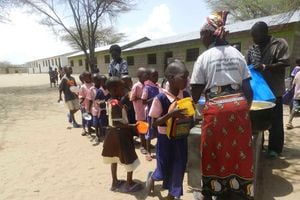
From Kapedo to Alem in Baringo County, learners walk long distances to school under scorching sun, not to quench thirst for knowledge but for the guaranteed meal at school.
The school feeding programme run by the government serves two purposes: providing nutrition for the learners and retaining them in school.
However, as drought continues to ravage many parts of the country, hunger is keeping children out of school in arid and conflict-prone pockets of Turkana and Baringo counties.
The school feeding programme, once a lifeline for learners, is faltering, and as a result, classroom attendance is dwindling.
Pupils of Kapedo Girls Primary School in Suguta Sub-County, Turkana County carry their desks to their classrooms on February 03, 2025 after the school reopened.
Photo credit: Jared Nyataya | Nation Media Group
At Kapedo Girls Primary School, located on the volatile border of Turkana and Baringo Counties, the school kitchen has been without activity since schools opened. Classrooms that previously hosted at least 20 learners now average just five.
“It is normal for a pupil to wake up and stay home because parents confirm that there is no food,” James Lokuwam, the head teacher told Daily Nation .
“Parents here are victims of banditry attacks, with no reliable livelihoods, and are waiting for the school meal as their only decent meal of the day,” Mr Lokuwam explained.
Esther Mateo, a resident, pointed out that Kapedo Girls had only recently reopened after more than a decade of closure forced by banditry attacks.
“Our livestock, the only source of livelihood, were driven away and many women widowed. Schools here should be prioritised for feeding programmes to encourage parents to send children to school to reduce retrogressive cultural practices such as cattle rustling,” she said.
Many families relocated their children to safer towns like Lokori, Lokichar, and Lodwar, despite expressing gratitude that the school had been rehabilitated.
Mr Lokuwam remains hopeful that food will be delivered, noting that other schools in the county have already received their rations.
The situation is mirrored in Tiaty Central, also in Baringo County, where children, like seven-year-old Krop Lokwee, begin the day with a bowl in hand, not a book, because food, not education, is what determines whether they survive the day.
Lokwee walks more than four kilometres each day through bushes and rugged terrain to reach Alem Primary School. For him, carrying a book is secondary - his bowl is the priority.
However, the school has depleted its rations received from neighbouring Nyakwala Primary School, leaving the learners to go hungry.
The head teacher, Shadrack Kamama explained that the school, with over 128 learners, was not factored into the feeding programme.
Chesakam Primary School, with more than 200 learners, received only one bag of maize and beans this term.
“If there is no food, many children will drop out. In such remote areas, girls may end up married off early, and boys turned herders,” said the head teacher Jack Limakok.
Riong’o Primary School in Tiaty East, with over 400 learners, including 88 boarders, faces a similar predicament. Some of the girls in boarding were rescued from early marriage, but the school now struggles to retain them without a dependable feeding programme.
Canon Christopher Chochoi addresses the girls at the rescue school on October 08, 2022.
Photo credit: Jared Nyataya | Nation Media Group
Meanwhile, schools in Turkana South Constituency that are located in similarly volatile areas reported better access to food. Kakong and Nakwamoru Primary schools received maize, beans, cooking oil, salt, and rice in the first week after opening.
But the wider feeding programme has been under strain for years. In November last year, Mary’s Meals Kenya, which had supported daily meals to at least 183,639 children across Turkana County, announced it would halt its operations.
The programme had covered 793 Early Childhood Development Education (ECDE) centres, with additional feeding centres targeting children highly susceptible to hunger due to prolonged drought. From 2026, the programme will be delivered through the Diocese of Lodwar.
Since the National Council for Nomadic Education in Kenya (Naconek) took over the school feeding programme in 2024, the programme in Turkana has narrowed its focus to ECDE centres, leaving many primary schools without support.
“We are experiencing a worsening drought where many families face starvation, and food in schools is often the main meal for children, especially in remote areas,” he explained.
The education director stressed the need for coordination with the Ministry of Interior and local administrators to ensure children are not left at home, while warning head teachers against selling food meant for the programme.
Parents, however, say delayed food distribution fuels malnutrition and school dropouts, particularly among pre-school and primary learners.
“We have been facing delays from both the county and the national government. Vulnerable learners who rely on school meals are missing out, which affects retention,” said Mr James Ekitela, a parent in Lokichar.
The 2025/2026 national budget worsened the school feeding programme crisis. Funding for the National School Meals Programme was reduced to cover only 60 per cent of school days.
Inflation and rising food costs, especially maize and beans, have made it difficult for schools to maintain consistent meals.
Uasin Gishu County government, whose budget prioritises bursaries and dairy programmes has also struggled to fill the gap. Some schools in the county have turned to alternative programmes, such as ‘Maziwa ni School Fees,’ which allows dairy farmers to pay fees via milk deliveries, primarily for ECDE learners.
Langas Primary School, which has over 1,800 pupils, participates in the ‘Tap2Eat Programme’ run by Food4Education (F4E), where each learner pays a subsidised fee of Sh20 per day.
The learners use NFC-enabled wristbands linked to virtual wallets via USSD codes to access meals, reducing the need for cash. Even then, the system excludes some children whose families cannot afford the daily fee.
Basic Education PS Belio Kipsang (second left), Uasin Gishu Governor Jonathan Bii second (right), Cooperatives PS Patrick Kilemi (right) and New KCC boss Nixon Sigei (left) during the launch of free school milk in Eldoret on May 23, 2023.
Photo credit: Jared Nyataya | Nation Media Group
In the heat-scorched hinterlands of Ganze in the outskirts of Kilifi County, the sound of a rhythmic metal clang against a discarded truck rim signifies more than just lunch; it is the bell of survival.
For thousands of learners in the region, the National Government’s School Feeding Programme is the primary reason they walk tens of kilometres through dusty thickets to reach the classroom. The promise of a bowl of githeri or porridge is the ultimate incentive for enrolment.
Kawala Secondary School Board member and chairman of the parents association, Justin Kaulu, said the school feeding programme keeps learners in school.
“In this school, education is a priority such that if parents do not have school fees we urge them to supply firewood in exchange for the fees. This ensures our children are fed and boosts enrolment. The school feeding programme is very important,” said Mr Kaulu.
At Jila Primary and Junior School, head teacher Samson Kahindi said the school feeding programme has boosted enrolment in rural schools. A typical day in the school starts with porridge taken at break time and later githeri at lunchtime.
“I have an enrolment of 910 learners who all depend on the school feeding programme. We receive funds in our school accounts from the Ministry of Education to feed our learners. But to supplement, we ask each learner to come to school with at least two pieces of firewood every Monday,” said Mr Kahindi.
Parents pay Sh20 monthly to pay the cooks. Apart from the National Government, the feeding programme is also supported by the county government and well-wishers.
The importance of school feeding in the Coast region cannot be overstated. In areas like Vitengeni, still in Kilifi County, where poverty and elephant invasions have decimated local crops, food is the primary driver of education.
Teachers report that before the programme was introduced, hunger-induced absenteeism peaked during the dry January to March season. Children would faint during morning assemblies or drop out to forage for wild fruits or engage in casual labour to help their parents buy food.
“The meal is the magnet between education and the learners. Food is what attracts learners to school. In class you might be teaching but a child is not concentrating because he or she slept hungry. Food has helped deal with absenteeism,” said Christine Kahasho, a teacher in Ganze.
In Mombasa, lunch is provided to public schools by the Food for Education organisation (F4E) and paid for by the County Government of Mombasa. The learners use digital watches to pay for the food.
The head teacher of Hindi Comprehensive School in Lamu, Ms Lilian Malika Kofa, said since introduction of the feeding programme by the government and well-wishers, it has greatly helped retain learners, mostly those from vulnerable families.
School children are served food under the school feeding programme. A feeding programne is in limbo after questions arose on the quality of food the education department bought for hungry schoolchildren in western Kenya.
Photo credit: File | Nation Media Group
“It has totally killed absenteeism and improved learners’ retention by almost 85 to 90 per cent,” said Ms Malika.
Apart from providing pupils with lunch, the school also ensures that the most vulnerable learners are given packed food for supper as they head home in the evening. Hindi Comprehensive School has an enrolment of 900 learners.
“Years back, you would follow up on a case of absenteeism and you’re told the child has accompanied their parents to look for food for the family. Today, those children are guaranteed lunch and even supper if they attend class. Learners no longer have reason to miss classes unless they’re sick,” said Ms Malika.
At Mokowe Arid Zone Comprehensive School, the head teacher Mr Charles Mzee said enrolment has continued to increase due to the implementation of the school feeding programme.
“There are 940 learners, out of which 214 are from Basuba in Boni Forest,” said Mr Mzee.
He said whenever there is a delay in dispatching food by the government, the school collaborates with parents and other stakeholders to ensure continuity.
“Scrapping the programme is similar to killing the morale of the children in schools,” said Mr Joseph Agutu, the head teacher at Lake Kenyatta Comprehensive School.
Reporting by Florah Koech, Sammy Lutta, Titus Ominde, Winnie Atieno and Kalume Kazungu