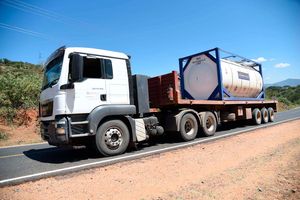
As Gulf Energy moves to acquire oil assets in Kenya’s South Lokichar Basin from British firm Tullow Oil Plc, Turkana residents are calling for greater transparency, community involvement, and protection of their rights before petroleum activities resume.
With Kenya’s petroleum sector entering a new phase marked by the exit of Tullow Oil and the entry of Gulf Energy, elders, civil society groups, and county leaders are demanding legal safeguards, frameworks for fair compensation, and respect for traditional structures to avoid a repeat of past grievances.
The transition, currently in its final stages, has triggered anxiety among residents, elders, civil society organisations and local leaders, many of whom are wary of repeating past experiences they describe as exploitative and exclusionary.
Public engagement forums on proposed amendments to the Petroleum Act and new regulations have revealed widespread concern over land rights, compensation, and environmental safeguards.
These concerns were raised during the public participation forums organised by the Energy and Petroleum Regulatory Authority (EPRA) and the State Department for Petroleum, which were held to discuss the Petroleum Act (Amendment) Bill 2025 and the Upstream Petroleum Regulations. The sessions were aimed at gathering feedback on new regulatory frameworks to guide petroleum activities in Kenya.
Elders in Turkana South and Turkana East have warned against repeating past mistakes, noting that petroleum activities previously divided communities and ignored cultural structures.
“I am worried about the return of petroleum activities because of the past experiences that were characterised by divide-and-rule strategies and uneven development among communities in Turkana East and Turkana South,” said Mr James Echuchuka, an elder from Lokori Town.
“Tullow Oil leaned toward Turkana South, yet many wells, including Ngamia 1, are located in Turkana East. We want assurances that this imbalance will be corrected and that we won’t be left behind again, under the new investor.”
He emphasised the importance of involving traditional structures, including elders, spiritual leaders and seers, in decision-making and land-related matters.
“There were times when seers and elders were not involved and petroleum activities were disrupted. In Kerio village, oil was found, but when elders were disrespected, the wells dried up. At Ngamia 1, operations stopped after a child died in an accident. When elders requested compensation and it was delayed, the project was halted,” Mr Echuchuka said.
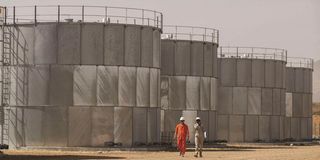
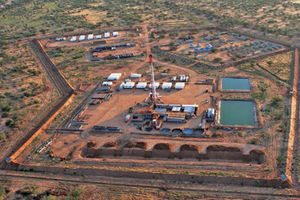
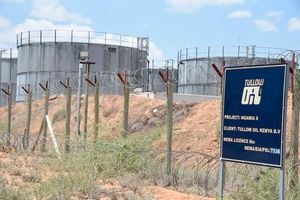
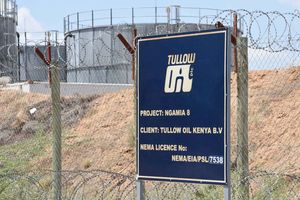
Tullow Oil facility at Ngamia 8 in Lokichar, Turkana County, on February 18, 2020.
Photo credit: File | Nation Media Group
He called for formal, conclusive consultations with traditional leaders before any new exploration begins, claiming that elected leaders who tried to act without consulting elders found hit dead ends.
Other elders echoed similar sentiments, highlighting concerns around land ownership and the lack of community consent in past engagements.
“Before the Early Oil Pilot Scheme was launched in 2018, three trucks left for the Coast without informing the community. The seers had to intervene to ensure procedures were followed,” said Mr Benjamin Ebenyo, the chairperson of the Turkana South Council of Elders.
“It is true we didn’t have documents back then, but now three communities—Nakukulas, Kapese and Lokichar—have title deeds. If they are excluded from compensation or consultation, it would be a grave injustice,” he said.
Civil society organisations are now pushing for stronger regulation and community benefits, urging lawmakers to strengthen regulations to prevent displacement, environmental degradation and exploitation.
“The regulations should include clear compensation guidelines for landowners and ensure the public is well informed,” said Eliud Emeri, the president of the Turkana Civil Societies Consortium.
“There is a clause saying anyone found on acquired land can be fined up to Sh1 million. That is a dangerous restriction given our nomadic lifestyle; it needs to be amended.
“We also need strict health and environmental protections. In the past, hazardous waste has harmed both people and livestock and polluted water sources,” he added.
Mr Emeri also criticised the lack of transparency around revenue collected from the Early Oil Pilot Scheme.
“Up to now, no one knows why the community did not receive a share of the proceeds. The new regulations should guarantee the development of pasture and water projects to minimise forced migration,” he said.
Mr James Namuron, a resident of Nakukulas village near the Ngamia 1 well, urged lawmakers to legislate the distribution of oil revenues.
“We need clear laws on how the community and county revenue shares are spent. Special hospitals should also be set up to treat those affected by hazardous waste,” he said.
Energy and Petroleum Regulatory Authority Director-General Daniel Kiptoo.
Photo credit: File | Nation
In response, EPRA Director-General Daniel Kiptoo said the government is committed to inclusive development.
“We are taking the community through proposed regulations to ensure petroleum activities are carried out in a sustainable and transparent manner,” he said. “We are in the final stages of transitioning from Tullow Oil to a Kenyan consortium led by Gulf Energy. This is an opportunity for Kenyans to take control of their resources.”
Mr Kiptoo encouraged locals to develop the skills and capacity needed to benefit from upcoming opportunities. “When we push for local content, it’s important that our people are ready with the necessary qualifications and experience,” he said.
Turkana Deputy Governor John Erus said the county has prioritised land rights and infrastructure, land registration, and environmental protections.
“We are working to ensure all land in the South Lokichar Basin is properly registered to avoid future disputes,” he said. “We also expect strong waste management policies, and we are empowering youth and women with skills to participate in the oil sector.”
Dr Erus called for unity among all stakeholders to avoid politicising oil development. “Our unity is critical. With collaboration between the national government, county government, and the community, we can build the infrastructure needed to make oil extraction beneficial for all,” he said.
Turkana Governor Jeremiah Lomorukai.
Photo credit: File | Nation
During a recent meeting with Petroleum CS Opiyo Wandayi, Governor Jeremiah Lomorukai said, “To achieve full field development and build a crude oil export route, we as leaders will remain united in pushing for a transparent and beneficial process for our people.”