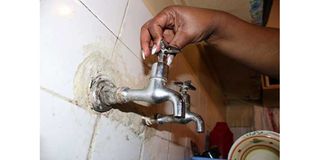
Eldoret City and its environs have been hit by fresh water shortages due to recurrent mechanical breakdowns, despite the principal water provider, Eldoret Water and Sanitation Company (Eldowas), hiking water tariffs by 300 percent to raise over Sh2.2 billion for infrastructure development and expansion of its services.
Many parts of the newest city, including the Central Business District (CBD), have gone without water for the last three days, sparking protests among residents over poor service delivery by the water firm.
“The water company needs to deliver services that befit the city status. There is need for proper financial management to ensure funds generated from the hiked water tariffs are utilised to facilitate a steady water supply,” said Gideon Kemboi from Langas estate.
The company management has attributed the interrupted supply to a burst on the main transmission pipeline from its Sosiani Treatment Plant.
“Our technical teams are conducting emergency repairs to help restore the supply,” said Dr Lawrence Tanui, Eldowas Managing Director.
According to a report by Auditor General Nancy Gathungu, the water firm is reportedly losing over Sh1 million daily in unbilled water and suspicious reversals of paid bills.
The water firm could have lost up to Sh963.4 million in cancelled water bills as at the financial year ended June 30, 2025, even as it aims to raise over Sh2.2 billion from the increased water charges for infrastructure development and expansion of its services.
“Although we generate Sh1.3 billion annually, Sh300 million is lost through illegal connections and leakages from aging infrastructure, and revenue from the new tariffs will enable us to improve service delivery,” explained Dr Tanui.
Eldoret city has been hit by recurrent water shortages, which have evolved from customary rationing to discoloration, generating protests from residents.
The challenges facing the water service provider reached a crescendo early this year when the firm was forced to temporarily interrupt water supply from the main Chebara Treatment Plant in Elgeyo Marakwet County after discoloration affected various parts of Eldoret city, raising concerns over health risks.
The late former President Daniel arap Moi in 1999 commissioned the Sh1.5 billion Chebara Dam, funded by the Belgian government, to help resolve water shortages in Eldoret, Uasin Gishu County. However, nearly 26 years later, the newest city still experiences recurrent water shortages.
The water firm continues to lose an estimated 18 billion litres of water annually due to illegal connections, translating to between Sh500 million and Sh1 billion monthly.
With a population of over 500,000, Eldoret is considered one of the fastest-growing urban areas after Nairobi, Mombasa, Nakuru and Ruiru, and requires an estimated 60 million litres of water per day against the current production of 43 million litres daily.
“There is need for the water firm to replace its aging infrastructure, blamed for the periodic water shortages and discoloration, and deliver water services befitting city status,” said David Kosgei from West Indies, Eldoret city.
According to the Auditor General’s report for 2023/2024, the water firm is already debt-ridden, with an outstanding loan of Sh256,666,667 for the Chebara Treatment Plant.
The firm’s outstanding debts stand at Sh528,199,121 (water and cleansing) compared to Sh597,404,809 in the last financial year.
“Eldoret Municipal Council (EMC) had borrowed Sh1.058 billion from KFW-Belgium to finance construction of Chebara Dam. This loan was not repaid by EMC, and when the company was incorporated, assets and liabilities related to the Department of Water and Sewerage were transferred. The company requested the National Treasury to restructure and reschedule the outstanding loan. The request was approved in June 2020, and the outstanding loan was reviewed to Sh312,496,364.40 alongside the repayment schedule,” said the firm in its report.
The company’s outstanding loans include expansion of the Chebara Treatment Plant (Sh279,319,644), Lessos water supply (Sh188,120,431), and Ellegirini/Kapsoya water supply (Sh656,879,132).
“The water shortage of about 13,000m³/day in Eldoret town and its environs is due to high demand as a result of ever-increasing population growth and development. There is also inadequate funding to improve and rehabilitate old infrastructure in an effort to reduce the high non-revenue water currently at 38 percent and initiate new expansion development programmes,” added the report.