A Moi Teaching and Referral Hospital (MTRH) employee has allegedly pulled off a Sh10 million heist by manipulating the government’s eCitizen payment system.
The suspect allegedly cleared patients’ hospital bills as paid while channelling the funds into her personal account.
Detectives in Eldoret City are investigating the scam that was carried out in collusion with an external accomplice, thus exposing serious weaknesses in the hospital’s financial controls.
Police describe the fraud, which involved Ms Jane Wangari Wachira, an MTRH staff member, and Khamisi Hussein Akida, her external accomplice outside the hospital, as a bold inside job that might involve senior officers in key departments.
The duo reportedly targeted unsuspecting patients seeking medical services at the hospital between January 1, 2025, and February 9, 2026.
According to Investigating Officer Edwin Chirchir, the suspects bypassed the hospital’s official government paybill, 222222, tricking and instructing patients to instead pay via cash or the accomplice’s personal M-Pesa account numbers.
Patients, unaware of the deception, believed they were paying their hospital bills legitimately.
According to preliminary investigations, the scam went on for more than a year before it was uncovered during an internal audit.
Detectives believe the duo could be part of a larger network that has been exploiting gaps in the e-Citizen digital payment platform. Senior officers in the hospital’s Finance and ICT departments are also being investigated to determine whether they provided the ‘technical backdoor’ that allowed the e-Citizen system to be manipulated.
Investigators explained that Ms Wachira exploited her insider position at MTRH to bypass internal checks and clear patient bills on e-Citizen without depositing the money paid by patients. Her exact position at the hospital has not been revealed.
“The suspect accessed the e-Citizen platform to purportedly ‘clear’ the patients’ bills without depositing a single cent into the hospital’s account,” he told the Eldoret Chief Magistrate during a hearing.
Meanwhile, her accomplice collected payments through channels, creating a cycle that left hospital administrators unaware of the missing funds.
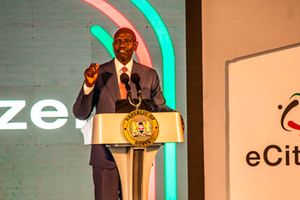
The State’s e-Citizen payment platform.
Once the bills were cleared on the system, official receipts were issued, and patients were discharged, even though no money reached the hospital accounts. Investigators say this created a financial gap of more than Sh10 million in the hospital’s accounts.
“Our preliminary investigations show that the respondents conspired to receive these funds by clearing bills on e-Citizen while pocketing the money,” Mr Chirchir stated.
“The suspects’ actions exploited both patient trust and hospital systems. Patients were cleared in the system and issued receipts, but the hospital never received the money,” he explained.
The scam was detected on February 5, 2026, when an internal audit of MTRH accounts flagged discrepancies and revealed the missing funds. The case was reported to the hospital’s police patrol base on February 9, under OB No. 13/9/2/2026.
Appearing before Eldoret Chief Magistrate Peter Ndwiga through a miscellaneous application, Mr Chirchir narrated how police managed to track the duo following a report filed at MTRH Police Patrol Base.
The court heard that upon his arrest, Mr Akida led detectives to Ms Wachira, identifying her as his co-conspirator working at MTRH as his insider.
However, detectives believe the two arrested suspects may be part of a larger network.
“We suspect that this is part of a larger network, and we will pursue all leads,” Mr Chirchir said.
They say the investigation is ongoing, and additional suspects, particularly senior hospital staff who may have facilitated the scheme, are likely to be named.
“We are analysing CCTV footage, mobile phone data, and bank and M-Pesa statements to trace the full extent of the syndicate. Key witnesses are yet to be recorded, and the Communications Authority of Kenya (CA) is assisting in tracing the digital trail,” Mr Chirchir said.
Moi Teaching and Referral Hospital in Eldoret City.
Photo credit: File
The court has granted police ten days to hold the suspects at Naiberi Police Station, with the next hearing set for February 26. They are expected to face charges of conspiracy to defraud and violations of the Computer Misuse and Cybercrimes Act.
Police say the scheme demonstrates vulnerabilities in digital payment platforms in the public sector, noting the need for robust audits, stricter supervision, and digital safeguards to prevent insider fraud.
“This is a wake-up call for hospitals and government agencies that rely heavily on digital payments. Without proper checks, insider fraud can occur even in major institutions,” Mr Chirchir said.
As investigations continue, police have urged other government institutions to review access controls and audit trails on e-Citizen and similar platforms to avoid similar fraud.
“Even widely trusted systems like e-Citizen can be compromised if internal controls fail,” Mr Chirchir cautioned.
The Communications Authority of Kenya has been listed as a third respondent in the case to assist with the digital trail.