The torn hospital bed sheets flutter like makeshift flags of distress. On one hand, young mothers cradle their babies. In the other, they wave these fabric remnants toward a phone camera, their voices unified in a desperate chorus: "Tunataka haki yetu" (We need our rights). "Tunataka kuenda nyumbani" (We need to go home).
The videos circulating on TikTok offer a glimpse into a world most never see: the maternity wards of Moi Teaching and Referral Hospital (MTRH) in Eldoret, where mothers and their newborns remain trapped not by medical necessity, but by unpaid bills.
Melvin Nyagoha,22, posted one of these videos from inside the ward where she has lived since July. What should have been a brief hospital stay for childbirth has stretched into a three-month ordeal with no end in sight.
"When I arrived to deliver my baby, the first thing they told me was to pay the Social Health Authority fees for a whole year within 24 hours," Melvin recalls. She had already received SHA's Lipa Pole Pole message and paid for four months, believing this would cover her hospital expenses. She was wrong.
"There was no option to pay later. We were asked to pay within that day of admission. Since I didn't have any money, I was admitted anyway."
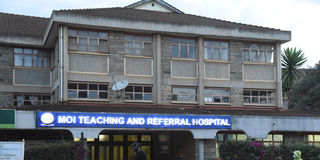
Moi Teaching and Referral Hospital. Teen mothers are being detained at the facility.
Photo credit: File | Nation Media Group
Now, nearly three months later, she remains confined with her baby in conditions that paint a stark picture of institutional healthcare gaps. "We sleep in shifts. Sometimes three people share one bed while others sleep on the floor. We have no diapers, no soap, no basic necessities. We have no money here to buy those items."
The overcrowding extends beyond her ward. According to Melvin, hostels at the facility house even more women in similar circumstances.
Her premature baby spent time in the newborn unit before joining her in the general ward. The extended stay has brought new concerns. "I'm worried that my baby's navel hasn't fallen off all this while, and she's getting infections with no proper treatment."
What began as a medical bill has become a mounting financial crisis. "I closed my file two days after admission, but the bill I've been given so far is about Sh72,000." With only Sh2,000 to her name, she attempted to negotiate. "I went to the billing department and paid what I had, hoping they would listen to me. My bill had shot up to Sh84,000. What am I supposed to do?"
The hospital's debt committee promised to consider bill reductions for discharge, but Melvin says they haven't honoured this agreement. Meanwhile, restrictions have tightened. "Before I posted my video, we were allowed to walk around and even go outside the gate. Now we've been restrained and cannot go beyond the hospital gates."
Eighteen-year-old Faith Jemutai arrived at the hospital when she was still 17, carrying the additional burden of having no identification card. Two months later, her bill stands at Sh57,000.
"Since I had no ID, SHA couldn't register me," she explains. The absence of this crucial document has compounded her isolation in ways beyond the financial.
"Life here is hard. Sometimes all the children in the ward fall sick together. I don't have enough breast milk. If we were at home, my child could have received proper nourishment."
Her personal circumstances add layers to an already difficult situation. "The father of my child denied responsibility. No one from my family has visited me here, not even once. I've tried calling my mother, but her phone has been off. I'm not sure if she's okay. She's my only parent."
The medical challenges have been severe. Her child once fell critically ill and required oxygen treatment. "I was restless. A well-wisher nurse paid Sh6,000 on my behalf to clear the child's admission."
The mathematical impossibility of her situation weighs heavily. "I don't even have Sh200 to buy diapers. How will I raise Sh57,000? If I were at home, I could work to ensure my child is okay. I can't do that here."
Melvin Felistus,18, shares a name with the TikTok poster, but her story carries its own particular hardships. Also hospitalised since July, she arrived unprepared for SHA's requirements.
"I came here with just two clothes for my baby, and those are the only ones we've had throughout this entire time."
Her baby has fallen ill four times during their three-month stay. When she herself experienced chest pains, doctors prescribed Amoxil but required her to purchase it out-of-pocket — money she didn't have.
Her bill has reached Sh70,000. While she lacks an ID for SHA registration, the father of her child is registered. This created a partial solution that ultimately highlighted the system's limitations.
Health Cabinet Secretary Aden Duale (left), accompanied by Uasin Gishu County Governor Jonathan Bii (second left) and other officials, during his visit to hospitals in the county. Duale later launched SHA-Taifa Care and Digital Health Ecosystem
Photo credit: Jared Nyataya | Nation
"We were told that his SHA card can only pay for my child and not for me. That's why I'm still here." The relationship didn't survive the mounting pressure. "He doesn't pick up my calls anymore. When he saw the bill rising, he bailed out."
Her connection to home grows more tenuous with each passing day. From Kakamega County, her father — her only surviving parent, who sells fruits for a living — cannot be reached because he doesn't own a phone.
Thirty-four-year-old Dorcas Nafula has been at MTRH the longest, since May 28. Her story illuminates how detained mothers face consequences that extend far beyond hospital walls.
When she left for the hospital, she entrusted her two children — one in Grade 4 and another in Grade 1 — to neighbours. Nearly four months later, she hasn't seen them once.
"When I arrived, they told me to pay annual SHA fees of Sh7,800. I don't have that kind of money. I'm a single mother who has to fend for herself."
The ripple effects of her absence have devastated her family. "My two children dropped out of school because there's no one to pay their fees. They only attended the second term because I had enrolled them before I left."
Updates from home arrive sporadically and bring little comfort. "My neighbours once told me that one of my children was hit by someone. I don't even know about their safety. My second-born cries over the phone when she calls."
The strain on her support system is showing. "They're tired of staying with my children. I don't know what to do."
For Dorcas, the contrast with the previous system is stark. "Linda Mama was more seamless compared to SHA. They never used to ask for anything. The only requirement was an ID."
Dr Abdi Mohamed, chairperson of SHA, acknowledged system failures when contacted about these cases. For underage pregnant women without SHA registration, he explained, "The hospital is at fault. SHA pays for underage mothers, and the system generates a temporary ID for them.
Regarding cases like Dorcas', where upfront payment was demanded, Dr Mohamed suggested these could result from "operational issues that the chief executive officer of MTRH can respond to."
He outlined SHA's revamped programme called Linda Jamii, designed specifically for teenage mothers like those detained at MTRH. "People shouldn't go to the hospital just when they need treatment and sign up for SHA. If a woman is pregnant, they should start preparation early. The hospital handles this registration for Linda Jamii during ANC visits."
MTRH Chief Executive Philip Kirwa admitted that mothers at the facility either lack SHA enrollment or cannot settle their bills. The hospital has established a credit committee "to enable disadvantaged patients to settle part of the medical bill and continue accessing healthcare services."
"The credit committee reviews patient status, and we waive bills for those found absolutely unable to pay," Dr Kirwa stated.
He noted seasonal patterns in teenage admissions. "Most admissions for teenage mothers occur in September and December, and most face challenges making payment for treatment. The teenage pregnancies occur during holidays, and some come from disadvantaged backgrounds, making it difficult to settle bills after seeking treatment."
Despite the documented cases, Dr Kirwa dismissed claims about detained teenage mothers at the facility. His advice remained procedural: teenage mothers should obtain documentation to process SHA and access treatment at affordable rates.