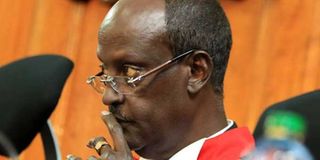
Supreme Court Judge Mohamed Ibrahim passed on in Nairobi on Wednesday, two days after returning to the country from India.
The judge, who was part of the inaugural Supreme Court team, was taken ill about three weeks ago and flown to India for treatment, according to a source.
He was hospitalised for a while before he was brought back to the country on Monday and taken to a city hospital where he was admitted at the Intensive Care Unit (ICU) until his death.
In her message of condolence, Chief Justice Martha Koome euologised him as a jurist of exceptional humility and integrity.
“Justice Ibrahim will be remembered as a steadfast guardian of constitutionalism, electoral justice, and human dignity. The Judiciary, the Supreme Court and the JSC mourn the loss of a distinguished jurist whose legacy bridges courageous advocacy and principled judging, and whose life exemplified fidelity to his oath of office, service to country, and compassion for the voiceless,” CJ Koome said in her message.
The Law Society of Kenya President Faith Odhiambo mourned Judge Ibrahim saying he served with "unparalleled grace and distinguished intellect".
"His rare calmness spoke of a man who fully understood the role of judicial authority as an opportunity to serve, and the nuances of justice as a tool for maintaining social order. His passing on is a big loss to the Supreme Court, the Judiciary, and to the administration of Justice in Kenya," Ms Odhiambo said.
She went on :"Since his appointment to Kenya's inaugural Supreme Court bench, Justice Ibrahim stood out as an independent, astute voice of reason. His sound contributions to Kenya's Jurisprudence portrayed great wealth of knowledge, depth of character and dedication to advancing the law. He will be dearly missed by all who experienced him."
Admitted to the Bar in 1982, he was the first member of the Kenyan Somali community to be admitted as an Advocate of the High Court of Kenya.
He practised law with notable firms before establishing his own practice and was deeply engaged in public interest litigation and civic advocacy during some of Kenya's most challenging political periods.
His work with organisations such as Kituo cha Sheria, the Lawyers Committeе for Human Rights, and as a founding trusteе of the Mwangaza Trust, reflected a lifelong commitment to access to justice, inclusion, and the defence of fundamental rights.
In 2017, Justice Ibrahim was taken ill during the hearing of the presidential election petition filed by Raila Odinga, who had challenged President Uhuru Kenyatta’s win.
The apex court eventually nullified President Kenyatta’s win, although Mr Odinga boycotted the repeat poll.
During the hearing of the petition, Chief Justice David Maraga informed the lawyers and advocates when they arrived in the courtroom ready for the hearing that the Judge, was being attended by his doctor.
But due to the time constraints, the other members of the bench had to proceed with the hearing.
Article 163 (2),of the constitution says the court is properly constituted for the purposes of its hearing, if it is composed or more than five judges.
Other Judges of the court then were Justice Maraga, Deputy Chief Justice Philomena Mwilu, Jackton Ojwang’, Njoki Ndung’u and Isaac Lenaola.
Justice Ibrahim was admitted to the Roll of Advocates in 1983 and practiced at the law firm of Waruhiu & Muite Advocates, and became a partner in 1985.
He later established his own law firm and was among lawyers who agitated for the return of multiparty politics.
During the vetting of Judges and magistrates, Justice Ibrahim survived after he promised to clear a case backlog of more than 200 judgments and rulings.
He was forced to give an undertaking to the former Chief Justice Willy Mutunga that he would complete the judgments he had left behind, as a condition to be allowed to continue serving as a judge.
Some of the cases had been pending for more than five years, and in some station like Eldoret, where he had already left. He also served as a judge of the High Court in Nairobi and Mombasa.
In one of the decisions of the Supreme Court decision, judge Mohammed Ibrahim and William Ouko made a dissenting opinion on the registration organization to champion the rights of Lesbian, Gay, Bisexual, Transgender, Queer or Questioning (LGBTIQ) persons in Kenya.
The two judges agreed that the government could not allow registration whose mission was furthering an illegality.
They said the NGO Co-ordination Board was proper in its decision to reject the five names proposed by Mr Eric Gitari for registration of the organization.
Mr Gitari sought to reserve for registration of an NGO in any of the names: “Gay and Lesbian Human Rights Council”; “Gay and Lesbian Human Rights Observancy”; “Gay and Lesbian Human Rights Organization”; “Gay and Lesbian Human Rights Commission”; “Gay and Lesbian Human Rights Council and Gay and Lesbian Human Rights Collective”.
Justices Ibrahim and Ouko, in their dissenting judgment, observed that the decision of NGO Coordination Board was primarily to be the prevailing penal system that outlaws acts that may be associated with the proposed names.
“In the face of Sections 162, 163 and 165 of the Penal Code, it is unfathomable how Mr Gitari would have been expected to proceed to reserve a name or register an association whose proposed name or whose expressed objects are in furtherance of activities that are contrary to or inconsistent with the law,” said the judges.
The said decision to reject the proposed names was not unreasonable, irrational, unlawful or disproportionate.
They said use of the phrase “any kind” intended by the framers of the Constitution and Kenyans did not mean to include associations whose activities are inconsistent with the Constitution or contrary to the law.
“There cannot be, for instance a right to freedom of association to form, join or participate in the activities of an association whose expressed objective would offend members of a particular community, religious, ethnic or racial group or whose name is obscene, offensive, hateful, derogatory or defamatory; or to adopt names of a proscribed group,” said the judges.