Uasin Gishu's coffee gamble: County targets South Korea in ambitious farming shift

Uasin Gishu County Governor Jonathan Bii (left), Sera Park second from right), Officer of Nowon Gu in Seoul, South Korea, who is also a Member of the Coffee Critics Association in the country, Jiyoung Park (slightly hidden), the Marketing Director of the Coffee Critics Association, and Meshack Malakwen, from the Presidential Advisory on Coffee, during a meeting at the Governor’s office in Eldoret City, Uasin Gishu County, on November 23, 2026.

Uasin Gishu is seeking to break away from its traditional dependence on maize and wheat farming by positioning coffee as a new high-value cash crop, with South Korea emerging as a potential export market.
The county government is courting investors from Seoul, South Korea, in a proposed partnership that Governor Jonathan Bii Chelilim says could open international markets for local farmers and transform the region's agricultural economy.
During a meeting with the South Korean delegation at the county headquarters on Monday, Dr Bii said the time had come for farmers to diversify from grain production and embrace crops with higher income potential.


"We want to change the culture of growing grains to coffee because this is a high-value crop that will change the fortunes of farmers in our county," Dr Bii said.
The proposed partnership is expected to create market opportunities for coffee farmers, with the Korean investors expressing interest in sourcing produce directly from Uasin Gishu.
The initiative comes as the county steps up efforts to expand coffee production across its six sub-counties, seeking to tap into what officials describe as favourable climatic and soil conditions for the crop.
The move towards coffee farming comes amid a wider shift in the North Rift, traditionally regarded as Kenya's grain basket, where farmers are increasingly reducing acreage under maize and wheat in favour of higher-return cash crops such as tea, coffee and sugarcane.
Rising production costs, erratic weather patterns and unstable maize prices have made cereal farming increasingly challenging, prompting farmers to seek more predictable returns from alternative crops. However, the changing agricultural landscape is raising concerns over the country's food security, given the region's critical role in supplying maize and wheat to the national market.
Uasin Gishu County Coffee Development Officer Nicholas Maritim said the region has suitable agro-ecological conditions for coffee growing, with altitudes ranging from 800 to 2,700 metres above sea level.
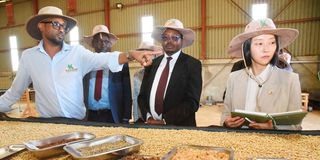
Sera Park (right), Officer of Nowon Gu in Seoul, South Korea, who is also a Member of Coffee Critics Association in the country, Uasin Gishu County Chief Officer for Agriculture Elphas Kesio (centre), and other officials look on as Charles Boit (left), Managing Director of Kapsuswa Coffee Estate in Uasin Gishu County, explains about coffee berries samples at the factory during a visit by the delegation, after they met Uasin Gishu County Governor Jonathan Bii.
The county receives between 900mm and 1,200mm of rainfall annually, with peaks in April and May, as well as August. Annual temperatures range between 8.4 and 26 degrees Celsius.
Maritim said coffee could thrive in all six sub-counties – Ainabkoi, Kapseret, Kesses, Moiben, Soy and Turbo – providing an opportunity to expand production beyond the traditional grain-growing areas.
The county currently has 1,686 hectares under coffee cultivation, with officials saying research conducted on the soils has confirmed their suitability for the crop.
"We have conducted thorough research on our soils and everything is favourable for coffee production," Maritim said.
The county is promoting Arabica coffee, with varieties including Batian, Ruiru 11, SL28, SL34 and K7.
To encourage farmers to take up the crop, the county government has distributed more than 2.5 million coffee seedlings over the past three years.
It has also strengthened agricultural extension services, providing farmers with training on coffee establishment and management, pest and disease control, as well as harvesting techniques.
However, the county's production figures point to significant room for improvement.
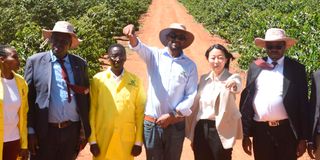
Sera Park (second from the right), an officer of Nowon Gu in Seoul, South Korea, who is also a Member of Coffee Critics Association in the country, Uasin Gishu County Chief Officer for Agriculture Elphas Kesio (right), and other officials are shown a coffee plantation by Charles Boit (centre), Managing Director of Kapsuswa Coffee Estate in Uasin Gishu County, during a visit, after they met Uasin Gishu County Governor Jonathan Bii.
According to Maritim, smallholder farmers currently produce an average of 769kg per hectare, while estate farmers achieve 3,964kg per hectare, against a potential yield of 6,428kg per hectare.
The proposed Korean market partnership is expected to provide an additional incentive for farmers to invest in the crop by offering access to international buyers.
Dr Bii said the county's transport infrastructure, including Eldoret International Airport, the railway line and road network, would support the movement of coffee to local and international markets.
"We are the City of Champions and once we venture into coffee farming, we shall take over the sector and become number one in the country. Our county has good roads, an international airport for quick exportation and a railway line," he said.
However, the county still lacks a coffee milling plant, a gap the governor said the administration was working to address.
Dr Bii said plans were underway to establish a milling facility that would support value addition, quality management and improved access to markets.
"Right now we don't have a milling plant but we are setting up one so that once completed, it will promote value addition and quality management, improve market access and farmers' bargaining power, and increase farmers' returns through better marketing opportunities," he said.
The South Korean delegation said its domestic market was ready to receive Kenyan coffee, citing the country's strong coffee consumption culture and appreciation of Kenyan produce.
Sera Park, the director of External Corporation from South Korea, said Kenyan coffee was highly regarded in her country, where coffee festivals and competitions are held annually.
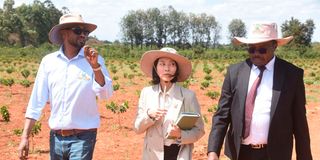
Sera Park (centre), Officer of Nowon Gu in Seoul, South Korea, who is also a Member of Coffee Critics Association in the country, Uasin Gishu County Chief Officer for Agriculture Elphas Kesio (right), are shown a coffee plantation in various level of maturity by Charles Boit, Managing Director of Kapsuswa Coffee Estate in Uasin Gishu County, during a visit, after they met Uasin Gishu County Governor Jonathan Bii.
She said Kenyan coffee had consistently performed well in the competitions, presenting an opportunity for Uasin Gishu to secure a share of the market.
"Our country always hosts coffee festivals and coffee competitions every year and from the competitions, Kenyan coffee has always been emerging as the winner. This will give you (Uasin Gishu) a high chance of our markets buying coffee directly from here," Ms Park said.
The county's push into coffee farming also comes amid efforts to improve earnings from the crop, following an announcement by President William Ruto that the price of a kilogramme of coffee had doubled from Sh60 to Sh120.
Nationally, coffee production and earnings remain concentrated in established growing regions.
Kericho County led in coffee deliveries by volume, supplying 6,624 metric tonnes to the Nairobi Coffee Exchange during the 2025/26 season, while Kirinyaga emerged as the leading county in earnings, generating Sh7.48 billion during the same period.
Uasin Gishu hopes that expanding coffee production, securing reliable export markets and investing in processing infrastructure will help it establish itself as a major player in Kenya's coffee industry.
In neighbouring Trans Nzoia County, within Kenya's traditional maize belt, farmers are also increasingly turning to coffee, buoyed by the revival of previously collapsed cooperative societies and more attractive returns.
The shift towards alternative cash crops is also unfolding against a backdrop of mounting uncertainty in maize production, with drought-related crop losses leaving some North Rift farmers reluctant to plant again despite government subsidies on fertiliser and certified seed.
Rising production costs, unpredictable rainfall and mounting debts have heightened the risks of cereal farming, pushing farmers to reconsider their investments as they seek more reliable sources of income.
Agricultural experts have previously warned that continued reductions in land under staple food production could weaken Kenya's capacity to meet domestic grain demand, exposing the country to increased reliance on imports, potential shortages and higher consumer prices.
Uasin Gishu's proposed expansion of coffee farming therefore presents a broader policy dilemma: how to improve farmers' earnings through diversification without undermining the region's traditional role as a major food-producing zone.
Follow our WhatsApp channel for breaking news updates and more stories like this.