AI-powered innovation promises to give Kenya’s exports a digital trail
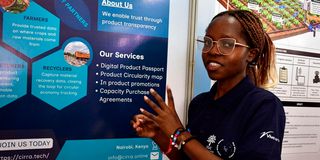
Hannah Muriuki a student of University of Nairobi (UoN) explains how the CIRRA OS system, which is an end to end traceability platform for goods at the Agricultural Trade Fair on October 03, 2026.

A small QR code attached to a packet of coffee, a crate of avocados or a box of Kenyan fruits could soon reveal the product’s full journey. With a scan on a mobile phone, an overseas buyer could know where the produce came from, who made or grew it, how it was produced, its carbon footprint and the journey it took before reaching the international market.
This is the idea behind CIRRA OS, a digital traceability platform developed by Hannah Muriuki, a Geospatial and Space Technology student at the University of Nairobi. The platform is designed to give products a digital identity that follows them from production through distribution and sale, and eventually to recycling or disposal.
And for the Kenya's export-oriented horticultural sector, the technology comes at a time when international markets are demanding more information about the products they buy. The European Union is moving towards Digital Product Passports for major product categories, creating pressure for exporters to maintain verifiable digital records about their goods.


Hannah sees an opportunity for Kenyan farmers and exporters to use such information not only to comply with market requirements but also to strengthen their bargaining power.
“If we are able to solve this problem for them and make it easier for them to continue accessing the market, access premium markets and bargain for better prices using information that proves the production process was hard, then we are also able to support and protect our agricultural industry,” she says.
Coffee, tea, avocados and other horticultural produce are among the products she hopes to bring onto the platform. For a buyer in the United States looking for Kenyan coffee, for example, CIRRA OS could provide a digital window into the product's journey without requiring the buyer to travel to Kenya to visit farms. The youthful innovator reveals that she has already started working with coffee and tea cooperatives.
The buyer, she states that can scan the QR code and access information about the origin of the coffee and the production process. The record could help explain why a particular product commands a premium price while giving the buyer confidence about its source.
According to Hannah, the idea started with a simple question: how can geospatial technology solve a real problem facing producers? As a student of Geospatial and Space Technology pursuing a Degree, she was looking for a project that could make practical use of data when she began developing the concept last year, ahead of a conference at the University of Nairobi.
She had observed that farmers and producers often struggled to get the highest possible price for their products, particularly when selling into international markets. “One thing that farmers in Kenya, or producers generally, face is that their products do not get the highest price they deserve,” she says.
She envisions that a verifiable digital record could help change that. A farmer producing a premium commodity could have evidence showing how the product was grown, the time taken to produce it and the processes involved. Instead of simply asking an international buyer to trust claims about quality, the producer could point to a digital record.
“If we ask for $12,000, we are able to show you that the reason why we are asking for this $12,000 is because there is a farmer who worked day and night to make sure that they have all of the factors necessary for growing this kind of product and really trying to make sure it's of the best and the premium quality,” she explains.
But agriculture was not where CIRRA OS began. Hannah’s original idea focused on electronic waste. She wanted to use geospatial information to make it easier for recycling companies to locate discarded electronics.
Electronic waste is frequently scattered across different locations, making collection and recycling difficult. She reasoned that if the location and identity of discarded electronics could be digitally captured, recyclers could more easily find the materials they need.
That concept eventually evolved into a wider traceability system capable of following different products through their life cycles.
At the centre of the platform is the Digital Product Passport. Producers provide information about their products, including their origin, manufacturer details and carbon footprint at production. The information is then linked to a QR code attached to the physical product.
The QR code is encrypted to a URL that leads to the CIRRA OS website. A user scans the code using a mobile phone and is directed to the relevant product information.
As the product moves through the supply chain, different actors can scan the same code. A manufacturer, distributor or retailer can create a digital record of where and when the product was scanned.
The location data is then plotted on a circularity map. A manufacturer can use a dashboard to follow the movement of its goods, seeing, for example, when a product leaves Kericho, arrives in Nairobi and eventually reaches the United States.
“It means that when this other person who isn't able to maybe visit Kenya to actually visit the farmers, they just have this information just from scanning,” Hannah says.
The system is intended to provide more than convenience. It can also create a chain of accountability, she shares. If a consumer develops a problem after using a product, the digital record can help trace the product back to its manufacturer. Information about its composition and production can then help establish where responsibility lies.
The journey does not necessarily end when the product is consumed. The developer wants CIRRA OS to help create a circular economy in which materials are tracked beyond their first use. “A consumer with plastic packaging or another recyclable material can use the platform to identify a nearby recycler.
Once the material reaches the recycling stage, the original Digital Product Passport can be retired to indicate that the product's life cycle has ended,” she states.
If materials from the discarded product are used to make another product, the new item receives a fresh Digital Product Passport. This creates a digital connection between the new product and the recycled material from which it was made.
The concept is particularly relevant to mitigating climate effects, as Hannah believes better traceability can help reduce waste and improve recycling. “One of the problems we are facing is we do not know where to dispose of some of this waste like electronics,” she says. “Our project is really making it easier for the recyclers to access this waste and for them to actually recycle this waste.”
CIRRA OS is also being built with the growing use of artificial intelligence (AI) in mind. Hannah, 19, says the platform has been structured so that AI agents can access product information. A company searching for a particular Kenyan product could use an AI platform to find the product and potentially process an order using information stored in CIRRA OS.
The technology is still at the piloting stage. Hannah has started reaching out to tea and coffee cooperatives and other agricultural stakeholders, while also seeking to onboard recyclers. One of the companies she is working with is Eco Metals Limited, which is interested in locating recyclable materials and tracking the quantities it recycles, including information that could support carbon-credit calculations.
She hopes to bring more farmers, manufacturers, food producers and horticultural businesses into the system.
For the young innovator, however, turning the idea into a functioning platform has not been straightforward. One of her biggest challenges has been access to mentorship.
She says data-driven innovations are less familiar territory compared with projects such as automated irrigation systems, greenhouses and Internet of Things (IoT) applications. Building a business around data has therefore required her to learn how to turn a technical idea into a commercially viable solution.
“The challenges I have faced as a person is lack of mentorship and finances to advance my idea and enrich it through research,” she told Climate Action in an exclusive interview.
To create visibility of her innovative idea, she was among the attendees of this year’s Nairobi International Trade Fair which was held at Jamhuri Showgrunds, Nairobi. The event, organised by the Agricultural Society of Kenya (ASK), ran from September 28 to October 4 at Jamhuri Showground under the theme “Promoting Climate-Smart Agriculture and Trade Initiatives for Sustainable Economic Growth.”
CIRRA OS operates as a business-to-business platform. Manufacturers and producers pay a monthly subscription to have their product information hosted on the system and made available to consumers and potential buyers.
According to Hannah, her immediate plan is to bring more manufacturers and producers on board and establish partnerships with verification bodies and regulators, including the National Environment Management Authority (NEMA) and the Kenya Bureau of Standards (KEBS).
She says that her long ambition stretches beyond Kenya. She wants to work with more farmers across the country and eventually expand into other African markets and world at large, connecting producers with local and international buyers through a digital record that remains with their products throughout their life cycles.
Follow ourWhatsApp channel for breaking news updates and more stories like this.