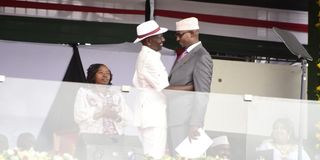
Wajir Governor Ahmed Abduulahi has lauded the national government for holding Madaraka Day celebrations in the county and the North Eastern region at large.
Speaking during the celebrations held at the newly constructed Wajir Stadium, Governor Abdullahi said the fete was been a blessing to Wajir, which he says is an underestimated economic zone.
“We fell greatly honoured to host this year’s Madaraka Day and it shall remain in our hearts for years to come,” he said.
The Council of Governors chairman said Wajir, which loosely translate to mean come together, is not just a geographical space but a strategic bastion.
“Wajir is nestled powerfully between Garissa and Mandera, Wajir has for centuries stood as a vital artery of trade, a historic crossroads connecting our Republic to our neighbours in Somalia and Ethiopia,” stated the governor.
He said Wajir has for long stood out among her peers attracting the colonial rulers back in the days.
“Long before colonial borders were drawn, Wajir was a prize to be won, a strategic stronghold and a fierce battleground where global empires, the British and the Italians, clashed. Today, this town is blessed with sacred historic sites for everyone to see,” he said.
Wajir remains a home to pioneer educational institutions in the country, including Wajir Full Primary School started in 1940s and Wajir High School, established in the 1960s.
He said the county had waited for long to get the national attention that it received on the June 1, 2026.
The celebrations attracted Kenyans from as far as Turkana and West Pokot who made their first visit to the northern Kenya.
Mr Domic Ikal from Turkana said together with others, they had spent six days on the road to arrive and witness history in Wajir town.
“It is refreshing and an achievement just to come to Wajir to witness have the town is. I am excited with development around and we need such development everywhere in the country,” Mr Ikal said.
Governor Abdullahi said, “This day marks a defining moment in Wajir ‘s journey. One that affirms its emergence from the margins into a recognized and valued part of kenya’s national story.”
The only thing Wajir missed for this event according the governor was the presence of the Late Raila Odinga.
“These celebrations loudly say that Wajir is no longer remote and peripheral; it is fully integrated into the country’s shared imagination and future,” he said.
He added: “ Wajir residents will remember this great honour bestowed upon us. They will remember you as the president who did what all thought was the unthinkable; rotating the hosting of national holidays and even more courageously deciding that northern Kenya and wajir for that matter will host Madaraka day.”
“For a long time, the people of the North Eastern Kenya have agonised albeit silently, about the question of belonging and identity. As a region, our post-independence history is often discussed through the lens of marginalization and judged by the images of drought ravaged livestock when rainfall fails, security related hardships and state-led citizenship challenges especially in obtaining identification documents and in old memories of exclusion.”
While revisiting the 1984 Wagalla Massacre, Governor Abdullahi urged the government to find a lasting solution to the victims.
“Numerous massacres were executed against the residents, the most heinous being the Wagalla massacre in Wajir in 1984. Others were the Malka Mari massacre in Mandera and the Garissa town massacre in Garissa referred to as "Garissa Gubay".
He said lifting of discriminatory vetting in the issuance of identification documents was a profound act of political courage.
“By removing the painful barriers of extra vetting and systemic profiling, you did more than issue identity cards to deserving Kenyans, you have restored dignity and their sense of belonging,” he said.
"The late Raila Amollo Odinga, my former party leader, and the late Minister Hon Ahmed Khalif. The late Raila was a true believer in devolution and was fond of Wajir County which he visited on numerous occasions."