Beneath the sun-scorched earth of semi-arid West Pokot County lies a fortune—gold that glimmers with promise but leaves behind a trail of ruin and devastation.
What was a blessing after the discovery of gold deposits in the region two years ago has turned into a thorn in the flesh.
The rise of illegal mining operations has introduced a host of problems that far outweigh the economic benefits, with exploitation, greed and a system rigged against the very people whose land yields the treasure being reported.
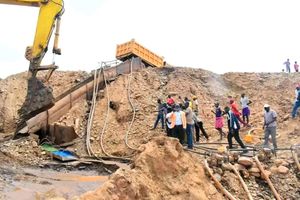
The mining sites at Lami Nyeusi area in West Pokot County on May 31, 2025.
Photo credit: Oscar Kakai | Nation
While a select few grow rich from the precious metal, thousands of small-scale miners and landowners are left grappling with dried-up wells, cracked farmland, and broken promises.
There are claims of a dark side to the boom, that the mineral sector is fuelling corruption, conflict, human rights abuses, and environmental damage.
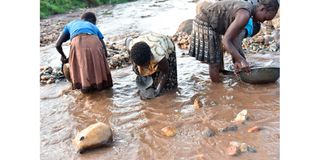
Pit holes and heaps of soil with a beehive of activity welcomes you in the gold mines of West Pokot County.
Residents knew about the new gold-mining venture in 2020 and sought to strike a jackpot, but it has become a death trap. Hitherto, dozens of people have lost their lives at gold mines while searching for the elusive treasure.
Massive tunnels of up to 500 metres deep have been dug, posing a serious risk to the lives of residents of Orwa, Kambi Karaya, Lami Nyeusi, Lous, Masol, Turkwel, Muruny, Seker and parts of Alale, limestone deposits in Sebit, Ortum, Muino within the county.
The areas are gradually becoming a melting pot, attracting both locals and foreigners who arrive in search of the precious mineral. Carelessly disposed soil from the mines have ended up deposited in the rivers, while leaving behind dangerous uncovered holes that threaten the environment and local livelihoods.
Residents cite exploitation by foreigners, environmental destruction, pollution, affecting education, land conflicts among clans and alleged graft where a section of government officers and leaders are said to be compromised.
Authorities have repeatedly warned about the dangers of unregulated gold mining, citing weak soil structures and a lack of safety measures that have led to frequent fatalities.
Nasolot Location Chief Michael Mwotor has called for stronger safety regulations, saying that residents are dying in the mines while seeking fortune. "We have seen too many deaths in these mines. The government must take action to ensure miners are safe. We cannot keep losing our people like this," he said.
There are also cases of human rights abuses and child labour at the mines. Workers are allegedly exposed to toxic chemicals.
Despite the ban and stern warnings from the government, fortune seekers have thrown caution to the wind, trooping to mines in search of gold. Nation has established that large-scale commercial mining activities are still ongoing in the region, with concerns over exploitation of residents and lack of safety measures.
The national and county governments have come under heavy criticism for failing to regulate gold mining activities in the region. The activities by rogue investors and brokers have left serious environmental destruction and exploited the local community, leaving a trail of deaths.
Two months ago, four people died after being buried alive at Kambi Karaya gold mines.
There is an alleged syndicate which is dealing with illegal large scale commercial mining of gold in the area especially using machinery that is not permitted without the necessary legal permits.
It is said that a few residents and local chiefs have collaborated with foreigners to take advantage of the community land to mine gold, with protection from compromised county security team and administrators who are said to be colluding with senior officers from the national and county government.
Among the investors and brokers are the Chinese and Somalis from the North Eastern region. Others are Kenyans from across the country.
At Loloi Primary School in Kampi Karaya, holes have been dug inside the school compound, posing a risk for learners.
Daudi Lomada, a resident of Lami Nyeusi, said that as residents die at the mines, foreigners, through a few committee members, have taken over the sites at the expense of locals. “There is a chopper that came here with big men and foreigners,” he said.
Anthony Rono, a miner said that foreigners have been exploiting and harassing them. “There is no peace here and they have been chasing us away. They don’t pay us well. We are paid Shs 500 in day. If they get you digging gold they mess around with you. We depend on gold because this is a semi-arid dry area where farming won’t take place,” he said.
“The committee members and chiefs collude with foreigners. Unreported deaths have been witnessed in debris. Initially the deaths in the gold mines were few, but they have now increased,” he said.
Enock Letreng, a miner, said that they are no longer getting profits from the mines. “They have been harassing us and enriching themselves. Many children are not going to school. Many have dropped out of school. They spent time in the mines From Monday to Friday. We had shunned banditry and now some people want to bring it back,” he said.
A concern has been raised over hundreds school children from West Pokot and Tiaty in Baringo counties engaging in gold mining activities. This has posed a threat to education as scores of pupils forgo school for labour, where they endanger their lives while searching for the precious metal.
Ms Mary Likiriko, a parent from the Orwa said the venture is ruining the lives of many children in the region.
Chairman of Artisanal and Small-Scale Mining Association of Kenya Oketch Sala on November 2, 2025.
Photo credit: Oscar Kakai | Nation Media Group
“Despite people benefitting from the venture, many children are absent from school to accompany their parents in the gold mines. Child labour is majorly reported in the region,’’ she disclosed.
Mr Samuel Murgor, the head teacher for Lonyangalem Primary School, said that many children in the region sneak from school to engage in mining.
“We have gold mine pits and a river near our school where mining takes place,” said Mr Murgor. He pointed out that the boys and girls wade barefoot in local rivers, scooping out sand and sieving it in turns, hoping to find gold nuggets.
West Pokot sub-County Deputy County Commissioner Wycliffe Munanda pointed out that the 2016 Mining Act is the primary law that governs mineral activities in mining.
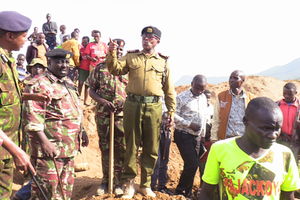
“Recently, seven Chinese nationals were arrested by the mining police and some jailed for one year and released after paying Sh3 million for being in the country illegally. We deported them back to China,” he said.
Mr Geoffrey Lowasikou, a lawyer based in West Pokot County said that there are many gaps in law in the undertaking of mining activities in the region.
“There was no public participation. Nema has not come out to enlighten the community on the aftermath of the activities. There’s need to fill the pits where mining is taking place,” he said.
It has also been revealed that the illegal miners are exempted from paying royalties as the money goes to the pockets of brokers and State officials.
A former West Pokot County mining officer Hashim Harun claims that a number of State officers are involved in the illegal mining activities.
"Many State officers are on the payroll. Some senior officers in Nema, Warma, security and members of the county assembly have been silenced," he said, noting that some officers sought transfer after a whistle was blown early this year.
"Chiefs and national police reservists threaten locals that the venture is legal and the senior people in Government are involved. The chain is long from bottom to up. They did away with the county mining office to create loopholes for corruption. The regional mining office is aware and the perpetrators went for transfer. Security officers go to the site to collect money. The investors cough millions every month for bribing protectors," he said.
West Pokot County National Environmental Management Authority (Nema) Director, Protus Musawa said that all mining activities taking place in West Pokot County are illegal.
"We only have four companies which we have issued licenses," he said.
However, stakeholders and investors through the Artisanal and Small-Scale Mining Association of Kenya (Asmak) have put measures in place to ensure West Pokot County residents benefit from the venture.
Association chairman Oketch Salah said cartels and brokers are exploiting residents in West Pokot by buying gold at poor prices, leading to loss of between 30-40 percent of the value of gold.
West Pokot County Mining Officer Brian Bundi said that the county government is committed to streamlining the mining sector to prevent exploitation and ensure fair returns for locals involved in small-scale mining.
Four months ago, the government suspended illegal large-scale commercial mining in more than 500 mining sites in West Pokot County.