Live update: Senators discuss governors snubbing summons

Labour and Social Protection Cabinet Secretary Alfred Mutua interacts with job seekers at the Kenyatta International Convention Centre, Nairobi on October 25, 2024.

Mbwana Ali, a 26-year-old from Shimoni in Lunga Lunga, Kwale County, was overjoyed when he received a text message confirming his recruitment for a cleaning job in Dubai under the government’s Kazi Majuu programme.
A Form Four dropout with limited job prospects, Mr Ali had pinned his hopes on this opportunity as a gateway to a better life.
“I had planned to work there for five to eight years, enough time to save and come back home to grow my agribusiness,” he told the Nation.

Job seekers fill out their forms at the Kenyatta International Convention Centre, Nairobi on October 25, 2024, during a mass recruitment drive for various job opportunities in Qatari companies.
Just days before he was due to arrive in Nairobi for processing, he says he received instructions from the recruitment agency requiring him to pay Sh30,000 for a mandatory medical check-up and document attestation.
“Where would I even get that kind of money? I applied because we were told the government would cover these costs through the Youth Fund then deduct the money from our salaries,” he said.
Ali was due to travel to Nairobi on June 9, 2025, but was forced to stay at home instead. His plans have now been put on hold indefinitely.
He is not alone. Ali is one of hundreds of young people from Kwale, Kilifi and other coastal counties who are now turning down job offers under the Kazi Majuu initiative. This government-backed programme aims to send over 4,000 Kenyans to work in the United Arab Emirates.
Launched by the Ministry of Labour and Social Protection, the initiative was marketed as a game changer in tackling youth unemployment.
Labour and Social Protection Cabinet Secretary Alfred Mutua interacts with job seekers at the Kenyatta International Convention Centre, Nairobi on October 25, 2024.
However, reports from the region suggest that the programme's promises are being undermined by a lack of transparency and inadequate support.
In Matuga sub-county, 27-year-old David Mwangi is facing a similar dilemma, but at an even greater cost.
Mwangi says that, having been selected for a construction job in January, he paid Sh130,000 for his visa, in addition to Sh7,500 for medical tests and Sh6,000 for document attestation.
“We were told that the government would provide soft loans through KCB Bank to cover the costs and the money would be deducted from our salaries,” he said.
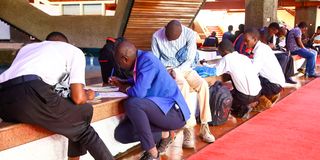
Job seekers fill out their forms at the Kenyatta International Convention Centre, Nairobi on October 25, 2024, during a mass recruitment drive for various job opportunities in Qatari companies.
However, when he approached the bank, he was told that a loan would require collateral in the form of either a guarantor or a title deed.
“I don’t have land or anyone to guarantee me. Later, we were told to register for the Uwezo Fund instead. We did, but we have not received a cent to date,” he added.
Mwangi took out a personal loan in April to cover the visa costs. Two months later, the job remains elusive and his repayment deadline is approaching.
“When I check online, my visa still shows ‘in process’. Calls to the agency go unanswered. I don’t know whether to wait or cut my losses,” he said.

Labour and Social Protection Cabinet Secretary Alfred Mutua interacts with job seekers at the Kenyatta International Convention Centre, Nairobi on October 25, 2024.
When the Nation contacted one recruitment agency, Zawadi International, an official who spoke on condition of anonymity said that the Sh30,000 was strictly for medical examinations.
“The government is only covering the visa and air ticket. The medical test is critical. What if someone is declared unfit to work, who will cover those costs?” the official asked.
Labour Cabinet Secretary Alfred Mutua has dismissed such complaints, arguing that some young people are unwilling to take responsibility for the process.
“People apply for Youth Fund and they qualify; they’ve already been picked. Now they’re just waiting for the offer letter,” said Dr Mutua explained.
“The Youth Fund is reluctant to pay for the medical check-up because if someone fails, the money is lost. People should be ready to pay for the medical. The government is paying over Sh200,000 for you. Really, you can’t raise Sh15,000? Then you are not serious we don’t want you. It’s as simple as that.”
According to the CS, successful candidates receive funding after passing the medical check-up and then wait for the offer letter.
“When the medical results are in, the offer letter follows and that’s when the Youth Fund application kicks in. From selection to departure takes about two months. There’s medical, training, documentation; it’s a process,” he said.
However, this explanation appears to contradict earlier assurances made to jobseekers.
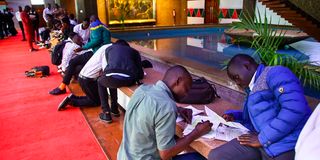
Job seekers fill out their forms at the Kenyatta International Convention Centre, Nairobi on October 25, 2024, during a mass recruitment drive for various job opportunities in Qatari companies.
According to Mbwana Omar, president of the Kwale Youth Assembly, hundreds of young people were misled into believing that the government would cover all the costs.
“We’ve received widespread complaints about the Sh30,000 fee. This goes against the initial promise that the Youth Fund would cover both travel and medical expenses,” Mr Omar said in a press statement.
He added that he had contacted Msambweni MP Feisal Bader for clarification.
“As of now, the MP’s office has not confirmed the legitimacy of the fee. We are advising all youth to pause travel plans to Nairobi or any payments until further guidance is issued. Your safety and financial security must come first,” he said.
When the Nation contacted Mr Bader, the calls went unanswered.
The situation has sparked growing calls for transparency from both the government and recruitment agencies.
In Kilifi County, another recruit, Daniel Jefwa, urged the Ministry of Labour to clarify the process. “We need the government to be fully transparent. The youth are willing to work, but these shifting and hidden costs are killing our morale,” he said.