Fear of losing control could be one of the reasons some county governments are hesitant to fully operationalise municipalities, putting them in breach of the Constitution and the Urban Areas and Cities Act (UACA).
According to the Senate County Public Investments and Special Funds Committee (CPIC), most of Kenya’s 47 counties are yet to fully implement the 2011 Urban Areas and Cities Act because of concerns that municipalities could dilute county authority.
The Act integrates county governments and municipalities within the devolution framework, where governors and county executive committees delegate powers and functions to municipalities, which operate as agencies of county governments.
President Mwai Kibaki’s greatest moment during his 10 years of power, according to his son Jimmy, was the promulgation of the new Consitution.
Photo credit: File | Nation
Despite the Constitution and the law clearly defining the structure, roles, and governance of county executives and municipalities, the committee warned that most counties remain reluctant to comply.
Article 184 of the 2010 Constitution mandates Parliament to enact laws governing urban areas, including criteria for classifying cities, municipalities and towns, principles for managing urban centres, and mechanisms for public participation in urban governance.
The Urban Areas and Cities Act, which stems from Article 184, requires municipalities to have full operational and financial autonomy.1
The Senate committee chaired by Vihiga Senator Godfrey Osotsi found that most counties had either partially or completely failed to comply with the Act by properly establishing gazetted municipalities and awarding them charters.
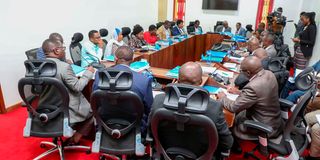
Of the nine counties that appeared before CPIC between Monday and Wednesday this week, none had fully complied with the Act, an irregularity repeatedly flagged by Auditor-General Nancy Gathungu.
Vihiga, Busia, Tana River, Mombasa, Kwale, Tharaka Nithi, Lamu, Nyandarua and Embu counties appeared before the committee to respond to audit queries touching on municipalities, water companies and hospitals.
Appearing before Commiteee on Wednesday, Vihiga Governor Wilber Ottichilo said his administration had awarded charters to Luanda and Kaimosi municipalities, with the rest expected to receive theirs later this year.
“The board is in place. Services have been transferred and gazetted,” he said, but disclosed that the county government was still managing the municipalities’ payroll.
Kwale Governor Fatuma Achani faced tough questions on how municipalities could operate independently while payroll and revenue collection remained centralised at the county level.
“If revenue is collected centrally, how independent are the municipalities, and are they operating autonomously?” posed nominated Senator Raphael Chimera.
Governor Achani said her administration awarded charters to Kwale and Diani municipalities in 2019 and to Kinango and Lungalunga in 2022. While the municipalities have their own budgets and implement their own projects, she said they do not collect revenue independently due to financial constraints.
She argued that governors face competing priorities, including health and early childhood development education (ECDE).
“As we plan for municipalities, we also have other mandates—health and ECDE. If we cannot allocate enough resources to health and ECDE, there is no way we can adequately fund municipalities. That is why municipalities currently depend on county resources,” she said.
“I do not think that is the issue. In Kwale County, I do not control. I do not need to control resources to have power,” she said.
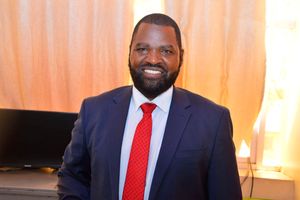
In Tharaka Nithi, Governor Muthomi Njuki said municipalities would not be fully operational until 2028, even though municipal managers had already been appointed.
Tharaka Nithi Governor Muthomi Njuki at a past event.
Photo credit: Evans Habil | Nation Media Group
He raised concerns about allowing municipalities to collect revenue from county streams, calling for clarity on how counties could comply with the law without disrupting operations.
Trans Nzoia Governor George Natembeya struggled to explain why he had retained an acting municipal manager for two years, contrary to the law, saying he was in the process of recruiting a substantive officer.
Also, Governor Natembeya urged the Senate to clarify how municipalities should collect and use revenue, warning that unclear guidelines could negatively affect county finances.
The committee commended Kilifi County for what it termed “impressive steps” toward compliance, but Governor Gideon Mung’aro stressed the need for a clear working framework between counties and municipalities to avoid friction.
Migori Senator Eddy Oketch, however, said the law was clear and left no room for interpretation or amendment.
“The financial records should be prepared by the municipal board. I do not know why this confusion persists. The relationship between a county and a municipality does not create another government but an agency. Governors are misreading the Act and think they are being forced to create parallel governments,” said Senator Oketch.
He added that municipalities should be established based on needs assessments and their ability to generate revenue, warning that poorly structured municipalities could become conduits for corruption.
Senator Osotsi observed that many governors, having fought hard to win office, were reluctant to relinquish authority.
“Many counties are hesitant to implement the Act because of the feeling that municipalities are taking over. Nearly all counties are facing challenges in complying with the Act,” he said, adding that the committee would organise a joint retreat with the Council of Governors to clarify the relationship.
“We see governors appearing before us suggesting there is a power struggle between county executives and municipalities,” said Senator Chimera.
“Where there is financial autonomy, governors begin to feel there is another arm of government. But there are only two levels of government—the national and devolved governments.This is the law as it stands, and it must be complied with,” he added.
Urbanisation in Kenya has been steadily growing at an annual rate of five percent from only eight percent of the population at independence in 1963 living in urban areas to 34 percent as of 2024.
Presenting even a better future, projections indicate that the trend will continue, with urban populations expected to reach 50 percent by 2050.
During the launch of the second KUSP in May 2024, President William Ruto decried how lack of coordination and planning has deprived Kenya of the numerous benefits of urbanisation, saying urban areas are significant economic engines.