Free things will finish this country': MPs spar with PS over Japan Expo
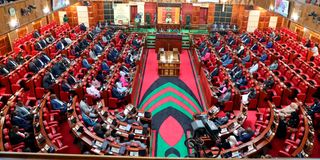
Members of the National Assembly follow proceedings during a past session.

What you need to know:
- Legislators wanted to know why Kenya could not afford its own pavilion at the Osaka Expo 2025.
- Kenya's attendance was sponsored by the Japanese government at a cost of US$2.2 million.
Kenya's love of freebies could end up being its greatest undoing, legislators have warned.
Members of Parliament said the country's tendency to rely on free things could eventually hurt its regional and international standing.
"These free things will be the end of us. These free things will finish this country," said Kajiado South MP Samuel Parashina.


He made the remarks during a National Assembly Trade Committee session on Thursday last week.
Why no pavilion at Osaka?
The legislators wanted to know why Kenya could not afford its own pavilion at the Osaka Expo 2025, held on the artificial island of Yumeshima in Osaka, Japan, from April 13 to October 13, 2025.
Kenya's attendance was sponsored by the Japanese government at a cost of US$2.2 million (Sh286.1 million), with the Kenya Export Promotion and Branding Agency (Keproba) coordinating the country's participation.
While Angola operated its own stand-alone pavilion, Kenya opted for shared exhibition halls (Type C pavilion) with other East African Community (EAC) member states, including Uganda, Tanzania, Rwanda and Burundi.
A Kenyan parliamentary and trade delegation visited the Angola pavilion to benchmark stand-alone pavilion operations for future expos.
A stand-alone (Type A) pavilion would have given Kenya greater architectural freedom, deeper visitor engagement and a higher national brand profile, but at significantly higher logistical and financial cost.
The committee, chaired by Ikolomani MP Bernard Shinali, asked: "Why did we (Kenya) not have our own pavilion? How much was it?"
'The love for free things is very costly'
State Department for Trade Principal Secretary Regina Akoth admitted the MPs' concerns about "the cost of free things".
"I must confess that the love for free things is actually very costly," Ms Akoth said.
"This was part of the package that was given to the country. Allow us to go back and do the maths about what this means for us and what benefit it would bring us."
She told the MPs that Kenya, which received support in kind from the Japanese government, opted for a shared pavilion "because of the resources required to construct a standalone pavilion and we did not have them".
"Both Kenya and Tanzania were under support," she said. "Angola was able to construct their own Pavilion and they had ample space that is why Kenya and Tanzania were seeking it."
Trade pacts and 'big brother' Angola
The legislators raised concerns over the many trade agreements Kenya is party to and what the country is doing to make the most of them. They cited Angola, which they said was "turning to be a big brother".
"Is this EA brotherhood really working? Kenya is positioned as the 6th largest economy in Africa but we do not see it out there instead of trying to get free services or help every time," Mr Parashina said.
He called it "shameful" that Kenya has to rely on regional and international partnerships just to market cash crops such as coffee.
Mr Shinali said: "It is the duty of the ministry to sensitize Kenyans on the various trade agreements."
"What are you doing for Kenyans to benefit out of those agreements and take advantage of trade agreements that Kenya has made?" he asked.
Ms Akoth said the government had organised stakeholder engagements "to walk them through what trade agreements say and how they can capitalise on them. We will share what will come out of it."
She said the government had realised that some trade agreements had not been fully used and would need to be rearranged.
Keproba under fire
The legislators faulted Keproba for not doing enough to market Kenya's export products, such as tea and coffee, abroad.
" Keproba has done nothing. It is supposed to market Kenya," the MPs said. "Kenya's exports have stagnated for two years with nothing much happening."
Keproba was established in 2019 through the merger of the Brand Kenya Board and the Export Promotion Council. The state corporation is mandated to implement the country's branding and export promotion policies, market goods and services, and increase Kenya's global competitiveness.
Mr Shinali urged the government to support Kenya's micro, small and medium enterprises (MSMEs) instead of depending on external support.
"Should we wait for other governments to support our MSMEs?" he asked.
Ms Akoth clarified that "the State Department of MSME does not fall under the Ministry of Trade and Investment. It falls elsewhere." She said that department's mandate "is to coordinate when and how", and committed to "work closely so we can get a cohort that is right. We are trying to harmonise. Not duplicate."
Kenya's trade agreements
According to the Ministry of Investments, Trade and Industry's 2025 report, Kenya is party to major bilateral, regional, multilateral and continental trade agreements.
It has participated in the General Agreement on Tariffs and Trade (GATT) since 1964 and in the World Trade Organization (WTO) since January 1995.
It benefits from the African Growth and Opportunity Act (Agoa), which gives duty-free access to the United States, and from Economic Partnership Agreements (EPAs) with the European Union and the United Kingdom, as well as preferential arrangements such as the EU ACP/Cotonou framework.
On bilateral deals, it has signed agreements with several countries, including Nigeria, Egypt, China, India and South Korea, and is pursuing deeper frameworks such as the US-Kenya Strategic Trade and Investment Partnership (STIP).
Regionally, it is a signatory to the Comesa-EAC-SADC Tripartite Free Trade Area, and is a member of the EAC Customs Union and Common Market.
It has also ratified the African Continental Free Trade Area (AfCFTA) and is an active trader under it.
Follow our WhatsApp channel for breaking news updates and more stories like this.


