Begging for life: Cancer patient's daily journey from Nyeri to SHA offices

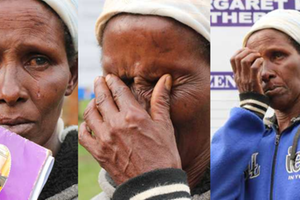
Gatamu Waigwa,a cancer patient during an interview at the Nation Centre in Nairobi on July 22,2025.

Every morning for the past four months, 70-year-old Gatamu Waigwa has risen at 4am in Nyeri to board a matatu to Nairobi.
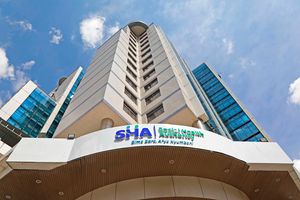
His destination: the Social Health Authority (SHA) offices, where he spends entire days until dusk, pleading with officials to save his life.
His crime? Being a cancer patient caught in Kenya's chaotic transition from the National Hospital Insurance Fund (NHIF) to SHA.
The retired anaesthetist's ordeal began when SHA slashed his oncology benefits from Sh600,000 under NHIF to just Sh400,000 – a reduction he says will kill him. Despite promises of a Sh550,000 oncology package, SHA has refused to honour the full amount, leaving Waigwa Sh200,000 short of what he needs to survive.
"I have two weeks left to finish the cancer medication I am currently taking, which costs Sh92,800, as well as injections totalling around Sh10,000," Waigwa told the Nation on Tuesday. "If I don't have them, according to my doctors, the cancer will spread and kill me. I do not want to die."
The gravity of his situation deepens when he considers the last quarter of the year – he still needs another Sh100,000 for medication to see him through December.
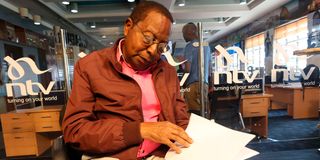
Gatamu Waigwa,a cancer patient during an interview at the Nation Centre in Nairobi on July 22,2025.
When he appealed to SHA offices, the response was crushing: wait until the next financial year to renew his cover and access the Sh400,000 package again.
"How can I sit and wait for the next financial year while this demon called cancer ravages my body from inside?" he asked, showing his official medical reports, lab test results, and a list of prescribed medications he must take to stay alive.
The journey to diagnosis
Waigwa's nightmare began in 2020 when he started experiencing urinary urgency and frequency, forcing him to visit the toilet abnormally often. In May that year, he underwent a PSA (prostate-specific antigen) test, followed by ultrasound and multi-parametric MRI scans.
The results were devastating. His PSA levels were dangerously high, and the ultrasound revealed an enlarged prostate – what doctors scientifically termed prostatic adenocarcinoma. A biopsy and subsequent histology examination confirmed prostate cancer with a Gleason scale of 4+4.
"To the doctor's horror, my PSA levels were just too high,"
Waigwa recalled, going down a painful memory lane.
"Without wasting time, he put me on Casodex tablets, which are very expensive."
At the time, NHIF was not covering his mounting medical expenses, forcing the working anaesthetist to dig deep into his savings.
"Cancer treatment in Kenya is probably the most expensive in the world, with many hospitals viewing cancer patients as cash cows to be exploited," he said.
"The pain I underwent around my lower abdomen was excruciating and hardly controlled by the very expensive drugs I still have to buy just to stay alive."
His treatment regimen was later changed from Casodex to Abiraterone tablets – hormonal treatments costing hundreds of thousands of shillings.
The NHIF lifeline and its brutal end
Relief came when NHIF began covering the bulk of his expenses with an annual allocation of Sh600,000. But that reprieve was short-lived.
"Before I could financially breathe, President William Ruto showed up and literally forced us to migrate to Social Health Authority because no one even sought my consent," Waigwa said bitterly.
The transition proved catastrophic for his healthcare. SHA reduced his allocation by Sh200,000, leaving him with coverage that lasts barely three months.
"I don't want to die right now all because of a shortfall of Sh200,000 that used to cushion my treatment regimen – all because SHA decided to steal that money from me," he said, tears streaming down his face.
Waigwa's personal circumstances compound his medical struggles. Having worked for 30 years as a civil servant and paid thousands to NHIF, he feels betrayed by a system that refuses to transfer his accumulated benefits to SHA, instead forcing him to start afresh.
"My wife and I parted ways in the 1990s. We had two children who are adults now, but she and the kids are not in the picture, which means I am in this fight for my life all alone," he disclosed.
Currently living in Nyeri, he started a beekeeping project in September last year, but the bees are still building their honeycombs, providing no immediate income. For medication, he must travel to Nairobi at a time when even bus fare is a struggle, having spent all his savings on treatment.
System in chaos
Waigwa's frequent visits to SHA offices have exposed a system in disarray. Former NHIF staff, he observes, are demoralised and uncertain about their future while facing salary cuts. Worse still, they cannot access SHA systems on their office computers, making it nearly impossible to help patients.
"So both patients and NHIF staff simply don't know the way forward," he explained.
SHA's refusal to refund rejected payments has created another layer of frustration.
"They owe me thousands from my NHIF account, which I had not spent. We need someone to transfer these monies from the NHIF account to the SHA account," he pleaded.
A desperate appeal
As Waigwa reflects on his cancer journey, the toll becomes evident. Most of his "cancer WhatsApp group friends" diagnosed alongside him are now dead. Two others are on chemotherapy, one on radiotherapy, while a woman diagnosed with breast cancer just before him has also died.
"I think I am alive today because of my firm belief in God and medicine," he said through tears.
His final appeal is to the highest levels of government: "We patients have been reduced to beggars having to do harambees, some are even selling land to make ends meet. There was no need of moving away from NHIF because, yes, the former had challenges, but it was working very well for Kenyans. Now Kenyan patients are on their own, sitting like ducks waiting to die."
Waigwa urges President William Ruto and Health Cabinet Secretary Aden Duale to intervene before it's too late – not just for him, but for countless other patients trapped in SHA's bureaucratic maze.
Time, for Gatamu Waigwa, is running out. In two weeks, his medication will be exhausted. Without intervention, the cancer he has fought for over four years will claim another victory in Kenya's healthcare crisis.
Mr Waigwa needs urgent financial assistance for his prostate cancer care. The required medication costs Sh92,800, and a life-sustaining hormonal injection that costs Sh55,000.
If you wish to help, you can send your contributions through M-Pesa to 0725208828 or Paybill No: 8024348, Account Name: GW