'I was given 15 days to live, it has been three years since...'
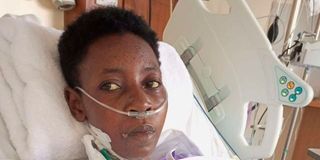
Caroline Wakanyi, 28, a rheumatic heart disease survivor who was told by a doctor that she only had 15 days to live in 2021. She later got an open heart surgery in 2023 and has been on a recovery journey to this day.

What you need to know:
- On the day of her surgery, she was surrounded by more than 50 doctors. After eight hours of open heart surgery that was successful, she was wheeled out of the theatre room to the Intensive Care Unit
- It was at the ICU that she had two cardiac arrests, one that doctors told her was a near-death experience that put all the nurses and doctors on edge
When Caroline Wakanyi first stepped out of her ward to get some sun, she realised that she had been hallucinating for 44 days. All this time, she couldn't walk on her own, so she could only see the outside world from her bedside window in the hospital.
"There were trees outside my window, and I could see different things that did not seem real. All I remember is seeing monkeys. I later realised that there were no monkeys there," she tells Nation.
The first thing she saw outside were cars. They looked alien. It was as though she was seeing cars for the first time. She had stayed in the wards for such a long time that she couldn't differentiate day and night. She was frail, had lost so much weight, and still could not eat without the help of a feeding tube.
On that 44th day, even though she was still weak and couldn't walk on her own, she felt like a freed bird that had been caged for long. Caroline was especially happy to feel the warmth of the sun.
"I felt like someone who was in a different world. After experiencing the radiance of the sun, I started seeing the world as it was," she says.
At the time, it had been three years since she was first diagnosed with rheumatic heart disease at a hospital in Kiambu County. Three years of being tossed from one hospital to another, begging to get surgery for her condition. Three years of living a borrowed life, fragile, and countless disappointments at hospitals.
Caroline is one of the 55 million people globally affected by rheumatic heart disease. It is a condition that the World Health Organisation (WHO) explains is a serious, yet preventable public health problem that is common in childhood. It starts as a sore throat and sometimes a skin infection caused by a bacterium called Streptococcus pyogenes (group A streptococcus).

Caroline Wakanyi, 28, a rheumatic heart disease survivor, three years after an open heart surgery. She weighed only 26 kgs after her surgery, and now weighs 41 kgs.
It mostly affects children in low- and middle-income countries like Kenya, manifesting in the form of fevers, fatigue, heart murmurs, and painful joints. When rheumatic fever escalates to heart valve damage, it can lead to shortness of breath, chest pain, irregular heartbeats and swelling of the stomach, hands or feet.
This is what Caroline felt in 2021 when she first visited the Kiambu hospital after living a healthy life for 24 years — fatigue, shortness of breath and episodes of chest pain. She received different diagnoses, especially asthma and low blood levels, but was later confirmed to have rheumatic heart disease.
In the same year, when she was trying to seek a second opinion from one of the country's referral hospitals, a specialist doctor told her that she had only 15 days to live. It was the first time a specialist had suggested surgery.
"It was my first time walking in such a big hospital. The doctor was so serious when he told me that. He also told me that the doctor who was to do the surgery was to travel from India. I also learned that I was going to be the first patient in that facility to have open heart surgery," she says.
It was in that hospital that she was told that her two heart valves were damaged. They also told her that she needed double heart valve replacement surgery.
Her case was discovered when it was too late and one of the valves was completely damaged. They only gave her drugs to sustain her until the Indian doctor flew into the country.
When the Indian doctor came, he told Caroline's family that they had to wait a little bit longer since the theatre in that facility was not fully equipped for such surgery. That news broke their hearts and because of that, they decided to seek a third option.
Long waiting list
This time, they went to another referral hospital in Nairobi. There, when the tests were done, they found out that it was only one valve that was badly damaged. She enrolled at that hospital's clinic and joined a long waiting list for patients who needed heart surgery.
"At the second referral hospital, the clinic made me depressed. I was the only young person there. I could see the nurses pity me. Every other week, I could see a different cardiologist and start retelling my medical history," she recalls.
Caroline noticed that her name on the waiting list kept being starred. She did not understand what that meant. She could see names of people who were listed after her being ticked, meaning that they were approved for surgery. It is there that she first heard of hospital 'bribery' where someone asked her to pay a certain amount of money so that they could approve her name.
"My family was not for the idea of bribing the hospital workers to get a surgery slot. I had been sustained all that while by God, so I knew He would somehow still help me," she says.
In one of her clinics, she met a stranger who linked her to the Aga Khan University Hospital where she finally had her surgery done.
"It was my first time going to that hospital. I knew I couldn't afford it, but I went there anyway. I didn't expect anything new. I knew that ultimately, I had to be operated on," she tells Nation.
It is there that she was slotted for surgery just days after presenting her case. Since she did not have money, the welfare department at the hospital had to do background checks on her to allow her to receive treatment at that facility for free. She had paid Sh5,000 for consultation, which was sent back to her.
On the day of her surgery, she tells Nation that she was surrounded by more than 50 doctors. After eight hours of open heart surgery that was successful, she was wheeled out of the theatre room to the Intensive Care Unit.
It was at the ICU that she had two cardiac arrests, one that doctors told her was a near-death experience that put all the nurses and doctors on edge.
So bad was the situation that she had to be put on a machine called an Extracorporeal Membrane Oxygenation (ECMO), which is a temporary life support system that takes over the function of the heart and the lungs when they are unable to do so on their own.
For nine hours, she depended on the ECMO. Her doctor observed her for four days, night and day, just to ensure that Caroline lived.
On that 44th day, which wasn't really her last admission day, she felt whole again. Her memory was still hazy. She had undergone dialysis because her kidneys had failed. She says that her liver too had issues making her have a yellowish complexion. In between the wait for her healing, her family was even called to bring a pastor to the hospital when she was unresponsive.
"I remember my fingernails just coming out effortlessly," she says.
Caroline had to learn to walk again. She felt ashamed returning home, knowing she would be taking her first steps alongside her eight-month-old nephew. Her taste buds were bland. After staying in hospital for close to 60 days, she was on her feet again.
"My doctor was so happy to see me walking. The hospital even had a party on the day of my discharge. It was such a happy day," she says.
When she was discharged in December 2023, she weighed only 26 kilogrammes (kgs), and now, she weighs about 41 kgs.
Two years after this surgery, Caroline is recuperating well at her home in Kenol, Murang'a County. She is now taking medication to maintain her blood pressure, remove any excess water from the kidneys, prevent blood clotting, and a few immune boosters.
"I am okay now. I can now give a helping hand and do house chores. I can walk. I can jump. I can run. The wound is now okay and I am back to living the life that I had before the surgery," she says.


