‘My life in Nairobi's Ebola quarantine centre’
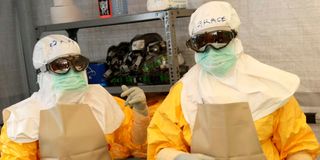
Health workers at an Ebola isolation facility.

Two contacts of Kenya’s index patient of the deadly virus tell the Nation, in anonymous interviews, about their experience inside the centre in Nairobi where they were expected to stay for 21 days. This came as 20 people who had been at the facility were on Monday cleared to leave. Their identities may be concealed but their stories, told in first-person, give a picture of the situation they found themselves in and their innermost feelings.
Patient 1’s story: ‘I listened to cries of other quarantined patients’
It began without warning. I had travelled from a neighbouring country to Nairobi Hospital to check on a relative, who had been critically ill and needed specialised medical attention. He had travelled from the Democratic Republic of Congo through Uganda.
At the time, none of us understood the true nature or gravity of his condition. I walked into his hospital room out of love and concern, sitting by his bedside to offer comfort and silent prayers. I held his hand, spoke soft words of hope, and stayed just long enough to fulfill my duty as family before returning home to my young children, assuming it was simply another tough medical battle.
The next morning, my world shifted completely. A phone call broke the quietness of my house, informing me that my relative had passed away and that his cause of death was suspected to be Ebola, a viral hemorrhagic fever.
Since I had visited him, I was classified as a primary contact. Within hours, health officials arrived, and I was taken into government-mandated quarantine.
Panic and disbelief clouded my mind. I had left my children behind with barely enough time to explain where I was going or when I would return.
Upon arrival at the quarantine facility, the reality of our situation became immediately clear. We were placed in shared living blocks where the risk of cross-contamination felt painfully high.
Facilities were tight, and multiple occupants were forced to share single restrooms and communal corridors.
One room housed a small family unit: a mother, her child, and another relative, all squeezed together in tight quarters sharing one toilet. A few days into our isolation, news spread through hushed whispers in the hallway that another of my relatives’ test results had come back positive.
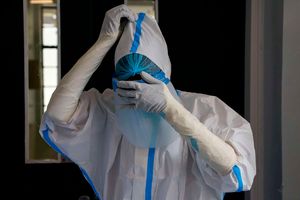
Emergency medical workers in full personal protective equipment (PPE) entered the facility, their faces obscured behind thick visors, to take her away to the treatment center.
Watching her be led away left the rest of us frozen in fear. Those she left behind were terrified. We realised that sharing facilities with someone who was actively infected put every single one of us at risk.
How could we survive quarantine if the place meant to keep us safe was exposing us to the very disease we were running from?
Desperate to protect ourselves, several of us spoke up. We negotiated with the ward managers, pleading for stricter sanitation and requesting access to alternate restrooms that had been designated for lower-risk individuals.
Every visit to the bathroom felt like walking through a minefield; every door handle was wiped down repeatedly with harsh disinfectants that left our skin and eyes burning.
Life in quarantine quickly devolved into an exhausting routine governed by fear, temperature checks, and blood draws.
Every morning began with the sharp knock of a health worker at the door. They would take our temperatures with infrared thermometers, log our vital signs, and monitor us for early signs of fever, headache, or muscle fatigue.
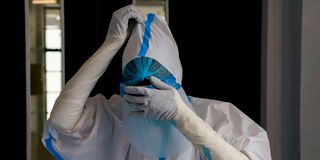
A medic wears a protective mask at Nairobi Hospital where an Ebola patient was isolated immediately upon arrival and treated at the hospital's East Wing Isolation Facility, but later died, in Nairobi, on October 7, 2026.
The waiting was the hardest part. The hours bled into one another. Deprived of normal routines, we spent our days staring at blank walls, pacing narrow floorboards, and frantically searching our body’s every sensation.
A mild headache caused by stress would instantly spark terror: Is this the virus starting? A sudden warmth in the room would make my heart race until the thermometer confirmed my temperature was normal.
To pass the time, I spent hours on my phone, checking in on my children, reassuring them that I was okay even when I wasn't sure myself. I listened through the thin walls to the muffled cries of other isolated patients. Some prayed aloud in Swahili, their voices carrying through the quiet corridors, asking for mercy and negative test results. We were strangers united only by exposure and an invisible threat, bonded through a shared nightmare.
When the first round of blood tests came back, relief briefly washed over me; I tested negative. But that relief was short-lived.
Because new positive cases continued to be identified within the facility due to early cross-exposure, the health authorities made a devastating announcement: our 21-day quarantine clock was being reset.
Hearing that our isolation was being extended was a crushing blow. The mental fatigue turned into pure frustration. We were remaining negative, following every safety protocol, and testing clean, yet we were trapped indefinitely because the system itself had failed to isolate infected individuals properly during the initial days. Anger began to replace fear.
We organised ourselves and voiced our distress to the doctors and facility managers. We argued that keeping negative-testing contacts in shared spaces with ongoing potential exposures was unfair and dangerous. We demanded individual rooms and proper infection prevention and control measures.
"We are testing negative, yet we are being kept here because of system failures! Move us to individual rooms where we can safely finish our days without facing new risks every time we step into the hallway!"
Our persistent appeals finally forced a change in protocol. The management reorganised the facility, moving us into individual rooms with strict single-occupancy rules. For the first time since entering quarantine, I could close my own door, sit in solitary safety, and breathe without fearing the air or surfaces around me.
The final days in individual isolation were quiet and reflective. Though the loneliness was intense, the sense of physical safety brought immense mental relief. I watched the sun rise and set through my room window, counting down the hours until the official 21-day incubation period expired.
When the final blood test returned negative and the discharge papers were signed, stepping out of the quarantine facility felt surreal. The air outside felt cleaner, the sun brighter.
Quarantine was not just a medical precaution; it was a profound trial of human endurance, resilience, and advocacy. It tested our spirit, forced us to demand dignity in the middle of a health crisis, and left us with a deep appreciation for freedom, family, and survival.
****
Patient 2’s story: The world was moving on without us
The ringing of my phone cut through the quiet afternoon just after I returned from my trip to Uganda. I picked up, expecting a routine call, but the voice on the other end was grim and official.
I had been identified as a contact of a suspected Ebola case, the caller said, and health authorities were already on their way. Minutes later, the wail of a siren echoed down my street, and an ambulance pulled up to my door.
When I stepped into the vehicle, the health workers tried to reassure me. "It’s just a precaution," they said. "A brief check, a few days for testing, and you'll be back home." I believed them. I packed light, bringing only two changes of clothes and my laptop, convinced I would be back at my desk by the start of the next week.
The facility was quiet, sterile, and cold. I was assigned a small room with a bed and a private bathroom, but no television, no radio, and no window view of the outside world.
In those early days, the rules were absolute: the door stayed shut, and stepping outside into the hallway, even to catch a breath of fresh air or a sliver of sunlight, was strictly forbidden.
A mind-numbing routine quickly took hold. I would wake up to the sound of footsteps in the corridor, say a quiet prayer, and stare at the ceiling. Hours dissolved into one another as I sat on the edge of the cot, mindlessly scrolling through my phone until the battery drained, searching for news or watching videos just to hear a human voice.
Meal times were marked only by a knock at the door, where food was left on a tray before the person in protective gear hurried away.
Eventually, small concessions were made to ease the strain. We were provided basic toiletries, hospital garments, and brief, carefully timed intervals where we could step into an open courtyard to stand under the sun, keeping strict physical distance from one another.
Seeing other human beings, even from twenty paces away, was a stark reminder of the world outside that was moving on without us. My work was completely stalled, my income halted, and my family left worrying miles away.
Through three separate blood draws, my results remained consistently negative.
As the promised "few days" came to an end, I waited eagerly for my release papers. Instead, a doctor arrived with bad news: the quarantine period was being extended. A new potential exposure within the facility meant the clock was being reset. The relief I had felt after my first blood test came back negative shattered in an instant. Anxiety began to creep in, heavy and suffocating.
Every passing day brought new psychological hurdles. Whispers travelled through the facility about other patients testing positive or being moved away.
Every slight variation in my body, a dry throat from the air, a slight ache from sitting all day, sent my heart racing. What if the test gets it wrong next time? What if I catch it here?
Follow our WhatsApp channel for breaking news updates and more stories like this.