Small thorn prick, big health threat: The case of mycetoma

Mark Ekaru, a mycetoma patient, during the interview in Kalokol, Turkana County.

What you need to know:
- A simple thorn prick in Turkana becomes mycetoma, a neglected tropical disease that destroys lives.
- Distance from healthcare facilities and stigma compound suffering of patients who lose livelihoods and limbs.
- New treatment options and awareness efforts offer hope for affected communities.
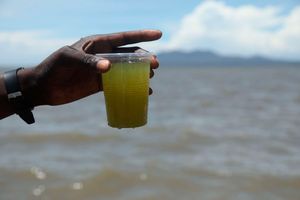
At sunrise on a cloudy Thursday morning, a boat stands still on the shores of Lake Turkana in Kalokol. The water glistens as the morning sun pierces the horizon, casting golden rays on its rippling surface. Mark Ekaru climbs into a boat and sits at the edge.

Mark Ekaru, a mycetoma patient, during the interview on the shores of Lake Turkana in Kalokol, Turkana County. Previously a fisherman, he stopped fishing in 2018 as a result of the disease.
His gaze stretches far into the vastness of the lake — its beauty unchanged, though its shape has shifted. The lake has expanded over time, swallowing homes and displacing families. For many, this transformation is a story of climate. For Ekaru, it is more personal and a quiet parallel; his life has shifted, too. Once, the lake gave him life. Now, it reflects his absence.
To a fisherman, this scene is routine. Nothing extraordinary about it. The sun, the boat, the silence of the morning — it’s all part of a rhythm they know well. But Ekaru is not going to fish.
He is reminiscing.
Before 2018, fishing was his lifeline. His mornings would begin like this: perching at the boat’s edge, scanning the waters, and waiting for the other fishermen before rowing out into the deep.
This morning, seven years had passed since he stood here.
When you meet Ekaru for the first time, you may not immediately notice that something is amiss. He’s in his late 20s and wears a calm expression.
But, the photo of him seated on the boat might catch your attention. His left leg is swollen.
“I rarely am without shoes,” he says.
“Most of my friends have never seen me like this. Whenever I meet them, I always wear shoes. I only remove them when I’m at home.”
He fears stigma—the kind that clings to unknown ailments in remote villages like here. “People whisper,” he says.
“They think maybe it’s a curse or witchcraft.”
It all started on a specific day in 2014 when a fishbone pricked his foot. As most people would, he did what seemed reasonable—pulled it out, shrugged it off, and went on with his day. Just a prick, right? If it hurt, there was always a painkiller.
“The pain didn't go away,” he says.
Painful swellings
“I thought it was a boil, so I visited a health facility, and they gave me some medication. I used it for a while, but the leg didn’t improve. I didn’t understand what was happening. Also, because of the distance to the health facility, it meant taking a day off from my work, and I required some transport money. So, I stopped seeking treatment. I thought maybe it would heal with time,” he offers.
But it didn’t. It worsened. Eventually, he couldn’t fish anymore. The pain made walking unbearable. He had no choice but to return home more than 60 kilometres inland. Since 2018, Ekaru hasn’t stepped into the lake. Not even once. He leans back slightly on the boat, his eyes scanning the horizon. “Today is my happiest day,” he offers. “Because at least I came back here. Even if I’m not fishing.”
At Lodwar Level Four Hospital, the county’s referral facility, doctors see more and more patients arriving with similar painful swellings. But beyond the clinic walls, the illness remains nameless. There is no word for it in the local language. Few know what it is. Fewer still speak of it. Even Ekaru, the health champion, sometimes forgets the English name.
But science knows it. “It’s called mycetoma,” says Dr James Kidalio, Director of Medical Services in Turkana County.
“People here are nomads and mostly walk barefoot. In some of these general surroundings, you find that mycetoma-causing organisms, either bacteria or fungi, are found in the soil and especially in water sources. And then by chance, locals get pricked by that particular thorn where those organisms are,” he explains.

Joyce Loote from Nadamak in Kalokol, Turkana County. She is a mycetoma patient who lost her leg due to a late diagnosis of the disease. By the time she was getting diagnosed, the disease had already progressed.
In his telling, it starts as a simple thorn prick, then, if left untreated, some painless subcutaneous nodules appear. “ Over time, it forms large masses on the skin, most often on the foot. It can even spread to the bone if untreated.”
He explains that mycetoma is one of the world’s neglected tropical diseases — conditions that thrive in poverty, in dry and dusty regions, far from the reach of laboratories, research centres, and public attention. Turkana, hot, remote, and frequented by prolonged drought, is a textbook case.
Yet, even in such an area where health practitioners see these cases, data on its prevalence remains unclear. Dr Kidalio cites weak health systems as the cause. Between 2019 and 2022, research was conducted in Turkana County to determine the prevalence of the disease. Based on a population of 926,976, the prevalence of mycetoma was estimated at 1.46 cases per 100,000 inhabitants per year. Dr Kidalio thinks the numbers could be higher, going by the people seeking treatment at the facility.
“For example, since I joined the county government in 2018, there has been an increased number of these cases. We have about 115 patients currently on treatment,” he notes.
Because of the illness, Ekaru can no longer work. He now relies almost entirely on his family to meet his daily needs. But he has found an escape—gospel music. With the support of his relatives, he has recorded many songs. As we leave the lake behind, driving along the rough, dusty road, he plays the music from his phone. We listen. We hum along. He is back on a long-term medication that he fetches every month at the Lodwar Level Four Hospital, at no cost. It takes at least Sh20,000, we learn, to diagnose and offer treatment to a single patient.
An hour's drive from his home, we meet Joyce Loote, a mother of three, inside her manyatta to escape the scorching sun. Though she lives here now, and her family has begun to settle, this is not her original home. They moved more than 35 kilometres away after her husband made a difficult decision to bring them closer to a health facility for clinic appointments.
“You see, 90 per cent of the Turkana population is rural. Generally, accessing health facilities to diagnose mycetoma is difficult. And then, of course, the poverty levels. Travelling to the health centre, putting into consideration the fact that the distance between health centres and where the population lives is an average of 35 kilometres, is a herculean task. That's way above the World Health Organisation recommendation of five kilometres to reach a facility,” Dr Kidalio adds.
For Loote, it started with a simple task. She was pregnant at the time, out gathering firewood—like so many women in this part of the country, where wood is still the main source of fuel. The path she followed was familiar: dry and littered with brittle thorns. As she bent to pull a stubborn branch from the undergrowth, something sharp pierced the sole of her foot. She winced, looked down, and saw a thorn embedded in her skin. She plucked it out, shook it off, and carried the bundle of firewood back home, unaware that such a small wound could change everything.
“It continued to swell. Doctors advised that I wait until delivery to start treatment,” she offers. By the time she embarked on treatment, it was too late.
“My only mistake was ignoring the pain,” she says, tears catching in the corners of her eyes. “I thought it was just a thorn. I thought it would go away.”
When we meet her, her husband has just returned home, carrying a bundle of palm leaves. It’s how Lucy makes a living—crafting mats and other items by hand. Only now, she can no longer fetch the leaves herself. That changed the day she was pricked by a thorn.
Two things were stacked against her from the start.
Long-term disability
First, she didn’t think it was serious. Just a thorn—common, forgettable.
Second, by the time she reached a facility that could make a proper diagnosis, the infection had already advanced. It was mycetoma. The damage to her leg was extensive, and there was only one option left: amputation above the knee.
Now, Loote moves with the aid of a crutch, learning to navigate life as an amputee. It’s not easy, especially in Turkana, where survival often depends on physical endurance.
According to Dr Borna Nyaoke, head of Mycetoma at the Drugs for Neglected Diseases initiative (DNDi), treatments for this neglected tropical disease are not only long but also expensive and require total adherence to be effective when combined with surgery. Surgery, she expounds, can remove these masses before the disease spreads too far, helping to prevent long-term disability.
Mycetoma, she explains, is classified as “eumycetoma” when it is caused by fungi.
“The current standard of treatment for umycetoma is Itraconazole 200mg twice a day for 12 months with surgery,” she offers.
In November last year, The Lancet Infectious Diseases journal published results from a clinical trial conducted in Sudan— a double-blind, randomised trial for mycetoma. In a double-blind trial, the participants don’t know whether they’re receiving the actual treatment or a placebo (another comparison drug). The researchers, administering the treatment, also don’t know who is receiving which option.
“The study revealed that when patients take the current standard treatment, Itraconazole, with over 90 per cent compliance for 12 months and undergo surgery at the six-month mark, the chances of a cure are significantly high. The trial, involving 104 patients, also tested a promising new drug, Fosravuconazole. This investigational treatment showed similarly high cure rates under the same conditions.
Unlike Itraconazole, however, Fosravuconazole is taken just once a week, has no notable safety concerns, and causes few drug-to-drug interactions, making it a potentially more accessible and manageable option for long-term treatment,” she explains.
DNDi, which has spent over a decade working on mycetoma in Sudan, has now turned its focus to Turkana, launching new studies to map the disease’s spread and provide support to patients.
“Our field trip to Turkana in 2024 allowed us to see how truly neglected the disease is. Patients are shunned by society as the disease is sometimes considered a curse and the afflicted are stigmatised, children are unable to go to school or play with their friends, women are ostracised and cannot get married, and men slide into depression as they cannot take care of their families,” offers the mycetoma expert.
Ekaru is one of the beneficiaries of their work in Turkana County. So is Jennifer Ekal. She lived for years with a swollen leg—an old nail prick, the likely cause—before finally receiving a diagnosis of mycetoma. Living closer to Lodwar Level Four Hospital has made a crucial difference for her, helping her stay consistent with her medication and follow-up care. “I have no pain, and I can walk around and do most of the household chores with ease. Also, members of my family and friends now know about the disease and what caused it,” she offers.
“As we work on increasing access to treatment globally, we’re also working on identifying other high burden countries and regions through our epidemiological studies, which are currently ongoing in Ethiopia, Senegal, India and Kenya,” says Dr Borna.