The Kenya National Examinations Council (Knec) has warned schools against misleading the public by publishing unauthorised and inaccurate analyses of the Kenya Junior School Education Assessment (KJSEA) results.
Knec accused schools of attempting to create and publicise "school mean scores" to rank performance, adding that it violates the philosophy of the competency-based education (CBC).
The Knec Chief Executive Officer, Dr David Njengere, said, unlike the former system, KJSEA does not provide an aggregate score because the CBE is about nurturing individual potential, not ranking learners. He added that each subject is assessed independently, and learners’ achievements are reported using performance levels, not totals.
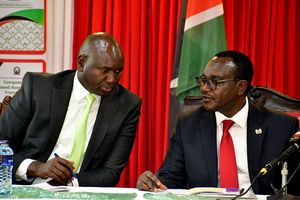
Knec CEO David Njeng'ere at a past event.
Photo credit: Bonface Bogita | Nation Media Group
This approach, the council said, ensures that learners’ excellence in one subject is not overshadowed by weaker performance in another.
“There is, therefore, no school mean score as is depicted in the attached fake analysis,” said the council on their social media pages.
Dr Njengere said the aspirations of the education reform are nurturing every learner's potential,
“The essence of junior school is to expose learners to a broad curriculum to enable them to choose appropriate pathways and tracks in senior school,” said the examination’s body boss.
He said Knec issued results showing the strength of each learner in each learning area and a statistical analysis of the strength of each learner in each pathway through the cluster weight.
In the 8-4-4 curriculum, after Knec released the results of the Kenya Certificate of Primary Education (KCPE) and the Kenya Certificate of Secondary Education (KCSE) examinations, schools used the ranking to lure learners to their institutions.
The National Parents Association chairperson, Silas Obuhatsa urged parents to be conversant with CBE and reporting of the assessment.
“Most parents were used to the 8-4-4 and see ranking and percentage but KPSEA and KJSEA is a different assessment. There must be awareness creation for parents to understand the new grading system,” said Mr Obuhatsa.
National Parents Association Chairman David Obuhatsa Silas (centre) and other members of the association.
Photo credit: File | Nation Media Group
The fundamental difference between Kenya's old and new education system was clearly outlined by Dr Njengere during the release of the Kenya Junior School Education Assessment (KJSEA) results.
Dr Njengere's explanation countered the misconception that the KJSEA should produce a single aggregate score like its predecessor, the KCPE.
The examination boss explained that under the 8-4-4 curriculum, the transition from primary school (Class 8) to secondary school (Form 1) was uniform.
"They all sat for the same subjects in KCPE, which means, all you needed was a total score out of 500 and then place the learner in a national school, which required 400 marks or an extra county school, which required 350 and so forth,” explained Dr Njeng’ere.
However, the CBE, is built on specialisation from senior school (Grade 10) onwards.
“Children are moving to senior school, to specialise in an area, therefore, they do not need these aggregated score. Instead, they need to know their strengths in the subjects they are going to pursue in senior school,” explained Dr Njeng’ere.
Dr Njeng’ere explained that since children are moving to senior school to specialise in a career pathway (STEM), Social Sciences, or Arts & Sports), they do not need an aggregated score.
"Instead, they need to know their strengths in the subjects they are going to pursue in senior school," added the examination boss.
The KJSEA results provide a detailed diagnostic report showing a learner’s performance level in individual learning areas. This data informs the student of the foundational competencies needed for their chosen specialization such as excelling in integrated sciences for a STEM pathway.