The river that kills: How climate change created Makueni's crocodile crisis
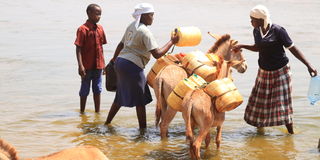
Residents of Kibwezi West risk their lives to fetch water despite the crocodiles' menace on September 6, 2025. Photo/pool.
What you need to know:
- More than ten people have been killed or injured by crocodiles in Makueni alone over the past year
- The river remains the only viable water source in a region where boreholes are scarce and piped water is a luxury reserved for towns. In Makueni, as in much of Kenya's drier regions, water security and wildlife danger have become inseparable realities.
River Athi once flowed as a symbol of life across Kenya's Eastern region, nourishing farms, sustaining wildlife, and quenching the thirst of thousands. Today, for the communities of Makueni County, it has become something darker: a source of life so dangerous that accessing it means gambling with death itself.
More than ten people have been killed or injured by crocodiles in Makueni alone over the past year. The Kenya Red Cross reports 21 deaths and 32 total attacks last year. Yet for the families living along this river's path, there is no choice. The river remains the only viable water source in a region where boreholes are scarce, and piped water is a luxury reserved for towns. In Makueni, as in much of Kenya's drier areas, water security and wildlife danger have become inseparable realities.
Beneath the shallow, murky waters of River Athi lurk Nile crocodiles, apex predators capable of growing up to five metres long and weighing over 750 kilograms. Over the past year, these ancient reptiles have not only claimed lives; they have shattered families and exposed a government system that appears unable or unwilling to protect its most vulnerable citizens.
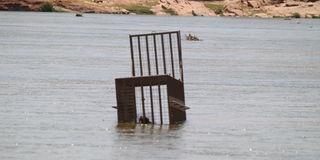
A trap erected by Kenya Wildlife Service (KWS) at Kambu in Kibwezi, Makueni County, following the tragic death of Kenneth Mutuku, who was fatally attacked by a crocodile in the Athi River. Photo taken on September 6, 2025. Photo/pool
The faces of loss
Robert Munyao knows this pain with an intimacy that words cannot fully capture. His six-year-old son, Brian, was attacked while fetching water from the river. His body was never recovered. The river stretch where it happened, Athi Kamunyuni, is now seared into Robert's memory as "the place that savagely took away Brian's life."
Robert's wife clutches Brian's schoolbooks, the only tangible memories left behind.
"My firstborn keeps asking if we'll ever see his brother again," she says, her voice heavy with a grief that has no end in sight.
Robert has reported the matter to authorities and begun the long, painful journey toward seeking justice. But progress has been agonizingly slow. "You know you're suing a state parastatal, and it's unpredictable if I'll ever get justice," he says.
The drawn-out court process offers little comfort. Three witnesses have already testified, yet the list stretches on.
Christine Nduku recalls the day with painful precision. She and her brother Brian had gone to fetch water, as they had done countless times before. The first trip was uneventful. But when they returned for a second round, everything changed. "The crocodile came," she says quietly. "It grabbed him."
There was no warning. No time to react. In an instant, Brian was gone, dragged into the water by a predator waiting beneath the surface. Christine's voice trembles as she recounts the moment when the familiar river transformed into a place of unspeakable horror.
Martha, a mother in Kitise, holds onto fading hope. Her 10-year-old son, Kennes, was dragged away by a crocodile as his twin brother watched helplessly. His body was never found.
"To me, even if it's a corpse, it'll give me closure," she says softly. "I just want to bury my son."
Kennes's twin, Mutinda, tried to save his brother.
"I shouted," he recalls. "I ran to the village to gather people, but by the time they came, he was already gone."
Ailing Kyalo Wambua sits silently under a shade at his home, his presence a living testimony to loss. His daughter, Irene Syombua, was fetching water from River Athi when a crocodile struck. Villagers fought desperately to rescue her, but their efforts came too late.
"If it weren't for the crocodile," Kyalo says softly, "Irene, our firstborn, would be sitting for her KCSE this year."
Now, Irene's younger brother, Rich, has taken over the household chores she once performed with joy, a cruel substitution for a sister lost.
Jennifer Mwikali lost her son-in-law to a crocodile attack. Her daughter, Muthenya, was eight months pregnant at the time and left widowed, abandoned by her in-laws.
"His body was found on the third day," Jennifer recalls. "He had been eaten."
Now, Muthenya survives on menial jobs, often falling silent even when spoken to, a psychological wound that has lived with her since her husband's death.
Mwongeli, a Form Three student, was fetching water with her cousin when she found herself asking an existential question: "If Jesus comes, will I go to heaven?" Moments later, a crocodile lunged from the water and seized her. Her cousin raced to the village for help. When rescuers arrived, Mwongeli was still locked in the predator's jaws. Her father acted quickly, blocking the crocodile's nose and startling it just long enough for it to release her.
Mwongeli survived, but the price was permanent physical injuries and deep emotional trauma.
"I asked myself if the world was ending," she says.
Her mother recalls that the Kenya Wildlife Service promised compensation, but months later, the family has received nothing.
The climate crisis beneath the surface
Understanding what is happening in River Athi requires looking beyond the attacks themselves to the environmental collapse happening across Makueni. Meteorological data reveal that the county has suffered a 30 per cent decline in annual rainfall over the past decade. Drought cycles that once arrived every ten years now return every three. This is the visible fingerprint of climate change.
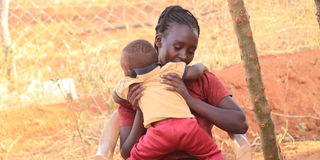
Muthina Isyima holds her child, born just months after her husband’s death, while fetching water at River Athi on September 6, 2025.
Less rain means less water. Less water means ecological collapse. Fish populations such as tilapia and catfish have plummeted due to pollution and reduced river flow. Starving crocodiles, deprived of their natural prey, have adapted by hunting what is available: the people who depend on the same water sources.
"Crocodiles are ambush predators," explains a wildlife expert, "and when hungry, they become bold and opportunistic. That's when humans become targets."
Climate change has forced both humans and crocodiles into the same shrinking spaces. As water sources dry up, communities and predators converge on the few remaining pools. It is a deadly equation: desperate predators plus desperate people equals tragedy.
Governor Mutula Kilonzo Jr. confirms the scale of the catastrophe. "Statistics show we've lost 32 people so far this year. There's not enough food for crocodiles in the rivers," he says.
The county government acknowledges the problem but struggles to address it comprehensively.
One of the few mitigation efforts underway in Kitise involves installing a sump tank with a submersible pump inside the river. The idea is to allow residents to access water without physically wading into crocodile-infested waters. Governor Kilonzo points to this initiative as a step forward, but he admits it is far from sufficient to meet the county's needs.
Martha, watching the crocodile traps along the riverbank, speaks to the belatedness of government intervention.
"It was only after Kennes was taken that KWS came and erected these traps you see here," she says. "Only that."
The governor urges the Kenya Wildlife Service to launch awareness campaigns educating communities about the dangers of approaching the river.
"People need to understand the risk," he says. "Avoiding the river is the first line of defense."
The governor also voices frustration over the lack of compensation for victims.
"The government earns significantly from wildlife tourism," he says, "yet the families who suffer from wildlife-related tragedies are left to mourn in silence." The Kenya Wildlife Service did not respond to requests for comment on their action plan or the status of compensation claims. For the families living along the River Athi, the water crisis represents an impossible choice between two forms of death: dying of thirst or dying in the jaws of a predator while trying to quench it.


