15 counties listed as high worm burden as millions of Kenyans grapple with open defecation

Public Health PS Mary Muthoni at a past event. She said the Health ministry has put in place measures to move the country from treatment to complete prevention and elimination of this entirely preventable disease burden among the most vulnerable people.

What you need to know:
- Some 27 counties carry a disproportionately high burden of worms, with counties in Western Kenya and the Coast region registering a prevalence as high as 40-50 per cent.
- This means that half of the population is infected and in need of urgent deworming.
Four in 10 people in the country are still practising open defecation, the Health ministry says. This translates to almost five million people. Consequently, 15 counties are now listed as high worm burden, according to the State Department of Public Health and Professional Standards.
The department further discloses that some 27 counties carry a disproportionately high burden of worms, with counties in Western Kenya and the Coast region registering a prevalence as high as 40-50 per cent. This means that half of the population is infected and in need of urgent deworming.
“Untreated communities act as reservoirs for transmitting re-infections to pupils, hence the push for a synchronised mass drug administration for the nation,” the latest data from the State Department highlights. Officials add that over 20 million Kenyans are infected with worms and in need of treatment while over a million pupils carry a heavy load of worms that undermine their health, school attendance and academic performance.
However, school absenteeism in the country has fallen by 25 per cent since deworming programmes were launched, and the nutritional status of Kenyan pupils has improved significantly; with an aggregate addition of a kilogramme of weight among 2-14 years olds at a population level, the data shows.
Speaking to Healthy Nation, Public Health PS Mary Muthoni explained that worms which affect humans are known as soil -transmitted helminths because they are acquired through infective eggs found in soil that is contaminated with feaces of an infected person, in areas where sanitation and hygiene are poor.
“Bilharzia is transmitted through contaminated fresh water, by urine of infected persons, often found among water poodles such as is common in rice fields, “she observed.
The eggs can be swallowed or can burrow the skin of a person and migrate to stay in the intestines as parasites and cause infection and ill health, while the bilharzia worms can penetrate the skin and in addition to the intestines reside in the wall of the urinary bladder and cause an infected person to urinate bloody urine.
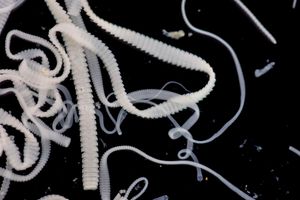
Soil transmitted worms (helminths) are a group of three parasites namely round worms (Ascaris Lumbricoides), whipworms (Trichuris trichuria) and hook worms (Ancylostoma & Necatar).
Bilharzia(Schistosomiasis) is also a hook worm.
According to the Health ministry, children aged two to 14 years are more likely to be infected by these worms and the effect on their health is far much worse as compared to adults.
Ps Muthoni pointed out that worm infections can reduce the absorption of nutrients in the body, leading to anaemia and malnutrition, and weaken the body’s immunological response to other infections such as malaria.
“Infected children may become too sick to attend school or too tired to concentrate in class.
For infected girls and women of reproductive age, blood loss worsens iron deficiency anaemia that is routinely caused by menstruation blood loss, hence causing far much worse ill health effects,” she told Healthy Nation.
The ministry further explains that control of these worms is based on periodical treatment with simple, safe and cheap deworming tablets to eliminate worms, health education to prevent re-infection, and improved sanitation to reduce soil and food contamination with infective eggs.
Deworming drugs, the PS added, are tablets for swallowing that are extremely effective with a single dose, at a cost of a few shillings per tablet, and are safe even if taken by those without worm infections. Periodic deworming tablets every 12 months addresses reinfection and the health problems associated with high worm load.
“This is because intestinal worms are most prevalent in poor countries where diagnosis is relatively costly. The World Health Organisation (WHO) recommends periodic mass administration of deworming drugs to school children in worm endemic (high-burden) areas,” she added.
According to WHO, more than 880 million school aged children are in urgent need of treatment for soil transmitted worms worldwide, while 120 million persons are at risk of bilharzia.
PS Muthoni, however, observed that all hope is not lost as the Health ministry has put in place measures to move the country from treatment to complete prevention and elimination of this entirely preventable disease burden among the most vulnerable people.
“These measures include entrenching elimination of soil transmitted helminths and bilharzia in policies such as the school health policy and the strategic plan for elimination of neglected tropical diseases in Kenya by 2030.
“The Health ministry together with development stakeholders and development partners in the space of water, hygiene and sanitation are working to address the nearly address million people in Kenya still practicing open defecation and hence sustaining the transmission of these worms. Most of these open defecations are concentrated in 15 high worm burden counties with over four in 10 people practising open defecation,” she told Healthy Nation while further explaining that this is being achieved through targeted health education, infrastructural investment in water, hygiene and sanitation and a deliberate effort to move Kenya to an open defecation free country by 2030 through nationwide safe waste disposal.
“Some countries like Japan that started with a higher burden of worms than Kenya have eliminated worms through deworming coupled with public education on hygiene, safe water, safe waste disposal and robust sanitation,” she said.