15 months without pay: The plight of TB health workers abandoned by the system

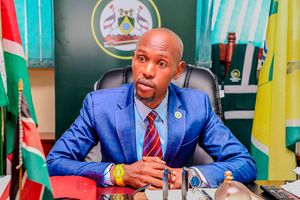
Lucy Kigumo, a clinical officer, during the interview.

What you need to know:
- For the 15 months they have not been paid, the counties have neither remitted their contributions to the Social Health Authority, nor their union dues.
The last time Lucy Kigumo, a clinical officer, was paid her salary by the Ministry of Health was in June 2024, 15 months ago. Since then, Lucy and her colleagues, who are laboratory technicians, have been surviving on their partners' incomes, while others have depleted their savings and taken loans.
Lucy is one of clinical officers and lab technicians who were employed by the Ministry of Health in partnership with the Global Fund to support the TB Programme.
"I joined the programme in 2015, six years after its start. At the time, the Global Fund funded our programme as well as the NASCOP and malaria programmes. We were posted to 31 counties across the country on annual, renewable contracts.”
"I was posted to Dandora 1 Health Center, where my work involves providing care and treatment, diagnosing, and following up with TB patients. On a clinic day, I see about 20 TB patients, but on a normal day, the figure can go up to about 50," she says.
The contract renewal continued until December 2023, when the programme was transitioned from the Global Fund to the Kenyan government. An agreement was made for the workers to be transitioned to permanent and pensionable terms, but this has yet to happen.
In January 2024, the Ministry of Health said it would pay us our salaries for six months, and we would then be absorbed. However, what followed was six months of no monthly salaries, followed by a lump-sum payment in June. That was the last money we ever saw.”
"Since then, we have not been paid. This September will be the 15th month we have not been paid by the government. In the meantime, our colleagues who were posted to the national government were absorbed and are earning their salaries. Originally, there were 116 workers in the TB programme. The 25 who were working in national facilities have been absorbed, but the 91 who work in county facilities have not," she adds.
"The government owes each of us at least Sh1 million," she says.
She explains that their work environment is hostile since they work alongside civil servants who are receiving their salaries. Besides, TB is a contagious disease, and the workers are not compensated for their work or provided with adequate medical cover.
"The lack of pay has led to debt, mental distress, and an inability to meet basic needs, including paying bills and school fees for our children. Due to this mental and financial strain, one of my colleagues took her daughter's life and then committed suicide.
"We have tried to get answers from the Ministry of Health, but they keep telling us that they are waiting for funds from the Treasury. The Health ministry has also not handed over the necessary budget and payroll information to the counties, which is a major barrier to our absorption," says Lucy.
Intervene
Lucy is now appealing to the government to intervene and resolve the issue quickly while she accuses the Kenya Union of Clinical Officers of neglecting their issue due to their small number.
Jackline Omae also echoes Lucy’s pleas. She is a laboratory technologist in the same institution Lucy works at and joined the programme in 2009.
" I'm financially down. I even have a daughter who has a chronic condition and requires monthly medication worth Sh16,000, which I cannot afford. It’s sad for us. We are really struggling to meet our daily expectations; we don’t know what to do. We are crying to the ministry to find a way to pay us.
"That same daughter with the chronic condition is in university. I'm supposed to pay her school fees. They have been given until October 3 to clear arrears, or else they won't sit for their exams, but I don't have any money to salvage the situation," she adds.
She explains that for the 15 months they have not been paid, the counties have neither remitted their contributions to the Social Health Authority, nor their union dues.
Peterson Wachira, the chairperson of the Kenya Union of Clinical Officers, explains that the Global Fund staff were initially hired to fill human resource gaps.
He notes that When the Global Fund contract was ending, there was an agreement for the staff to be absorbed into the government payroll. The Public Service Commission indicated that each county should absorb the staff working within its jurisdiction, but a problem arose due to a lack of a clear agreement between the national and county governments.
“Counties are claiming they don't have the money to absorb the staff, even though the numbers are small, sometimes as few as two officers per county. The staff haven’t been hired because of lack of goodwill from the counties,” says Wachira.
Responding to allegations of the staff that the union had sidelined them and was not really keen on fighting for them because their numbers are small, Wachira says the union has been actively pursuing the matter.
“We have pursued the ministry to either absorb the staff or continue paying their salaries until an agreement is reached. We filed a petition to the Senate Health Committee, led by Senator Jackson Mandago at the time, regarding UHC and the Global Fund issue. This was done during the UHC demonstrations. We met Health Cabinet Secretary Aden Duale who said the Ministry of Health did not have a budget, but promised to look into it.
“However, I believe the issue is not about money. The National Assembly and the Senate can assist by providing a budget, as they did in a supplementary budget before, to sort out the issue,” he adds.
On September 27, 2024, the Council of Governors (CoG) sent a letter to the Ministry of Health stating that county governments need an additional budget of approximately Sh136,310,040 to absorb the additional staff and cover their salaries, pensions, and other benefits. The CoG also noted that the provided list of staff was inadequate for a smooth transition because the detailed payroll data was still with the Ministry of Health.
Separately, in a January 29, 2025, letter to the National Treasury, Public Health PS Mary Muthoni requested funding to resolve the employment issue for healthcare workers previously supported by the Global Fund TB Programme.
The PS highlighted that the Global Fund's support ended on December 31, 2023, and despite a prior government commitment to absorb the staff, the transition has failed.
"The Public Service Commission had initially approved a six-month temporary absorption by the Ministry of Health, which paid the staff until June 2024. However, the subsequent planned transition to county governments beginning July 1, 2024, has stalled due to counties citing a lack of funds," said PS Muthoni.
The PS requested that the National Treasury directly allocate funds to the Ministry of Health to cover the unpaid salaries since July 1, 2024.