20 health agencies to lose Sh1bn in upcoming financial year's budget
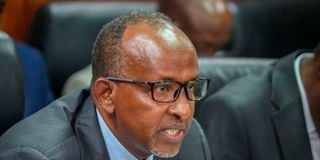
Health CS Aden Duale when he appeared before the National Assembly Health Committee at Parliament buildings Nairobi on May 15, 2025. He has requested the committee to rethink its budget, especially for the Semi-Autonomous Government Agencies.

What you need to know:
- The affected agencies include Pharmacy and Poisons Board, the Nursing Council of Kenya, Health Records and Information Managers Board, Tobacco Control Fund, Tobacco Control Board, and the Kenya Medical Laboratory Technicians & Technologists Board.
At least 20 government health agencies will lose nearly Sh1 billion in the financial year that begins in June.
These cuts will make it difficult for these agencies to pay their workers and cover basic day-to-day expenses. If the agencies cannot maintain their normal operations, it means health services provided to Kenyans could be significantly affected.
The Semi-Autonomous Government Agencies (SAGAs) are from the Department of State for Public Health and Professional Standards.
Of the 20 public entities, six received no money at all in the draft budget for 2025/26 that is currently being reviewed by committees in Parliament.
The affected agencies include Pharmacy and Poisons Board (PPB), the Nursing Council of Kenya, Health Records and Information Managers Board, Tobacco Control Fund, Tobacco Control Board, and the Kenya Medical Laboratory Technicians & Technologists Board.
It is only the National Quality Control Laboratories, previously unfunded in the February Budget Policy Statement, which has now received about Sh10.7 million.
Rethink budget
During his presentation to the Departmental Committee on Health chaired by Seme MP James Nyikal, Health Cabinet Secretary Aden Duale requested the committee to rethink their budget, especially for the SAGAs.
“The historical underfunding of salary budget in SAGAs, particularly in referral hospitals, Kenya Medical Training College and the Regulatory Bodies coupled with establishment of new specialised hospitals means that there is need to increase funding to employ and retain health workers to ensure optimal provision of specialised health services so that Kenyans can draw value for money in the modern infrastructural developments under the State Department,” he said.
Public Health PS Mary Muthoni told the MPs that the proposed budget cuts by at least 20 per cent will affect day-day functions of the agencies.
“I request the intervention of the committee to reconsider this proposal and allocate resources to the aforementioned agencies, at the very least to enable them to pay the personnel emoluments (salaries) for their staff,” she said.
Some areas of development may not be achieved because of zero allocation or reduced funding based on the projections that had been made earlier this year.
The State Department of Public Health had prioritised 15 developmental projects, two of which did not receive any funding from both the Budget Policy Statement and the current draft of the budget. They include Building Resilience and Responsive Health System Project and the Public Participation Projects.
Some projects like the Infrastructure Upgrade at Kenya Institute of Primate Research, Construction of the Kenya Medical Practitioners and Dentists’ Council Examination Centre, as well as the construction of the Kenya Nuclear Regulatory Authority Central Radioactive Waste Processing Facility did not receive any funds.
"I urge the committee to reconsider reviewing funding allocated to the capital projects, particularly the ones whose project implementation period is coming to an end," said PS Muthoni.
CS Duale said that while the ministry has set targets for the health sector, those can only be achieved if the budgetary ceiling is revised upwards.
“This is for the benefits spelt out to reach to citizens, otherwise we will remain with very good policies that are not funded. For instance, the operationalisation of the Primary Healthcare Fund, which is fully publicly financed, is not funded in the sector ceiling while the Emergency, Chronic and Critical Illness Fund has only been allocated Sh2 billion for operationalising the fund,” he said.
On the flip side, the Health ministry also received key funding in areas that were previously snubbed during the writing of the Budget Policy Statement earlier this year.
Medical interns got the lion's share from the draft budget - about Sh4 billion, followed closely by Community Health Promoters who got over Sh3 billion for their stipend share from the national government.
Other allocations include Training for Human Resource for Health capped at Sh203, 000,000, payment of medical doctors basic salary arrears (Sh1,750,000,000) and the Primary Health Care Networks -Sh 225,098,139.
Despite the inclusion of medical interns in the budget, Ms Muthoni told the committee that her department will need an additional Sh3.6 billion to on board 5,499 interns as of July this year.
“The State Department is requesting the committee to consider allocating this deficit for payment of medical interns’ stipends in the proposed FY2025/26 Draft Estimates,” she said.
Health products
Even though the Pharmacy and Poisons Board did not receive any funds from the draft budget allocation, PS Muthoni proposed the separation of the board’s functions and have regulation of pharmacy profession be different from regulation of health products.
“This separation will streamline oversight, expedite approvals, foster innovation, clarify accountability, and align Kenya with global best practices, thereby enhancing the country’s competitiveness in the trade of health products,” she advised.
“PPB faces staffing shortages in key areas, hindering compliance and regulatory efficiency. Addressing these gaps is vital to meet global standards. Adequate funding is needed for recruitment, capacity-building, infrastructure, and system improvements to ensure KHPTA (Kenya Health Products and Technologies Regulatory Authority) operates independently and effectively,” she added.