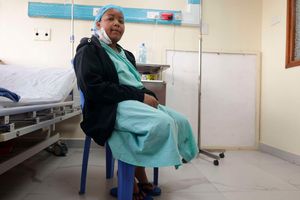
29 million registered, only 5 million paying: Why SHA is on life support

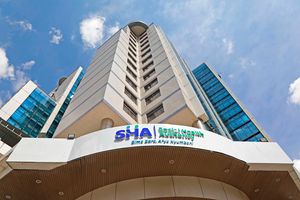
The Social Health Authority building in Nairobi.

What you need to know:
- Of the 29 million , only about five million are actively paying premiums.
- For every shilling that informal sector workers contribute to SHA, the fund pays out more than Sh26 in claims.
For every shilling that informal sector workers contribute to the Social Health Authority (SHA), the fund pays out more than Sh26 in claims, and the ratio is getting worse.
That is the main crisis now threatening Kenya's Universal Health Coverage ambitions, as SHA faces mounting pressure from debt to hospitals, an informal sector that has largely stopped contributing, and a Parliament worried about its sustainability.
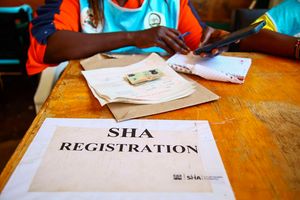
When SHA was launched, the government's promise was straightforward: it was building a health insurance scheme that works for everyone. Of the 29 million Kenyans who have since registered, only about five million are actively paying premiums.
The rest signed up and walked away, and those who do pay are largely the already sick. They enrol, access care and drop off, leaving the fund with bills it cannot absorb.
The result is a loss ratio in the informal sector that has gone from 1,922 per cent in January 2025 to 2,655 per cent by June 2025, meaning SHA is paying out more than Sh26 for every shilling it receives from that segment, according to calculations by the health agency.
The claims settlement rate stands at 74 per cent. The authority targets 85 per cent population coverage, projecting 43 million Kenyans comprehensively covered, with an average premium of Sh14,090 per household needed to sustain the fund.
"If we were to even reduce this 2,655 per cent to 200 per cent, I would not have enough resources to pay out. So if we want to solve the problem of SHA, this is the problem we need to be solving," SHA Chief Executive Officer Dr Mercy Mwangangi said in a statement.
Seme MP James Nyikal, who chairs the National Assembly's Departmental Committee on Health, said at a committee engagement in Mombasa last week: the revenue that SHA collects is really not enough to meet its expenses. As things stand now, they are barely getting what they need to run.
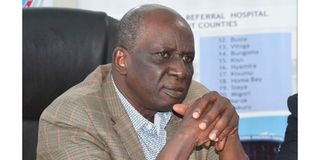
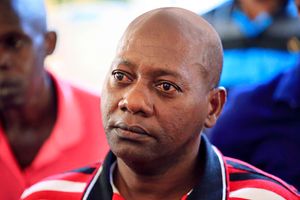
National Assembly committee on Health chairperson and Seme MP James Nyikal.
SHA was built on the principle that if everyone contributes, the healthy subsidise the sick, the young subsidise the old, and the system sustains itself over time. That model broke down under the National Health Insurance Fund (NHIF), brought down by mismanagement, fraud, and a benefit package that could not keep pace with the actual cost of care.
SHA was supposed to fix all of that. The new system separated contributions into three funds. There is the Social Health Insurance Fund (SHIF), which covers inpatient and specialised care; the Primary Healthcare Fund, financed directly from the exchequer for outpatient services at lower-level facilities; and the Emergency, Critical and Chronic Illness Fund. Each fund has its own bank account, and the law prohibits moving money between them.
"There is no commingling of funds,” Dr Mwangangi told the parliamentary committee in Mombasa, saying The law expressly prohibits her from removing money from one fund to another.
The formal sector has held up because employers remit contributions directly, and the loss ratio there has remained manageable, ranging from 35 per cent in January 2025 to 72 per cent by June 2025. The informal sector is where the model is breaking down.
Dr Brian Lishenga, Chairman of the Rural and Urban Private Hospitals Association (RUPHA), said SHA made a mistake by not creating awareness of its benefits package, including what it covers for those in the informal sector, before the launch, and that irregular incomes make fixed monthly contributions impractical for many such households.
"SHA is a health insurance that requires a completely different mind-set. You pay when you are well so that the system can afford to treat you when you are sick. Convincing millions of Kenyans who earn irregular incomes, who have competing financial priorities, and who have historically had little reason to trust government institutions to adopt that mind-set was never going to be simple," Dr Lishenga said.
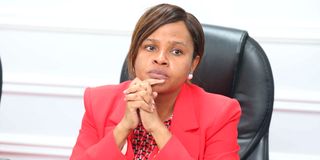
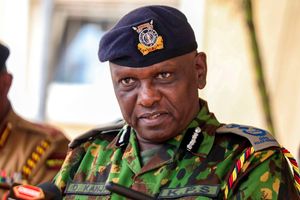
Social Health Authority CEO Dr Mercy Mwangangi.
He added: "Lack of formal identification documents among some of the most vulnerable populations, and weak enforcement mechanisms that mean non-contribution carries no real consequence are the main reasons for defaulters."
According to the Kenya National Bureau of Statistics, the informal sector represents 83 per cent of the country's workforce, totalling 19.9 million workers against just 3.1 million salaried employees. For someone earning Sh10,000 monthly, the SHA contribution of at least Sh6,000 annually is a significant financial decision, equivalent to three months' rent, meals, school transport or business stock.
The challenge mirrors what brought NHIF down, where only the sick consistently paid premiums and many dropped off once they received full benefits, rendering the scheme unsustainable. Under NHIF, only 22 per cent of registered informal sector members were active against a target of 74 per cent, while the retention rate for formal sector workers was 77 per cent against a targeted minimum of 88 per cent, leaving the insurance unable to settle claims or meet administrative costs.
The government acknowledges that voluntary registration will never achieve universal coverage in an economy where 83 per cent of workers are informal, but has yet to develop a clear strategy to ensure compliance from that segment.
Dr Mwangangi has insisted SHA is not dead and that the authority is running a surplus. "The authority has collected Sh159.34 billion in contributions since its establishment and disbursed Sh122.34 billion to healthcare providers, generating a net operating surplus of Sh36.99 billion, against NHIF's net deficit of Sh2.26 billion in its final year," she said.
Yet even as SHA points to that surplus, hospitals have been pressing the authority to settle outstanding claims, with some reporting they have not been paid for close to three months, with the amounts running into billions of shillings.
Also Read: MPs committee - This is what ails SHA
The Social Health Authority building in Nairobi.
Dr Nyikal said the surplus figure told only part of the story. "A surplus on paper means little if the money earmarked for the Primary Healthcare Fund is insufficient, if NHIF legacy debts remain unpaid, and if informal sector loss ratios continue accelerating toward figures that no fund can sustain," he said.
He said the design and concept are good and that what SHA is going through is a problem of implementation requiring cooperation from management, providers and the public.
"SHA has the architecture, the digital tools, and the political backing of a government that has staked considerable credibility on its success. What it does not yet have is the 24 million registered Kenyans who are not paying. Until that changes, the surplus will continue to look different depending on which column of the ledger you are reading, and the dream of Universal Health Coverage, a Kenya where no one skips treatment because they cannot afford it, will remain exactly that," Dr Nyikal said.
"If people wait until they are sick to register and pay, then immediately incur huge costs, where does the money come from? We must build a culture where Kenyans pay in advance to create a sustainable pool," Dr Nyikal said.
Without the informal sector, the health committee boss said, “the numbers do not add up.”
“The informal sector is the majority of the population. They must become regular contributors to SHA, not when they are sick, not when they are forced to, but as a habit, a norm, a reflex. That requires trust in a system that has historically let them down, simplicity in processes that are currently anything but simple, and enforcement mechanisms," Dr Nyikal said.
Follow our WhatsApp channel for breaking news updates and more stories like this.