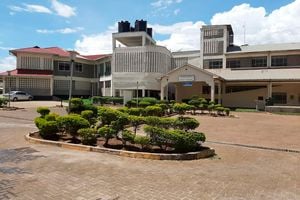
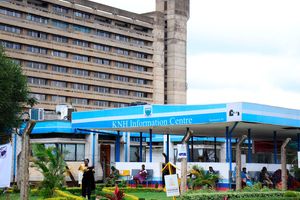
A detained patient, a crippled Nairobi facility and Sh78,000 hospital bill
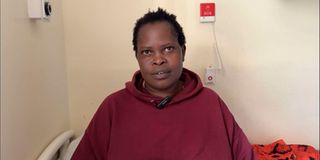
Margaret Kegenga. She has, for the past 22 days, been detained at the Balozi Hospital, South B, over a medical bill of Sh78,200.

The ward is quiet—too quiet. Five empty beds line the room, separated by walls and curtains that billow slightly when the breeze sneaks in.
Across the corridor, four private rooms sit vacant, their doors ajar. The delivery room, too, waits for no one. In this entire upper floor of Balozi Hospital in Balozi Estate, South B, there is only one patient: Margaret Kegenga.
For 22 days now, her world has shrunk to these few square metres—the ward where she sleeps, the corridors that wind past the men's and paediatric wards, and a small backyard where she sometimes escapes the heavy silence upstairs. Other times, she clings to her phone, finding brief relief in TikTok jokes. Anything to forget, even momentarily, that she cannot leave.
"I feel like torture," she says, her voice steady but worn. "I don't sleep comfortably at night because I don't know what could happen to me in the middle of the night. It is just me here and the guard manning the facility. I don't feel safe at all."
This is not where Margaret thought she would be when friends directed her to a private surgeon for an umbilical hernia surgery—a procedure to repair a bulge in the abdominal wall near the belly button. On September 21, when she was admitted, relief washed over her. Finally, answers. Finally, a solution.
"I had struggled with this condition for a while and received conflicting diagnoses," she recalls. "One health practitioner told me I had fibroids, while another said I was pregnant because of how big my belly had grown. I even began attending antenatal clinics. Later, it was discovered that I was neither pregnant nor had fibroids."
The condition had taken more than her health. "This tore down my marriage," the 46-year-old says quietly. But she had hope. "When I was told that I could get help here, all I thought was, 'I have SHA, I should be okay.'" She is a paid-up member of the social health scheme, which hosts the Social Health Insurance Fund (SHIF).
Then, something happened.
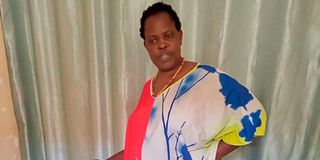
Margaret Kegenga at the Balozi Hospital, in South B, Nairobi.
On September 27, Margaret was discharged—but she couldn't pay the bill of Sh156,000. The SHIF fund paid Sh44,800. The facility's administration said the only way out was to clear the bill to enable them to pay the specialists who had attended to her. And so, she stayed.
A mother's isolation
The solitude is perhaps the hardest part. Occasionally, her two daughters—aged 20 and 13—come to visit. But even that brings its own anguish.
"Our home is at Uthiru Gishagi. For them to be here, it means that I have to cater for their transport while still figuring out what they will eat back at home. I can't afford it. They are currently staying with my mother."
The days blur together. "Being here alone, hungry and desperate is tough," Margaret says. "I have not had any meal since yesterday evening. It is now noon, yet I have to take medication, including some to manage hypertension. When I get something from well-wishers, I request one of the workers to get me some ugali and vegetables."
From the corridor of this upper floor, she observes the slow unravelling. She has seen some of the staff crying while holding envelopes. Someone has walked around counting the beds. Another group has taken away the oxygen cylinders.
"They told me that they are closing down, and I need to pay my medical bills," she says. "Thankfully, the director has discounted it to some Sh88,200 from Sh210,000. I paid Sh10,000 yesterday and now remain with a Sh78,200 balance. I cannot afford to pay. I have made pleas to family and friends but still…"
Facility founder
"You think I am happy that Margaret is there? I am really sad. You know she is the only patient at the hospital now," says Ali Hussein, a surgeon and founder of the facility, his voice tight with frustration when reached by phone.
When he begins to tell the hospital's side of the story, it is a narration that depicts a facility on its knees.
"I am not malicious to detain a patient. I don't have those guts. I am a human being. I am a doctor. I am trying to find ways to release her."
According to Dr Ali, the facility that used to see at least 25 outpatients every day and the same number of inpatients every month can no longer afford to pay staff or meet its running expenses.
"We have not paid September salaries," he says, the weight of it evident. "And you know why we are closing the hospital? It's because of such issues. That is one. I have piles of logbooks and title deeds over the past six years. An accumulated debt of almost 8 million."
The numbers are staggering. "Among others, NHIF went defunct with Sh25 million owed to us. Now, SHA owes us Sh23 million. Yesterday, they wired some Sh89,000 to our account. You tell me, what can I do with this? I have letters from suppliers demanding payment. How do I pay them?
Dr Ali explains that in the past, they have let patients go even with bills that triple that of Margaret's. "We are hesitant because this was an elective surgery. We explained that on top of the hospital fees, there are the surgeon's and anaesthetist's fees. We were in total alignment until the day of discharge."
Currently, the facility is offering outpatient services only and has already given notice of closure and end of employment to its more than 20 staff.
"I want Margaret to go home as well. The sooner the better. I hope we find a way out soon," he offers.