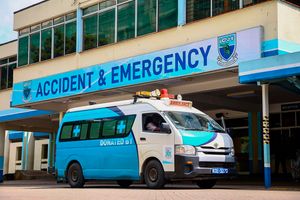
A tale of two ambulances: Where you land determines if you live or die
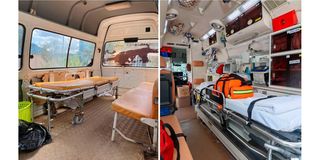
Inside two ambulances expected to offer emergency medical care for patients. The first is ill-equipped and the second is well equipped.

What you need to know:
- Inside Kenya’s ambulance divide, equipment, training and response systems determine whether emergency patients live, die, or suffer.
- From advanced life support units to bare county vehicles, a hidden crisis shapes survival chances during emergencies across the country.
When disaster strikes, where you are taken, and what is waiting for you there, can be the difference between life and death. But for most Kenyans, that is a lottery. Healthy Nation goes inside the ambulance divide.
The walkie-talkie crackles just before midday.
Alvin Ekidor is about 300 metres from the hospital when the call comes through. The caller first asks him whether he is available for dispatch. He says yes. The caller then walks him through what to expect: a patient who has been involved in an accident, currently at a facility with no CT scan equipment. He needs urgent transfer to another hospital for a head scan before treatment can begin. Time matters.
Alvin confirms the dispatch time and heads out immediately.
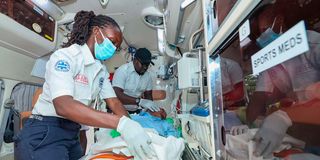
Paramedics and ambulance operators Faith Kahumba (left) and Kevin Odwar attend to a patient while responding to an emergency at Luton Hospital along Ngong Road, Nairobi, on April 16, 2026.
When he arrives at the hospital, he radios in his arrival and is directed to the patient. Beside him are two colleagues, Faith Kahumba and Kevin Odwar, both Emergency Medical Technicians (EMT) like himself. The three work as a team, with duties shared depending on what the situation demands.
Faith takes down the handover notes from the nurse in charge, pressing for more detail about the patient before the transfer is made official. The nurse goes through everything: oxygen levels, blood pressure, pulse, the medication already given to stabilise him, and the reason for the transfer. Kevin then joins, and together with the nurse, they move the patient onto the ambulance stretcher and wheel him out.
Inside the ambulance, Faith and Kevin sit with the patient, making sure he is strapped in and stable. The receiving facility has already been alerted. As the siren whirrs to signal there is an emergency case inside, Faith and Kevin appear calm. The monitor beeps steadily. Faith checks the patient's vitals and inspects the head bandage the nurse put on before the transfer. Despite the speed at which the vehicle moves, the ride is surprisingly comfortable. Outside, road users hear the siren and pull aside, some visibly irritated at the wait, but they move all the same.
We are inside one of the few Advanced Life Support ambulances in the country.
"It is like a moving Intensive Care Unit," Alvin tells Healthy Nation.
Not every ambulance in Kenya looks like this one.
Nation sought access to public ambulances across several counties, to see what equipment they carry, how they are staffed, and what patients can expect when they are loaded inside. In most cases, ambulance operators said they needed authorisation before they could speak to us or allow filming. Most doors stayed shut.
But we do get a glimpse inside one ambulance from a county government. What we see tells its own story.
The floor is dirty. The stretcher has one set of rusty wheels. There is no bed sheet, nothing to lay a patient on in case of an emergency. The bench where an emergency technician or nurse is supposed to sit looks weak and broken. There is no functional safety belt. There are no gloves, no visible medical equipment. What the ambulance holds is a box of masks, a dustbin and some trash bags. The vehicle is old and bare.
We are not allowed to film it.
What we do know beyond that comes from those who have ridden inside the public system, and what they describe is a world away from the ambulance Alvin, Faith and Kevin operate.
No equipment
A student nurse who did her internship at a county hospital says her first ambulance ride was not what she had imagined. "We got a pregnant woman who needed urgent surgery. The ambulance did not have any gloves. The stretcher was down. There was no equipment that could help us stabilise the patient. We were moving in faith," she tells Healthy Nation.
She had never seen an Advanced Life Support ambulance before, only in movies.
"I used to think that all ambulances are fully equipped like the ones in movies. The experience I have had so far is just a basic ambulance," she says.
That day, there was no EMT on the vehicle. It was her and her fellow student nurses, people still in training, with no formal instruction in emergency care, handling a real patient in a real emergency with no gloves and a stretcher that would not rise.
"Thankfully, we got to the next facility and she was taken in for surgery. I hope she survived," she says quietly.
She asked not to be named, fearing victimisation.
Back in Alvin's ambulance, the contrast is stark.
Alvin has been in Emergency Medical Services for eight years. He completed both the Emergency Vehicle Operator Course and the Emergency Medical Technician course. He says his posting at Luton Hospital in Nairobi was his first time working in a fully equipped ambulance.
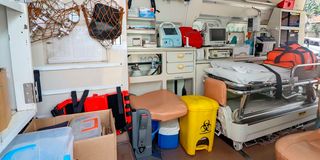
The interior of an ambulance, fully equipped with a stretcher, emergency medical supplies, and life-saving equipment, at Luton Hospital along Ngong Road, Nairobi, on April 16, 2026.
"This is different. Emergency care is the first defence line in saving lives. If the government invests in proper personnel, a good system that connects the EMT from where the patient is to the facility and also enhances the readiness of receiving facilities, more Kenyans will be saved," he says.
He also points to a gap that most people do not realise exists.
"Even though there are different ambulances, very few people know about them. This means that many lives that could have been saved miss out on this essential service," he says.
Every morning, before a single call comes in, the crew runs through a checklist. Hygiene is first, the ambulance must be clean. Then equipment: is everything in place? Are the machines that need charging fully powered? Is the medication still within its expiry date? They also carry a portable trauma bag for situations where they need to go directly to the scene and stabilise a patient before loading them into the ambulance.
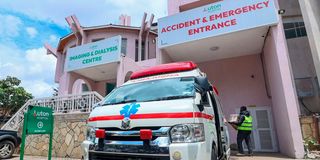
An ambulance belonging to Luton Hospital along Ngong Road, Nairobi, on April 16, 2026.
It is painstaking work, but in emergency care, the preparation before the emergency is everything.
Kevin has been in the industry for more than ten years. He has seen things that stay with a person.
He was there during the Dusit attack in 2019 and worked through the Gen Z protests that took place 2024. He once responded to a patient with a compound fracture so severe that the neck and body had been separated. Those experiences, he says, have never left him.
"We are human; the primary thing is our safety. In volatile cases, we normally work with the police so that they neutralise the area so that we take the casualties. Sometimes we have to take risks in order to save lives," he says.
Working in a properly equipped ambulance, he adds, changes what is possible.
"It has everything that an ambulance needs. The other one has only basic equipment. I believe that even with the best equipment, having qualified personnel differentiates an ambulance from any other vehicle," he says.
Faith came to emergency care through her mother, who has worked in the medical field for years. Five years in, she says the job has reshaped the way she sees the world.
"Life can be fickle, and fragile," she says.
The cases she encounters most are accidents, falls and pregnancy-related complications. She has helped women deliver babies in downtown Nairobi. But not every shift ends well, and she does not pretend otherwise.
"Sometimes we come across patients who are stubborn, they are injured but they do not want to go to hospital. We feel bad when we lose patients," she says.
It is the saves, though, that keep her coming back.
"We feel great when we save a life. That is what inspires us to keep going. The other day I saved a teenage mother who was on the verge of losing their life, and that of their unborn child," she says.
"We managed to take her to the hospital where she had a caesarean section in good time. I followed up to find out if the baby survived. The baby died. That was disappointing, but every day as we go home, saving lives is what makes us wake up the next day happy to go to work," she adds.
What ought to be changed
On what needs to change, she has a request for the government.
"I would ask the government to fill the gap between the home and the hospital when there is an emergency. It is important that they also employ qualified people and invest in ambulances and stock them fully," she says.
The gap Faith is describing is not unique to the capital city.
In Bungoma, we spoke to a private ambulance operator whose vehicle carries a stretcher, an oxygen cylinder, a chest compression machine and a first aid kit. That is the full inventory. No monitor, no ventilator, no syringe pump, and no delivery pack.
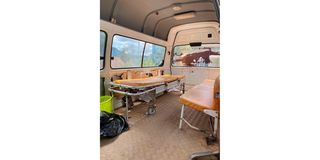
ONE TIME USE ONLY Inside a government ambulance in a deplorable state, with no equipment that is required in case of an emergency, on April 16.
It is a reminder that "private" does not automatically mean "equipped." Between the Advanced Life Support ambulance and the most basic vehicle on the road, there is a broad and largely invisible spectrum, and most Kenyans have no way of knowing which end of it they will land on when disaster strikes.
Here is what the numbers show. Data from the Kenya Institute of Public Policy Research and Analysis (Kippra) shows that assault is the leading cause of medical emergencies in the country, accounting for about 42 per cent of all reported cases between 2018 and 2022. Road-related injuries have also been rising sharply.
Last year, the National Transport and Safety Authority recorded about 4,458 fatalities linked to road accidents. In its 2024 policy paper on strengthening emergency medical care in Kenya, Kippra noted that half of all deaths and a third of disabilities caused by road injuries could be addressed with effective emergency care.
"Accidents and injuries are leading in the Average Length of Stay in hospital, with affected patients spending an average of 22.2 days. The Ministry of Health classifies road accidents and injuries as disease burdens. Road accidents result in injuries and trauma. Injuries cause mortality, disability and even impairment, which have an implication on treatment cost, quality of life and productivity of an individual."
The paper calls for agility in response and adequate preparedness, from handling patients at the scene of an accident, to the ambulance ride, to the readiness of the receiving facility. Every link in that chain matters. Right now, too many of those links are broken.
The World Health Organization lays out clear standards for what different ambulances should carry and do.
A Basic Life Support (BLS) ambulance should be able to provide initial, non-invasive life-saving care: basic airway repositioning, cardiopulmonary resuscitation, control of external bleeding and immobilisation of the spine and fractures. The specific scope of BLS, however, is determined by each country.
An ambulance belonging to Luton Hospital along Ngong Road, Nairobi, on April 16, 2026.
An Advanced Life Support ambulance goes further. It must provide all BLS functions, plus advanced care for critically ill patients, including advanced airway management, procedures such as chest drain placement, administration of intravenous and intraosseous therapy, and advanced patient monitoring.
By that standard, the ambulance that Alvin, Faith and Kevin operate meets the bar. Most in Kenya do not.
There have been moves to address this, on paper, at least.
Last year, the Kenya Medical Practitioners and Dentists Council (KMPDC) mandated all ambulance service providers to formally register with it, creating a unified professional framework for pre-hospital and inter-facility emergency care. Ambulance operators, EMTs, paramedics and related providers, previously overseen by the Kenya Healthcare Professionals Oversight Authority, now fall under KMPDC.
The aim is to ensure vehicles are properly equipped, staffed by qualified personnel and operating under clear clinical protocols. As of last year, about 200 emergency medical service providers had registered with KMPDC, with approvals still pending.
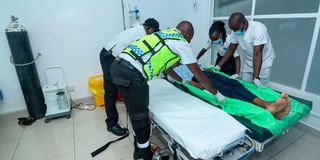
Paramedics and ambulance operators while responding to an emergency at Luton Hospital along Ngong Road, Nairobi, on April 16, 2026.
Kenya also plans to roll out emergency medical services covered by the Social Health Authority by June. The package would include payment of the ambulance fee and the first 24 hours of hospital care.
Back in the Advanced Life Support ambulance, the patient is stable. Faith is still watching the monitor and the siren is still on. Alvin keeps his eyes on the road.
They get to the facility. The patient is handed over. There are smiles, quiet, tired ones. Another life pulled back from the edge. The three then turn back to the ambulance and begin cleaning it, methodically, the same way they started the morning. By the time they are done, it is back at the parking lot, fully prepared, waiting for the next call.
What surrounds them in that vehicle, the ventilator, the defibrillators, the three oxygen cylinders, the syringe and infusion pumps, the nebulising machine, the delivery pack and the advanced stretcher with its airbag system, represents what emergency care in Kenya could look like, if the will and the investment were there.
What is inside the advanced life support ambulance?
- Patient monitor
- AED (automated external defibrillator), for cardiac arrest cases
- Syringe and infusion pump for drug administration
- Ventilator, supports patients from 5kg and above
- Nebulising machine, for asthma attack cases
- Medications, both oral and injectable
- Three full oxygen cylinders
- Seatbelt for safety
- Oxygen masks
- Fluids
- Delivery pack
- Suture bags
- C-collars and C-spine for neck and spine support
- Defibrillator (automatic and manual)
- Advanced stretcher, adjustable height, with an airbag
- Electricity to power the machines
- Fire extinguisher