Abandoned boats become toxic waste in Lamu's pristine waters
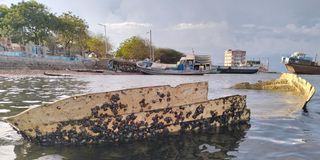
An old boat abandoned and left to rot inside Indian Ocean on Wiyoni Beach in Lamu County on March 26,2025.

What you need to know:
- These vessels—ranging from large fishing boats to small dinghies—are composed of materials including timber, metal, plastics, and fiberglass that pose significant dangers to both marine ecosystems and human health.
The azure waters of Lamu's coastline, once pristine and teeming with marine life, now face a mounting crisis as abandoned boats and vessels litter the archipelago's shores.
This environmental hazard is compounding the already serious problem of plastic pollution, threatening the Indian Ocean ecosystem.
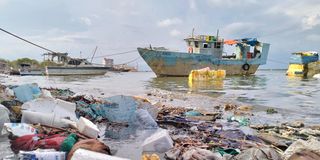
A section of the Lamu Island Beach infiltrated by solid waste materials ranging from plastic bottles, fishing nets and parts of old ragged boats.
While recent anti-plastic campaigns have reduced some visible waste along Lamu's beaches, environmentalists are increasingly concerned about the proliferation of derelict boats left to deteriorate in coastal waters. These abandoned vessels—ranging from large fishing boats to small dinghies—are composed of materials including timber, metal, plastics, and fiberglass that pose significant dangers to both marine ecosystems and human health.
"These abandoned vessels often contain fuel residues, paint, and other chemicals that leach into the water, polluting the marine ecosystem," explains Shee Bwana of the Blue Economy Network-Kenya.
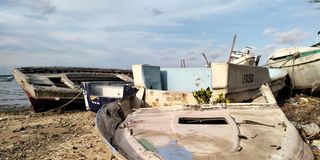
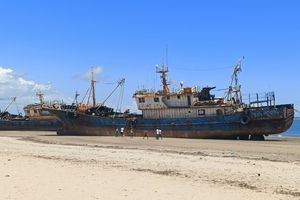
Old ragged marine vessels dumped on the shores of Wiyoni Beach in Lamu Island.
"Decomposing boats can harbour bacteria and attract pests, posing health risks to nearby communities."
The practice of abandoning boats along Lamu's shores has historical roots but has become increasingly problematic as vessel materials have evolved from biodegradable timber to synthetic substances like fiberglass and plastic that persist in the environment for decades or even centuries.
Ali Abuu, 58, a boat owner in Wiyoni, says while growing up, they used to see their parents abandoning their old marine vessels at sea or on the beaches and shores to rot, especially once they became irreparable.
"Once the boat becomes old, we either have its parts sold as spares or we just abandon it on the beaches, where it finally gets washed away by ocean tides never to see it anymore. We adopted the behaviour from our forefathers," says Mr Abuu.
According to the Lamu County Environment Department, no comprehensive survey has documented the exact number of abandoned vessels, but officials estimate hundreds of derelict boats currently litter the archipelago's coastline. This growing problem reflects broader trends of marine pollution affecting the entire Indian Ocean region.
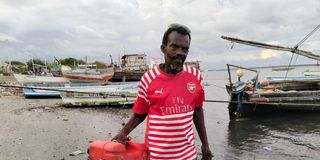
Lamu Island senior coxswain Mohamed Hassan. He has criticised the Lamu County government for lacking waste management policies to curb careless disposal of solid waste, including having specified yards to dump old, ragged boats.
Edward Menza, Lamu County National Environment Management Authority (Nema) director, describes the abandoned boat situation as "a time bomb waiting to explode," with far-reaching environmental consequences.
When exposed to wave action, saltwater, and solar radiation, materials from these vessels—particularly plastics and fiberglass—break down into microplastics, particles smaller than a strand of human hair, that persist throughout the marine environment.
"Marine organisms such as jellyfish and mussels filter these particles out of the water. Those microplastics accumulate not only in the stomachs but also in the tissue and even the body fluids of shellfish," Menza explains.
"Those plastics might contain toxic substances such as softeners, solvents, and other chemicals that end up poisoning marine organisms and, if they enter the food chain, possibly humans as well."

Lamu Marine Forum environmentalist Mohamed Athman. He expressed concern that if dumping of old, ragged boats inside the Indian Ocean will continue in the area, it will affect marine life, human beings and the economy, including tourism.
He warns that the Lamu fishery sector will likely face losses soon if the situation is not curbed, noting that the catch might be reduced if fishermen's nets become choked with debris.
This local threat mirrors the broader plastic pollution crisis in the Indian Ocean. Research indicates the Indian Ocean now contains more than 14 million tonnes of microplastics, with concentrations particularly high in coastal regions near population centres. This is according to the United Nations.
These pollutants have been detected in over 700 marine species, disrupting reproductive cycles, damaging internal organs, and introducing toxic chemicals into the food web.
Environmental degradation poses substantial financial risks for Lamu County, where fishing and tourism are primary economic drivers.
Mohamed Athman of the Lamu Marine Forum points out that abandoned vessels directly increase marine litter, with economic consequences reported: "Throwing old, unused marine vessels in the ocean always raises the costs of clearing the stranded debris from beaches and harbours, together with the ongoing costs of operating adequate disposal facilities."
The county produces approximately 8,000 metric tonnes of fish annually, supplying markets domestically and internationally, including exports to China, Korea, Japan, and European countries. According to 2022 research by the Kenya Marine and Fisheries Research Institute, coastal fisheries in Kenya could generate over Sh300 billion annually if properly managed—a potential undermined by marine pollution.
Tourism, another cornerstone of Lamu's economy, also suffers as debris-strewn beaches deter visitors seeking pristine coastal experiences.
The localised crisis in Lamu reflects global challenges in addressing marine plastic pollution. Currently, approximately 11 million tonnes of plastic enter the world's oceans annually—a figure projected to triple by 2040 without significant intervention.
UN Secretary-General António Guterres has emphasised the urgency of addressing this crisis: "The pollution of our oceans by plastic waste is a global emergency. Every year, we dump eight million tonnes of plastic into our oceans — the equivalent of a garbage truck every minute. Without urgent action, by 2050, there could be more plastic than fish in the sea."
International efforts to combat marine plastic pollution have gained momentum but face significant challenges. The Intergovernmental Negotiating Committee (INC) is working to develop a legally binding global treaty to end plastic pollution. However, progress has been slower than hoped. The second part of the fifth session (INC-5.2) is scheduled for August 5-14, 2025, in Geneva, Switzerland, following several rounds of difficult negotiations.
The complexity of completely ending plastic pollution stems from multiple factors: the material's ubiquity in global supply chains, varying waste management capabilities across countries, the economic interests of plastic-producing industries, and disagreements over responsibility and financing between developed and developing nations.
In Lamu, the absence of proper disposal facilities compounds the problem of abandoned vessels. Mohamed Hassan, a local coxswain, explains that despite understanding the environmental implications, boat owners have limited options: "Our county government has slept on the job. We have no yards reserved for disposing of old boats."
Khadija Alwy, a resident, notes that other regions have implemented boat recycling programmes: "In other places in the world, boat manufacturers, builders, and owners are equipped with mitigation skills, including how to recycle old boats by grinding them for filler materials."
Lamu County Environment and Climate Change Chief Officer Mohamed Dirie acknowledges these concerns and indicates the county is developing a comprehensive waste management policy to address various forms of pollution, including abandoned vessels.
Environmentalists say addressing Lamu's dual challenges of abandoned vessels and plastic pollution requires coordinated action at multiple levels. First, the county urgently needs improved infrastructure, including designated disposal yards and recycling facilities for end-of-life vessels. Secondly, community education needs to be expanded through awareness programmes about proper disposal methods and environmental impacts.
I urge everyone to obey the laws and regulations pertaining to waste management in the country," says Menza.
"In 2024, Kenya, through Nema promulgated the Environment Management and Coordination (Waste Management) Regulations, replacing the 2006 regulations. Let's all adhere to what is expected of us in that particular document. All guidelines pertaining to waste management handling, including proper, safe disposal are contained there," he adds.
For Lamu's communities, whose livelihoods and cultural identity are intrinsically linked to the ocean, the stakes are particularly high. The archipelago's future prosperity depends on preserving the marine ecosystems that have sustained it for generations.
"Remember, what fish eat is always translated to our health systems," warns Dirie. "We're seeing chronic diseases because of those microplastics ingested by humans through eating fish."