African health leaders urge self-reliance as donor aid set to plunge by 40 per cent
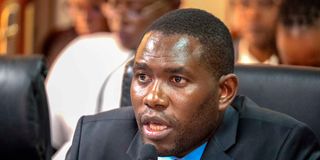
Medical Services PS Ouma Oluga at a past event. He has emphasised that the continent must take full ownership of its health agenda to prevent recurrent funding crises as external support dwindles.

What you need to know:
- A 2024 analysis by the African Institute for Development Policy reveals that over 60 per cent of Kenya’s health sector funding is donor-dependent, with nearly 90 per cent of that support coming from USAid, the Global Fund, Gavi, and the UK government.
African health leaders are urgently calling on countries to transition away from donor dependency to long-term, locally-led health strategies and robust domestic financing frameworks as global external aid rapidly declines.
The call, made at the Regional Health Financing Forum at Strathmore Business School, comes as analysis shows external health aid is projected to decline by 30–40 per cent in 2025 compared to 2023, posing a severe threat to strained African health systems.
Speaking at the forum, Medical Services PS Ouma Oluga emphasised that the continent must take full ownership of its health agenda to prevent recurrent funding crises as external support dwindles.
Also read: Trump aid freeze triggers HIV crisis in Kenya
While acknowledging the critical role of donor funding in fighting diseases like HIV/Aids, malaria, and tuberculosis, Dr Oluga warned that over-reliance leaves health systems vulnerable when global priorities shift.
“Many people don’t appreciate the health sector's contribution to driving economies, in terms of productive populations and lost working hours,” said Dr Oluga. “It's not just about the money we invest — we must also consider the opportunity cost of poor health.”
He also called for predictable domestic financing through taxation and insurance contributions, underpinned by stronger governance and accountability. “If you view health as an economic imperative, you start to recognise the cost of failing to invest,” he added, outlining the government's two-pronged approach to mobilising domestic resources.
The call for self-reliance was echoed by Dr Willis Akhwale, a senior advisor at the Africa CDC, who linked sustainable financing to preparedness for public health emergencies. He noted that donor dependency during the Covid-19 pandemic slowed critical responses.
“Without self-reliant systems, we are always reacting instead of planning,” Dr Akhwale stated. “Every African country should have a long-term financing framework that integrates routine healthcare and emergency preparedness.”
He also urged investment in data-driven resource allocation to maximise health and economic returns.
The forum reflected a growing consensus among global health stakeholders that, at a time when the sector is at a critical inflection point and donor funding is rapidly dwindling, African countries must take the lead in shaping the future of health on the continent.
“Our reality today calls for urgent reflection and action. Africa must chart its own path, rooted in self-reliance, sustainability, and accountability,” said Dr Caesar Mwangi, Dean of Strathmore Business School.
Acknowledging the gradual decline in trust between the public and health institutions, and between those delivering public and private healthcare services, Dr Kanyenje Gakombe, chairman of the Kenya Healthcare Federation, called for concerted efforts to build trust alongside innovation and investment in healthcare system resilience.
“Trust is a very important form of capital that we need right now. If there is too much noise in the sector and a lack of trust between public and private sector players, we cannot unlock the capital or efficiency gains needed,” he said.
In its recently published guidance on addressing drastic cuts to global health financing, the World Health Organization (WHO) noted that Kenya is among the countries that have intensified efforts to shield their health sectors from the effects of shrinking donor support.
According to WHO, the government has allocated additional budget funds to the Ministry of Health, with parliamentary approval expected in the coming months for further increases, to sustain key programmes and ensure continuity of care.
Also read: Critical areas suffer cuts despite Sh138.1bn health budget boost
For decades, Kenya’s health system, like many others in Sub-Saharan Africa, has relied heavily on external partners to fund essential programmes.
A 2024 analysis by the African Institute for Development Policy reveals that over 60 per cent of Kenya’s health sector funding is donor-dependent, with nearly 90 per cent of that support coming from USAid, the Global Fund, Gavi, and the UK government.
While this donor-dependent model has been instrumental in achieving major public health gains, the analysis notes that it has also left the country vulnerable since much of the external funding is disease-specific, focusing on HIV/AIDS, malaria, immunisation, and tuberculosis rather than strengthening the overall health system.
Similarly, the US President’s Emergency Plan for AIDS Relief (Pepfar), implemented through the defunct USAid, provided nearly 60 per cent of Kenya’s HIV response budget, funding treatment for over 15 million people and employing thousands of health workers nationwide.
However, analysts now warn that if the trend of donor cuts continues, the loss of US funding alone could lead to millions of preventable deaths worldwide by 2030.
According to WHO, external health aid is projected to decline by 30–40 per cent in 2025 compared to 2023, posing immediate and severe challenges to already strained health systems.
A WHO survey conducted in March 2025 across 108 low- and middle-income countries found that funding cuts had reduced critical services such as maternal care, vaccination, emergency preparedness, and disease surveillance by up to 70 per cent in some nations.
More than 50 countries have reported job losses among healthcare workers and major disruptions to training programmes, which threaten to reverse years of progress in global health.
A path forward
In response, WHO has issued new policy guidance, ‘Responding to the Health Financing Emergency,’ outlining strategies to mitigate aid cuts and transition to domestically financed systems.
“Sudden and unplanned cuts to aid have hit many countries hard,” said WHO Director-General Tedros Adhanom Ghebreyesus. “But in the crisis lies an opportunity for countries to transition away from aid dependency toward sustainable self-reliance based on domestic resources.”
The WHO guidance stresses the need for governments to protect essential services, especially those serving the poorest populations, and to improve efficiency through better procurement, strategic purchasing, the integration of donor-funded programmes into comprehensive primary healthcare systems, the reduction of administrative overheads, and the use of health technology assessments to ensure that every shilling delivers maximum health impact.
WHO also urges governments to view health spending as a productive investment that drives economic growth, prevents instability, and safeguards national development, rather than as an expendable cost during periods of financial tightening.
Across Africa, countries are beginning to act decisively. Nigeria has increased its health budget by $200 million to offset aid shortfalls, directing the funds toward immunisation and epidemic response.
Meanwhile, Ghana has lifted the cap on excise taxes earmarked for its National Health Insurance Scheme, thereby boosting its budget by 60 per cent and launching the Accra Reset; a framework designed to reimagine global health governance and financing partnerships.
Similarly, Uganda has outlined a policy agenda to integrate fragmented health programmes and enhance efficiency within its public health system.