After the floods, Kenya faces a hidden health crisis
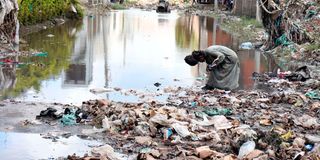
A man rummages through a flooded section of Sai Road in Nairobi’s Industrial Area on March 9, 2026 following heavy rains in the city.

When floodwaters finally soak into the ground, a dry landscape does not mean that everyone is back on their feet. Experts warn that the rainy season leaves behind a trail of lingering diseases, and are urging those affected to remain cautious.
The Ministry of Health has already announced an ongoing flu outbreak associated with the long rainy season. But waterborne and vector-borne diseases pose an even greater threat.
Aggrey Aluso, Executive Director, Resilience Action Network Africa, tells Nation that weather events carry both direct and indirect impacts that can cripple healthcare systems.
"This could be short-term, especially when health facilities are destroyed by natural disasters like floods, but the long-term impacts carry even more weight when people actually become sick," he says.
When floods occur, Mr Aluso explains, the number of people infected with waterborne diseases rises sharply. These include cholera, typhoid, dysentery and bilharzia.
A report released last year by the International Federation of Red Cross (IFRC), which analysed the March-April-May long rains and their flood implications in Kenya, underscored this reality. A cholera outbreak that began in February last year persisted throughout the long rainy season. By May 13, last year, IFRC data showed 244 cholera cases and 11 deaths. The first case was reported on February 12 from Sakuri B Village, Kuria East, Migori County, after six people presented with acute watery diarrhoea.
In the context of urban flooding, such as what is currently occurring in Nairobi, Mr Aluso notes that sanitation becomes a serious challenge. The city's vast sewer network sustained damage during the heavy rains, and with Nairobi hosting the country's highest concentration of industries, the risks go beyond contaminated water.
When floodwaters rise in an industrial city, rainwater can mix with heavy metals such as lead, iron and aluminium, causing long-term health complications.
A 2018 World Health Organisation (WHO) report titled Chemical Releases Associated with Floods identifies several risk factors, including industrial facilities located in flood-prone areas, structures that are not flood-resilient, and inadequate warnings to communities living nearby.
"Chemicals in floodwaters may contaminate drinking water sources and, as floodwaters recede, may be deposited on farmland and in buildings such as homes and schools. Contaminated farmland may remain unfit for agricultural use for many years," the WHO report states.
A study published last year in the journal of the Royal Chemistry Society lists traffic-related heavy metals as chromium, copper, lead, nickel and zinc, with copper and zinc found in particularly high concentrations during flood run-offs.
"When you get exposure to something like lead, you will likely get lead poisoning," Aluso warns.
The WHO classifies lead as one of the ten chemicals of major public health concern and urges member states to protect the health of workers, children and women of reproductive age. Once lead enters the body, it is distributed to the brain, liver, kidneys and bones, where it is stored in the teeth and bones and can be detected through blood tests.
"In the industrial context, if this is not controlled, it can cause serious issues," the public health expert says.
He also cautions that during such outbreaks, children may miss critical immunisation schedules, with lasting consequences for their health.
Relevant policies
Aluso calls for upstream reforms in disaster preparedness, urging the government to anticipate scenarios such as flooding and develop policies and programmes capable of managing and preventing their health impacts.
"We should have urban planning that takes into consideration the reality of climate change, so that we can avoid diseases linked to floodwaters," he said. "We have a whole office in the presidency on climate change. We don't see this reflected in practice, where we are able to anticipate and put resources towards prevention."
The damage is not only physical. Nelson Aseri, a psychologist, says flooding events can have long-term psychological impacts on those affected.
During floods, individuals experience a range of intense emotions, fear, anger and panic, which make it difficult to regulate their feelings and respond appropriately to the world around them.
"Individuals experience these impacts on different levels. For some, it comes as re-traumatisation of a past experience; for others, it comes as environmental trauma," he explains.
Aseri notes that in future, those affected may encounter rain in an entirely different setting, yet the brain recalls the original experience with full force. He adds, however, that trauma is not always only destructive, it can also prompt positive change, particularly when employers respond by developing policies to protect their workers' wellbeing during and after traumatic weather events.
Outside Nairobi, particularly in western Kenya, the picture is equally concerning. Dr William Olaka, the Director of Public Health in Kakamega County, explains that floods trigger a surge in vector-borne diseases such as malaria and bilharzia.
"When people are displaced by floods, they mostly seek shelter in areas where mosquitoes are likely to breed in large numbers. Rain creates more breeding sites through stagnant water. People are then exposed to mosquito bites, putting them at risk of malaria," he says.
Dr Githinji Gitahi, chief executive of Amref, stresses that even as floodwaters retreat, the health crisis is far from over.
"Kenya must brace for outbreaks of cholera, typhoid and acute diarrhoeal diseases, as floodwaters have contaminated drinking sources across the country — and we were already fighting an active cholera outbreak before the rains came," he says.
Along the coast, Dr Githinji warns of a potential surge in dengue fever, as stagnant water creates fertile breeding grounds for mosquitoes. He also notes that Kenya has historically experienced Rift Valley Fever following major flooding events. He adds one further, often-overlooked hazard: "Watch out too for snakebites, from snakes displaced by the floods."
Githinji urges the public to boil or chlorinate all drinking water and to practise basic hygiene, particularly washing hands with soap at every critical moment, to guard against diarrhoea and cholera. He advises people to drain all stagnant water around their homes, sleep under treated mosquito nets and discard any food that has come into contact with floodwater.
"If you or your family develops severe diarrhoea, prolonged fever, or yellowing of the skin, go to a health facility immediately," he warns. "Early treatment is the difference between life and death. These diseases are entirely preventable. We have the knowledge and the tools. What we need is the will to act now, before the window closes."
Follow our WhatsApp channel for breaking news updates and more stories like this.